
MusicRadar Verdict
What’s on offer is vast. The TD516 configuration offers an excellent trade-off in terms of keeping the most important elements while saving space and money. Not having to reach for a USB cable feels like the advent of a new era for electronic drums, and we might be about to see a lot more e-kits out in the wild as a result.
Pros
- +
Roland’s next-gen V71 sound engine delivered at a snip of the flagship
- +
Full digital pad compatibility
- +
Excellent wireless connectivity for Roland Cloud resource
- +
Future editing tools in the pipeline
Cons
- -
You’ll need to splurge for the VAD version to get Roland’s best snare pad
- -
Cloud subscription isn’t cheap and you’ll lose access to content without a subscription
- -
A few really high quality rock kits wouldn’t go amiss
MusicRadar's got your back Our team of expert musicians and producers spends hours testing products to help you choose the best music-making gear for you. Find out more about how we test.
Roland TD516 review: What is it?
Forget what you know about electronic drums. What was once primarily aimed at offering an at-home solution to space and noise issues by way of compromises in nearly every area has evolved over the decades. Realistic playability and response? Evermore faithful recreation of the physical size and placement side of our acoustic drum kits? These are nuts that have certainly been cracked before now, leaving one final piece in the puzzle left to solve: sounds.
Ironically, while manufacturers have been serving-up convincing digital facsimiles of complex electronic circuits from guitar amps, effects and vintage keyboards for years, it seems that distilling one of the most primitive instruments of all into a portable box has also taken the longest to mimic. What is it about a hollowed-out log with some synthetic animal skin stretched over it that is so difficult to capture in a drum module?
Well, apparently electronic drum brands are starting to find the answer. Pearl started the ball rolling with its Steven slate drums-equipped Mimic Pro. Alesis followed suit with the Strata Prime, and Roland brought a double-barrel to the shootout with its DWe (Roland acquired the Californian acoustic drum royalty in 2023) and its 7 Series, V71 module-powered kits in 2024.
These releases all form a new wave of next-generation electronic drum sets and modules with one primary objective: provide VST-rivalling sound generation in a ‘traditional’ drum module format. Gone are the lo-res sample layers with baked-in ambience, taking with them the giveaway machine-gun repetition.

In their place sits sophisticated, nuanced sound libraries which, rather than giving you dynamically filtered variations on the exact same drum and cymbal sample when you strike a pad softer or harder, have been captured from real drums being hit expressively. Not only that, but electronic drum makers have felt the penny drop on the fact that the booming, head-nodding, gut-bothering sound of an acoustic kit played in a room isn’t achieved by placing your ear three-fingers from a drum head. It’s a culmination of sympathetic resonances and reflections interacting, and to even approach capturing that requires microphones. Lots of them. Turns out that hollow log and faux hide are actually pretty complex.
“But you just said we’ve already got that. Why am I reading this?”. Well, if Roland’s wallet-melting (albeit impressive) 7 Series kits left you with a choice of swapping your car for some of the finest electronic drum sets on the market, you might want to delete your Auto-Trader ad. Because, in true democratic economic style, Roland recently unleashed the next-gen concept on us little people with not one, but two more odd-numbered e-drum series’.
Not only that, but at the centre of them both sits the exact same sound engine as found in the flagship Roland 7 series. While you Google the catch, I’ll clarify that this isn’t some marketing spin. The proof? Both the ‘entry level’ (within this tier) V31 (we reviewed the Roland VAD316 recently, too) and - the subject of this review - the V51 can load presets from the Roland V71. Of course, there’s a lot more going on here than just sounds, with new pad designs, a UI overhaul, improved connectivity and on-board integration with Roland’s Cloud resource.
Roland TD516 review: Configuration

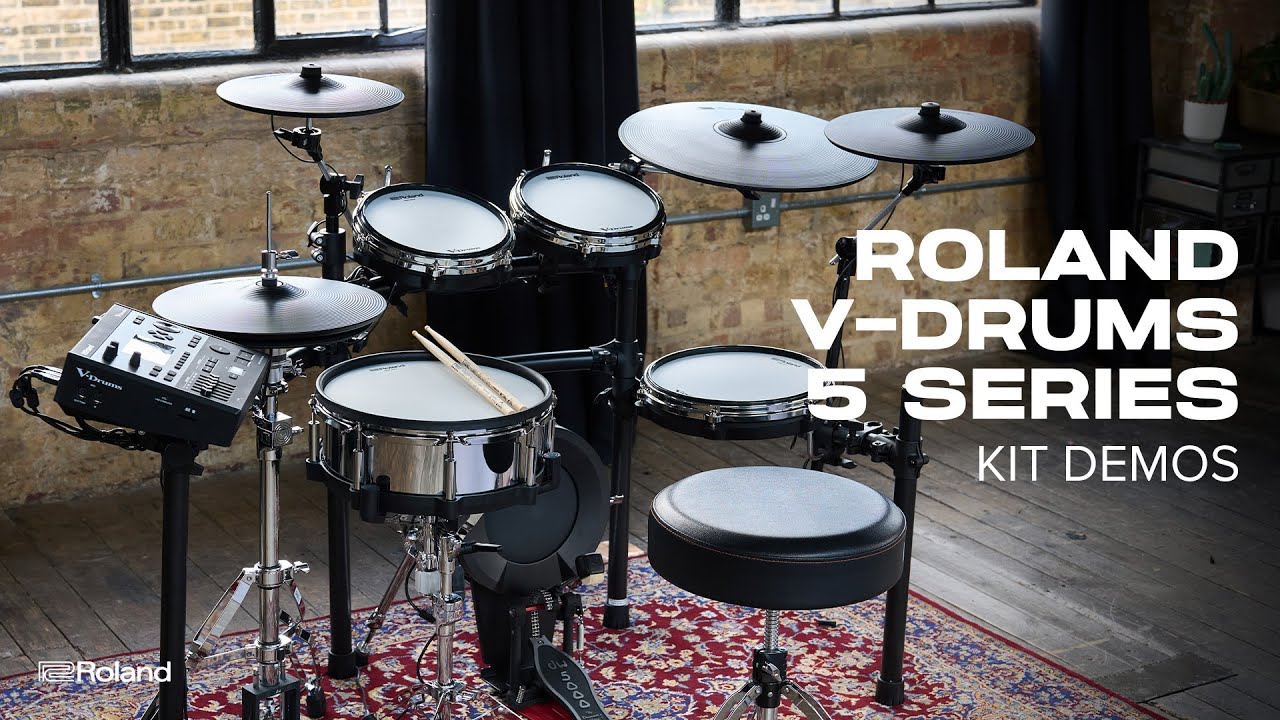
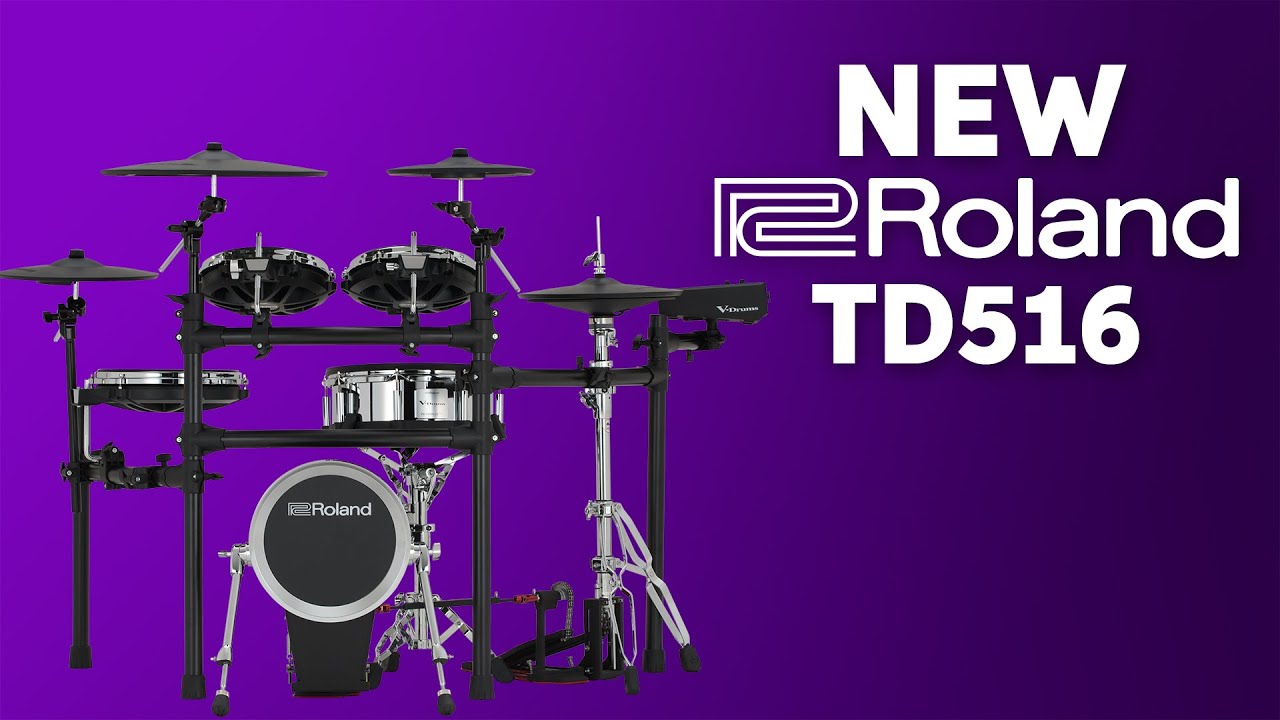
The 5 Series comprises three tiers of kits, all of which include the V51 module, but pair it with a different pad configuration. The TD516 I’m testing for this review sits in the middle, with Roland’s real-shell configuration of the VAD516 priced above it, and the more compact TD513 below.
As the 5 Series replaces the outgoing TD-27 Series, you’ll be glad to hear that the headline of the playing surfaces is once again a trio of Roland’s digital pads. We get the flagship VH-14D 14-inch, two-piece hi-hats; an 18” CY-18DR ride cymbal and the tried-and-tested PD-140DS snare. It’s worth noting that these form the first of the big differences between the 5 Series configurations, with the VAD516 including Roland’s top-of-the-line PD-14 DSX, and the TD513 equipped with all-analogue pads.


Next up, the TD516 comes with a pair of Roland’s new PD-10P 10-inch pads for the rack toms, and a 12-inch PD-12P in the floor tom position. These are a new design which feature chrome hoops and a rubber rim, designed to give a more natural feel when playing rimshots. But as well as this, Roland has applied multi-sensor technology under the head to help eliminate the machine-gun effect.
This configuration is kitted-out with Roland’s KD-12 kick drum pad with a 12-inch playing surface, introduced as part of the 7 Series last year. Finally, the crash cymbal slots are fulfilled by the CY-12-CT and CY-14-CT pads, offering 12-inch and 14-inch crashes respectively, and the T at the end of the model numbers denotes that these are Roland’s ‘thin’ models, which, while not new (the slimmed-down format arrived with the previous generation of V-Drums kits), are a feature that I don’t feel always gets the credit it deserves.
Roland’s ‘thin’ model cymbals are a feature that I don’t feel always gets the credit it deserves
They’re lighter, they move more naturally, and when profiled side-to-side with Roland’s previous crashes, feel svelte and agile, while still inviting you to crash them with all the mite of a real B20 pie. In both of the ‘TD’ V-Drums configurations, the whole lot is mounted to Roland’s MDS-Standard 3 rack, which bolts together securely and offers three sides on which to hang everything from. The crash cymbal boom arms are mounted into ‘hideaway’ ports on the tubing either side of each rack tom, saving space on the rack for wider tom placement. But, they can also be moved and mounted elsewhere if you’d rather position them differently.
Now, that’s a lot of model names and numbers to wrap your head around, but to simplify it - the TD516 gets you a full-house of digital pads. Step up to the VAD516 and you’re gaining real drum shell dimensions, Roland’s (frankly awesome) flagship digital snare drum, larger cymbals and a kick drum. Step down to the TD513 and you’ll lose the digital pads and get smaller tom and kick playing surfaces.
Roland TD516 review: The module


There’s a lot to cover with the V51 module, and it starts before you even boot up. As an owner of a Roland TD-27 for a number of years, the first thing I notice is the size difference. The V51 takes the form of Roland’s ‘pro’ modules such as the V71 and its predecessor, the TD-50X. Gone are the hardware controls for instrument selection, tuning, muffling and level, and instead Roland has equipped it with a bank of 6 faders for adjusting individual kit part volumes whenever you goddam feel like it.
Booting-up offers a breath of fresh air, too. The colour screen ousts the now rather old-school-looking display of the TD-27. But it’s bigger, too, allowing for a much friendlier graphical representation when it comes to navigating menus and changing parameters.
There’s a definite ‘app’ feel to a lot of the screens with larger, icon-based layouts rather than a reliance on scrolling deep into multiple screens. Despite the new UI, though, Roland hasn’t thrown the baby out with the bath water, and as such, I’m able to start delving and finding my way around pad settings, sound tweaking and the module’s basic functionality without having to read the manual.
At the time of writing, Roland is still yet to release its supplementary apps and software for the 5 Series. On the menu for release is the V51 Editor for desktop, which explodes the module’s functionality into a full desktop application, allowing you to make deeper editing dives. As well as this, Roland has announced the V-Drums Play mobile app, which will hand over control of functions such as preset selection, metronome and recording control to your smartphone.
The V51 follows in the V71’s footsteps by delivering a truly enjoyable experience with the factory sounds
The most important aspect here is, of course, the sounds. In the last decade or so, computer-based sound libraries have really become the go-to for e-kit drummers who want to simulate the sound of a pro-recorded kit at home, and, as mentioned earlier, it’s the biggest hurdle manufacturers have faced. This is due largely to the fact that multi-sampled and multi-mic’d drum kits create a lot of data in the form of sample information. To capture it is one thing, but software companies - unlike instrument manufacturers - have the advantage of not being responsible for the hardware that plays it back. As well as the sample data, you need processing power fast enough to translate a hit on a pad into ultra-low latency audio, and, in the case of a drum kit, it needs to do that with a lot of polyphony to incorporate the sustain of cymbals and four limbs continuously striking multiple pads. In short, there’s a lot of number-crunching going on.
Roland has delivered, though, and the V51 follows in the V71’s footsteps by delivering a truly enjoyable experience with the factory sounds. Whether it’s crispy, tight snares, punchy kick drums or warm, open-sounding toms, the drum sounds are responsive throughout most of the preset acoustic kits. The cymbals ring out with character, and, especially in the case of many of the ride cymbals, have an added dimension of realism to them, from the stick attack to the sustain.
During my time with the TD516, I had access to Roland Cloud Ultimate, allowing me to take an all-you-can-eat approach to trying out sounds from Roland’s subscription service. It’s home to some great V51-ready kits ported from DW Soundworks including a collection of 50th Anniversary kit presets, a DW acrylic kit and more. With the module connected to my home Wi-Fi connection, and the Roland Cloud Connect app installed on my phone, it takes a couple of minutes to beam a whole new set of studio-captured DW presets into the module.
It’s straightforward, and you can place them on whatever user preset slot you like. Any paid-for Cloud content remains playable in the kit as long as your subscription is valid. If you’d prefer not to subscribe, you can buy a perpetual license to take full ownership of any downloaded content to keep forever. The big question - is it worth it? That’s impossible to say, as my tastes are different to yours. But I will say that I own Superior Drummer, Steven Slate Drums, BFD and titles from Mixwave and GGD, and I didn’t feel the need to connect the V51 to my computer for sound generation throughout my time using it.
For big-album, roomy-sounding rock drums and contemporary metal, there’s still some work to be done
Now, that’s not to say that the module beats, or in some cases rivals these libraries unanimously. In fact, there are some areas that I hope Roland will continue to expand into. For big-album, roomy-sounding rock drums and contemporary metal, there’s still some work to be done. At times the kits head a little too much towards processed, slightly synthetic sounds. But, if it’s live, well-recorded, natural-sounding acoustic kits you’re after, it’s got them, and they’re satisfying to play. Let’s face it, very few of us own a space that happens to be on-par with the world’s greatest drum rooms, and as such the most appealing sounds within the V51 for me are the ones that could replace an acoustic kit played in a realistic room.
It’s not just the traditional sounds that grab the attention though. Hats must be removed for Roland’s sound designers all round. The electronic kits sound modern, as well as classic, and will totally fit-in to function band and pop sets. For the more experimental tastes, there are some wildly addictive crunchy, compressed and distorted kits which inspire different grooves every time I sit at the kit, and there are some killer world percussion samples in there to boot. That is, with the exception of one timbale which sounds like it was modelled on a certain reality show about sending celebrities to a jungle and, presumably, leaving them there forever to think about what they’ve done.
Roland TD516 review: Verdict
The TD516 is very, very good, and so it should be, given the price. But, that justification hasn’t always been matched by the result. With the V71 module, Roland turned the corner drummers have been hoping for. Now, we’re seeing the results of the world’s leading electronic drum manufacturer passing that advancement down to more affordable price points.
This review scratches the surface of what is on offer, because what’s on offer is so vast. The TD516 configuration offers an excellent trade-off in terms of keeping the most important elements while saving space and money. Not having to reach for a USB cable feels like the advent of a new era for electronic drums, and we might be about to see a lot more e-kits out in the wild as a result.
Roland TD516 review: Hands-on demos
MusicRadar
Roland
Sweetwater Sound Check
Roland TD516 review: Specification
- Drum sound module: V51
- Snare: PD-140DS
- Tom 1: PD-10P
- Tom 2: PD-10P
- Tom 3: PD-12P
- Hi-hat: VH-14D
- Crash 1: CY-12C-T
- Crash 2: CY-14R-T
- Ride: CY-18DR
- Kick: KD-12
- Drum rack: MDS-Standard 3
- Other features: Wi-Fi, Bluetooth, 3x digital pad slots, SD card slot, user sample import
- Contact: Roland
