


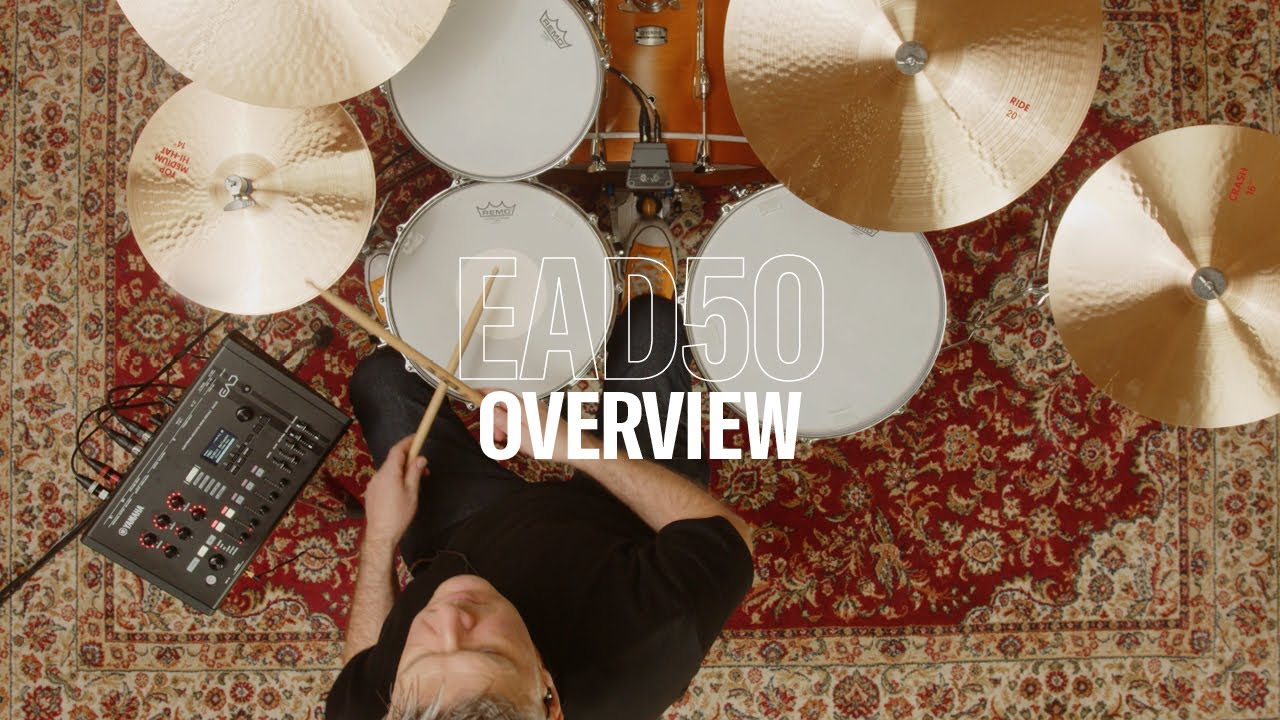
NAMM 2026 is officially underway, and If you’re anything like us, you’ll have been keeping your eyes peeled for the most exciting new releases. Yamaha knows this, and has leaned into it with teasers for an all-new electronic drums product over the last couple of weeks.
The cryptically-cropped pictures got tongues wagging - is it a new electronic drum set module? Maybe a new multi-pad? As of now, we know that it is, in fact, a new addition to Yamaha EAD line-up: the EAD 50. And it seems to have its sights set on doing away with your sample pad, trigger module, mics, interface and mixer in one fell swoop.
Unless you’ve been locked in a practice room since 2018 (and if you have, we’ve got a lot to catch up on), you’ll know about the Yamaha EAD10. It’s a multi-faceted hybrid drum processor comprising a trigger/stereo microphone, sound module, effects processor, audio recorder and more.
Now, the EAD50 is here to take things to the next level with more power, more control, and a number of upgraded, pro-level features. It starts with an update to the dual-purpose trigger/microphone sensor.
The DSU50 combines a pair of custom-matched cardioid condenser microphones, and as with the original EAD10 sensor, an integrated bass drum trigger. This time, though, it’s built into a more rugged, stage-ready housing.

One thing many EAD10 users have called for is the ability to combine multiple microphones, and the good news is, not only does the EAD50 do so, it gives you five combo XLR/TRS jack sockets. So, as well as the stereo signal from the DSU50, you can add a further three mics to your kit, or simply connect five third-party microphones for full multi-track mixing, processing and recording.
There’s more when it comes to triggering, too. Expanding on the EAD10’s total trigger and footswitch count with five dedicated, stereo trigger inputs. These will work with pads and triggers from a range of manufacturers, and offer a combination of 1-3 zones. What's more, you can split each input for a total of up to 10 trigger inputs.

Need more trigger inputs? The EAD's USB Trigger Link connection allows you to hook up an additional trigger converter/drum module and send a further 12 trigger signals to the EAD50.
Output connectivity is also improved, with a set of eight balanced individual outputs over TRS jacks, balanced stereo outputs via XLR sockets, and an unbalanced stereo output (jacks). There are two sockets handling memory functions - either from a USB memory stick, or SD card. These allow you to stream four channels of audio, with the ability to route them flexibly too. Ideal say, for using a backing track and click track sent to different audio outputs.


As well as playing audio, the EAD50 is, of course, capable of recording it too. On board is a built-in recorder, sampler and looper to help you capture your performances, as well as expanding your creative possibilities. In addition to standalone recording, it's also equipped with a 8-in/10-out USB audio interface for recording with a DAW.
To the top of the EAD50, we get more hands-on control thanks to 11 rotary encoders, plus a five-channel master mixer section giving you real-time tweaking of your mic’d kit, triggered module sounds, monitoring and more.
Now, that’s a lot to navigate, and while the EAD50 has a screen to make sound-editing easier, Yamaha has also developed the EAD Touch app for iOS and Android. This gives a more visual representation of what’s going on under the hood, and, being mobile device-based, gives the added benefit of harnessing the power of your device’s touchscreen.
The EAD 50 is available for preorder now. For more information, head to Yamaha’s EAD product page.
