MusicRadar Verdict
The EFnote Mini offers a compact yet stylish package, ideal for kids, those limited for space at home or live players looking for a small footprint e-kit that looks and sounds the part on stage.
Pros
- +
Super stylish design
- +
Small footprint
- +
Ideal size for kids
Cons
- -
Basic touch screen
- -
Limited effects
MusicRadar's got your back Our team of expert musicians and producers spends hours testing products to help you choose the best music-making gear for you. Find out more about how we test.
EFnote Mini review: What is it?
Since the company’s launch in 2018, EFnote has released a decent range of electronic drum set configurations under its 3, 5 and 7 series’. In 2024 the line-up grew further with the new flagship EFnote Pro - focussed on live stage use and aiming to blur the lines between electronic and acoustic drums thanks to its full-size drum and cymbal pads and unique stage-box style module (you can check out my review here). The most recent addition to the EFnote family and the focus of my review takes a step in the opposite direction from the Pro, looking to minimise the footprint for drummers in the market for a great-looking, home practice solution.
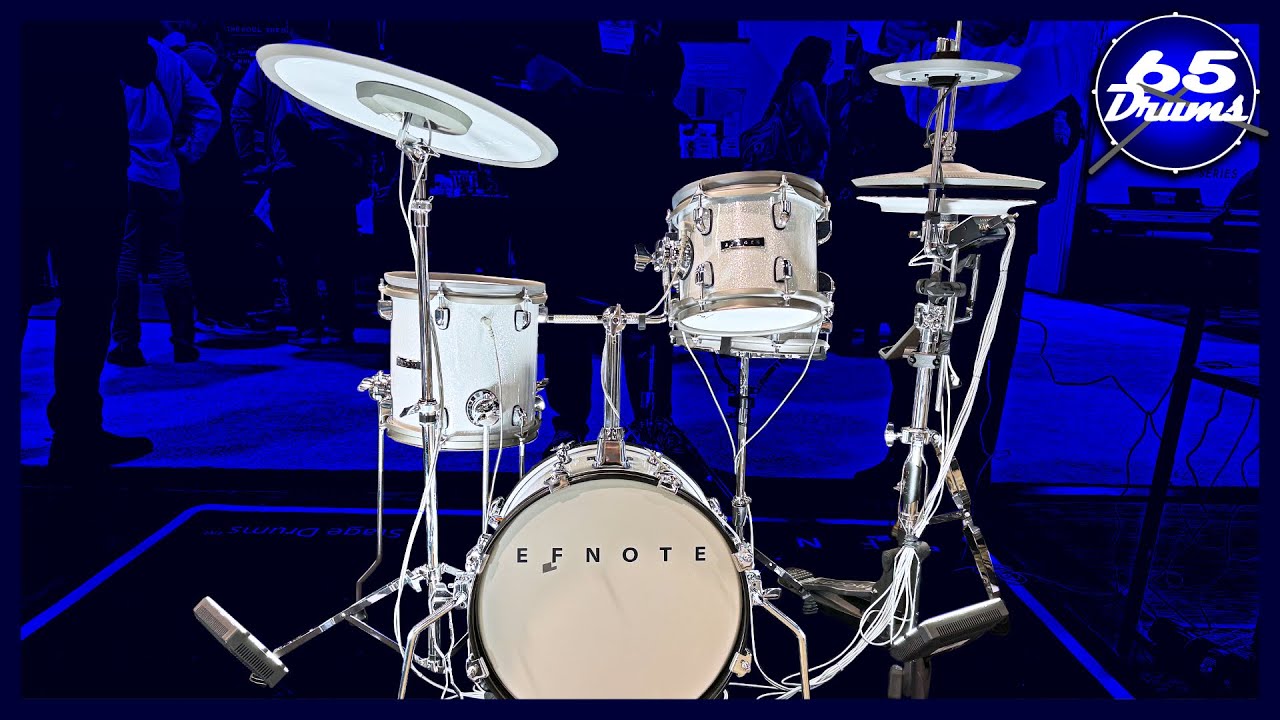
The EFnote Mini combines the compact form factor we’ve grown accustomed to seeing on more traditional e-kits, with the visual stylings of a full-sized acoustic kit (or even an acoustic style e-kit in more recent years). The result is an extremely cute compact drumset reminiscent of Ludwig Breakbeats or Tama Club Jam jungle-style kits, yet smaller still and completely electronic.
The 7-piece setup comprises a tiny 14''x10’' bass drum (with riser), 10''x4.5’' dual-zone snare drum (plus dedicated X-stick wedge), 8’’x6.5'' rack tom and 10''x10’' floor tom (both dual-zone). On the cymbal front, there are 14” hi-hats, a triple-zone 16” ride and a dual-zone 8” splash/crash. A snare drum stand, cymbal stand for the ride, tom mount and a rod for the splash are all included, but you’ll still need a bass drum pedal, hi-hat stand, throne and of course some drummer’s headphones or a drum monitor before you’re ready to go - something you’ll need to budget for on top of a kit that’s already north of two grand.


Whilst I’m on the tricky subject of price, weighing up the value of an e-kit naturally relies on a multitude of factors, not just its size. With the EFnote Mini it would be easy to see such a tiny kit and wonder why it isn’t more affordable; in the case of more common rack-based e-drum setups, it almost certainly would be. The EFnote 3, for example, comes in at a slightly lower price point than the Mini, yet offers additional tom and cymbal pads, plus larger diameter drums. But to counter-argue, the Mini is a unique proposition and the full-depth drum shells are 6-ply birch, finished in EFnote’s signature white sparkle wrap. This gives an overall feeling of quality and makes it look like the real-deal, albeit in a slightly shrunken form.
Arguably one of, if not the main consideration when it comes to shopping for an e-kit is the module itself. This is where all the computing power happens and where the actual drum sounds come from - without it we’re just left with some very good looking but fairly useless lumps of wood and rubber.
In the case of the EFnote Mini, its namesake module has been especially designed for this kit, with a new collection of sounds and some features borrowed from other modules. It’s most comparable with the EFnote 5 module (which uses the same touchscreen) but is finished in a fetching white rather than brushed steel. It comes pre-loaded with 12 kits plus room for 18 user kits, but there’s also a growing number of freely available kits which can be downloaded via the EFnote Tools app.
The pads connect to the module via a cable snake which allows for an extra tom or crash to be connected. There’s actually a 14” crash and stand add-on pack available from EFnote, although I found it tricky to find in stores at the time of writing this review. The module also features 1/4” left and right jack outputs, Bluetooth audio, a mini-jack input and USB-C connection for 8-channel multi-track recording to a computer.
EFnote Mini review: Performance & verdict
When it comes to customisation of sounds, the module allows fairly basic control over panning, tuning and muffling, although I found the muffling control a little too subtle when trying to tame a particularly lively snare sample. There’s also a two-band equaliser and eight types of ambience (such as room, hall and stage reverbs).

Each kit sound is bone-dry out of the box (something I’ve found to be the norm with all EFnote kits), so the reverb is certainly a necessary feature. The effect level is dialled in as a percentage, with 100% of course offering maximum ambience. I’d love to see a way of mixing the dry and wet levels in future firmware updates as I found the dryness of the samples was still prominent even with the reverb level set to maximum.
The overall sample quality is decent, focusing on natural sounds within a mixed bag of styles, and promising to keep the majority happy. Most of the presets are geared specifically toward the Mini setup, using a splash sound in place of a crash for the most part and tonally matching the size of the pads. The same can be said for the bass drum and tom samples which work well to mimic the physical aesthetic of the kit.
Tweaking presets and replacing/swapping sounds is easy, or alternatively the entire kit can be duplicated to a free slot and used as a starting point for a new creation. Most of the kit presets are borrowed from other EFnote modules but there are some brand new ones too. Some highlights include FunQ pico, Street Groove, Firstnote mini and Super Vintage (which is one of the downloadable kits available through the app).
Navigation through the module is straightforward and intuitive thanks to the touchscreen and rotary dial combo. It’s a shame that there’s no colour screen though as I feel the old-school Game Boy vibe does cheapen it somewhat.


In terms of hardware, I’ve been continuously impressed with EFnote’s build quality and attention to detail. Even with the relatively small 16” ride cymbal here for example (compared to full-size 20” rides on other kits), the separate bell, bow and edge triggering alongside the physical playability makes it feel perfectly natural under-stick. An added bonus is that the ride plays fantastically as a crash/ride which means the splash can work as intended rather than as a strangely tiny crash. The 12” optical hi-hats play well, comparable to EFnote’s 14” models which I’ve been impressed with before. All EFnote cymbals have 360 degree playability which means smooth triggering and choke function all the way round.
The drums themselves feel solid and the 14” bass drum felt completely planted to my mat thanks to solid spurs and riser, however hard I played it. The drums are - as I’ve already discussed - very small. I needed to be quite precise when it came to avoiding the rims, particularly when it came to the 8” tom, but it’s something I got used to fairly quickly. On the whole, the dimensions add to this unique kit’s charm.
The EFnote Mini is versatile enough to be an ideal set up for adults or children alike. Proportionately it would likely suit the frame of a younger person but has plenty of adjustability to adapt to anyone. I’m over 6ft and despite probably looking a bit silly sat behind it, I managed to get it set up comfortably for me. There’s plenty of length on the supplied, bass drum-mounted tom arm, although I was maxed out on the height of the floor tom legs. In terms of actual floor space, the footprint of the setup kit is roughly 3.8ft by 2.3ft (without throne).
So, should you buy this kit? The EFnote Mini genuinely offers something a little different from the pack and would make for an excellent looking and sounding home practice kit - I'd even consider taking it to the stage for the right gig. If you want something with more pad choices (and physically larger pads), a wider range of sounds and editing capability, then there are ways to get more for you money both within the EFnote stable and beyond.
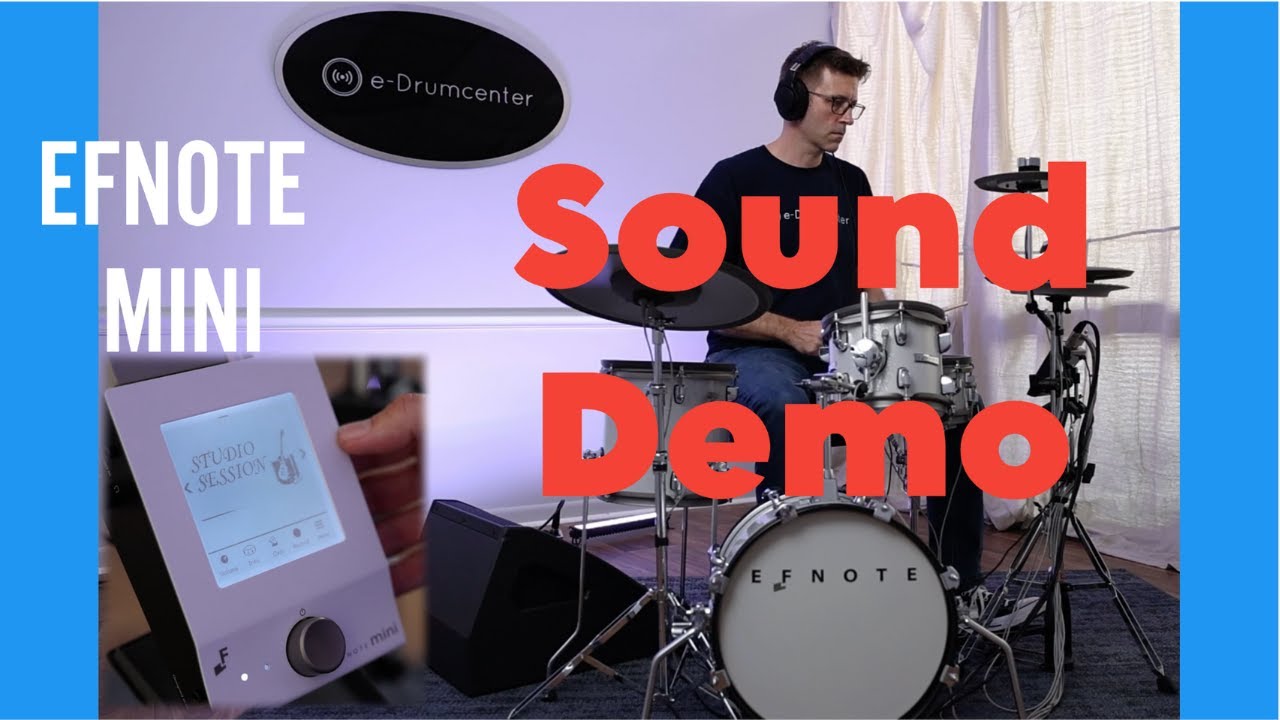
EFnote Mini review: Hands-on demos
MusicRadar
E-Drumcenter
65 Drums
EFnote Mini review: Specification
- Configuration: 14''x10’' bass drum, 10''x4.5’' snare drum, 8’’x6.5'' rack tom, 10''x10’' floor tom, 14” hi-hats, 8” splash/crash, 16” ride.
- Preset drum sets: 12
- User drum sets: 18
- Preset instruments: 8
- Preset sounds: 153
- Equalizer: 2-band
- Ambience effects: 8
- Connections: 2x line-out, 6.3mm jack, unbalanced
- Outputs: Stereo phones out, 6.3mm jack
- USB: USB-C audio interface 8 out / 2 in - USB-C MIDI interface in / out
- Bluetooth connectivity: Yes
- Pad material: Mesh
- Shell material: Birch
- Shell finish: White sparkle
- Cymbal finish: Grey
- Contact: EFnote