


There’s no denying the power of the modern digital audio workstation.
Armed with nothing more than a laptop, a single piece of software and enough determination, you can create radio-ready tracks able to compete with anything made by the world’s biggest producers. DAWs are amazing, but spend enough time staring into a computer screen and wiggling a mouse, and you may start to feel more like an accountant than a musician.
That’s where hardware comes in. Although DAWs can, on the whole, deliver the same sounds, what they can’t give you is that tactile hardware experience. That’s what we’re here to rectify today.
Hardware can be intimidating, however, especially if you’ve only ever worked with a computer. It can be expensive, too, and there’s so much choice available that it’s tough to know how best to spend a limited budget when you’re venturing into hardware-based music-making. As a beginner, how do you know where to start?
We’ve done the hard work for you and put together some suggestions of beginner-friendly – and budget-friendly – gear. And, to make things easier, we’ve broken them down by genre. No matter what kind of music you make, there’s something here for you.
Note that this assumes you already have a computer and DAW, plus studio monitors and an audio interface. If you plan on plugging in multiple pieces of gear, like synths and drum machines, you’ll probably need a mixer too.
The harder they come: Why hardware?
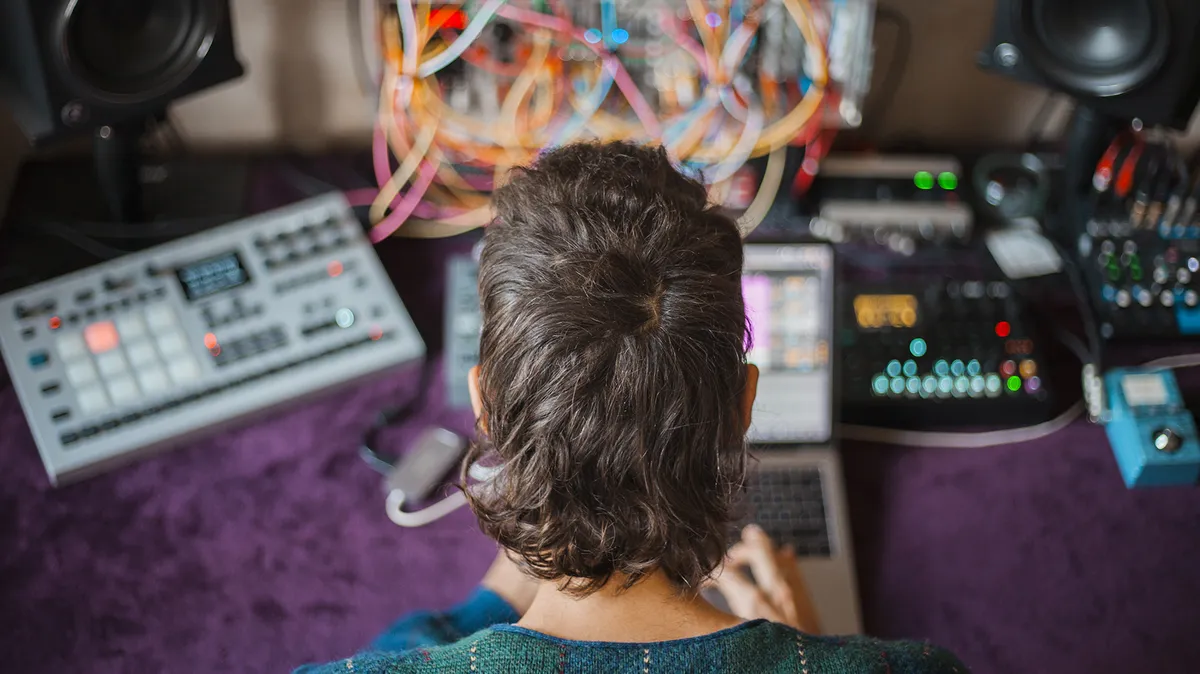
Why bother with hardware anyway? There are many reasons to take a step outside the walled garden of the DAW. Tactility is something that’s already been touched on (pun obviously intended). Laying your hands on a real piano-style keyboard, banging out beats on drum pads and opening up a filter with the twist of a knob: this kind of hands-on music-making can greatly enhance the creative process, in both the results you end up with and how much fun you have doing it.
Then there’s portability. A lot of modern gear is not only small and lightweight, it’s also battery-powered, meaning you can throw it in your bag and take it on the go. The ideas you come up with in a coffee shop, at the park, or on the train are going to be very different to the ones that arrive in the studio. Plus, there’s the opportunity to jam with other musicians.

Don’t forget the sound of the instrument, too. While DAWs can do a lot, one thing they can’t do is analogue. Emulations sound great, but to many producers’ ears, nothing compares with the warmth and character of an analogue synthesizer. Even digital devices like samplers and FM synths sound different when they're run through digital-to-audio converters and a mixer. You can drive a mixer, too, for real analogue saturation, or add a couple of effects pedals in to your set-up to spice up your sounds.
Ultimately, working with hardware is about finding new ways to be creative, venturing outside the box to discover a new perspective on your music-making. Your music will thank you for it.
1. Hip-hop beatmaking

Sampling is at the heart of hip-hop and beatmaking. If you make beats, you’re likely already working with samples into your DAW. From there, it’s just a hop, skip, and a jump into the world of DAWless beatmaking – and with the recent release of the Akai MPC Sample, it’s never been more affordable to get into hardware hip-hop.
Akai’s samplers have been at the center of hip-hop production since the MPC60 dropped in 1988. Over the years they’ve grown ever more complicated, and at the top of the range, they’ve effectively become hardware DAWs.

This year, Akai went back to basics with the MPC Sample, and it’s proven to be a big hit. Although it’s extremely affordable, it’s still a capable machine, with 2GB RAM and 8GB internal storage, 32 stereo voices, a Chop mode for slicing up loops, internal effects, and of course those famous 16 RGB MPC pads. You don’t even need a mixer, as it’s handily equipped with an onboard audio interface.
While the MPC Sample can emulate the sound of classic samplers, it can’t do true 12-bit recording. If you’re a lo-fi head or looking for a sound closer to classic boom-bap records, check out the LIVEN LoFi-12 from Sonicware, a sampling groovebox with a decidedly grungy character. Like the classic samplers of the 1980s, it captures audio at 12-bit, which has less fidelity than the modern standard of 16-bit. This imbues it with that warmth and grit you associate with classic hip-hop. And, as it’s a groovebox, it has a sequencer already built in.
Finally, if trap is your thing and 808s are key to your sound, you may want to skip the sampler and go straight to the analog source. Inspired by the classic Roland TR-808 drum machine, Behringer’s RD-8 recreates the sounds and workflow of the original at a significantly reduced price, including those instantly recognizable boomy kicks. It also adds a Wave Designer for punchier hits and an analogue filter for further sound-shaping.

2. Techno, house and UKG
Though the TR-808 sits at the heart of hip-hop, it’s another Roland drum machine that occupies that spot for genres like house and techno. This is the legendary TR-909. With its punchy kick drum, sharp hats and pummeling snare, it provided the backbone for countless club hits, leaving a trail of dancefloor destruction that leads all the way back to its debut in 1983. Accordingly, any hardware setup for house, techno, or UK garage would do well to feature some sort of 909-adjacent machine, but an original unit will cost you thousands of dollars.
The most versatile modern alternative would be the TR-1000, Roland’s recent analogue-infused remake of the 808 and 909. It’s also eye-wateringly expensive, though, so for now, file the TR-1000 away in the “aspirational” folder and look instead to Roland’s TR-8S.
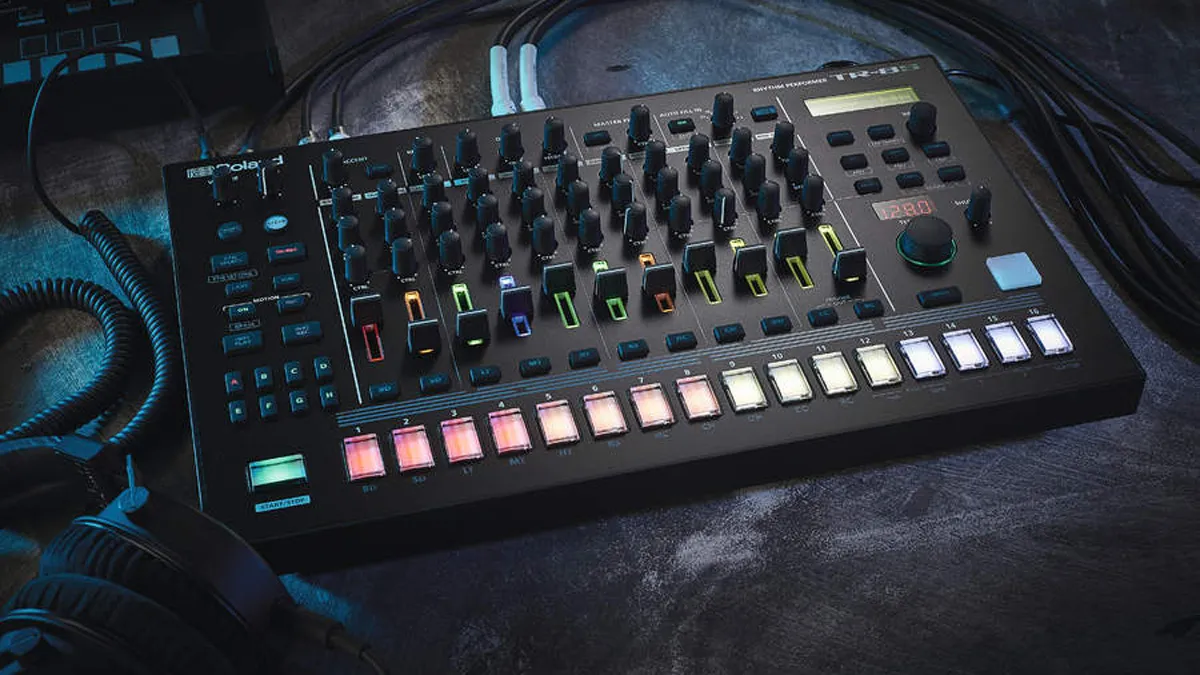
With circuit-modeled takes on the 909 and 808, alongside other drum machine favorites like the 707, 727, 606 and CR-78, it’s got everything you need to make club-rattling beats. It’s also a sampler, so UK garage producers can sequence vocal chops to their heart’s content. The TR-8S is also on the expensive side, however. If it’s looking beyond your means, check out the TR-6S, a six-track version of the machine with less hands-on control, limited connectivity and no velocity-sensitivity. They both feature internal audio interfaces too.

Prefer analogue kicks and snares? Then you might want to point your credit card at Behringer’s RD-9, a reasonably-priced remake of the TR-909. The original drum machine used a hybrid combination of analogue kicks, snares, clap, toms, and rimshot, plus digitally-sampled hats, crash and ride. Together, these form the blueprint of modern dance music. Behringer’s RD-9 adds the same Wave Designer from the RD-8 for transient-shaping, and the filter as well. Modern 909 sounds – particularly those used in techno – have been heavily processed, so you might be surprised by the raw sounds that come out of the box. You can use it for classic ‘90s sounds, then, or hook it up to an effects pedal or two to give it a more unique character.

Unless you’re making modern techno that’s heavy on the rumbles, you’ll need a bassline to go with your beats. Roland’s S-1 Tweak Synth is a fantastic – and super-affordable – little synth that does not only bass but also melodies and chords. It’s inspired by the SH-101, an iconic monosynth used on countless techno and house records. You can expand on its virtual analogue sound with two oscillator modes that let you draw your own waveforms or chop them up, emphasizing the harmonics for more metallic tones. You also get a 64-step sequencer for acid-style basslines.
3. Drum ‘n’ bass, jungle and breakbeat
Sample-based hardware music producers tend to fall into two camps: those that swear allegiance to the Akai MPC series, and those who fly the flag for Native Instruments’ Maschine. With the MPC’s hip-hop roots, and Native Instruments long part of the European dance scene, it’s not surprising that user demographics tend to shake out the same way. This is not a hard-and-fast rule, mind you, but speed up the BPMs and you’re probably going to find more Maschine power users than MPC fiends.
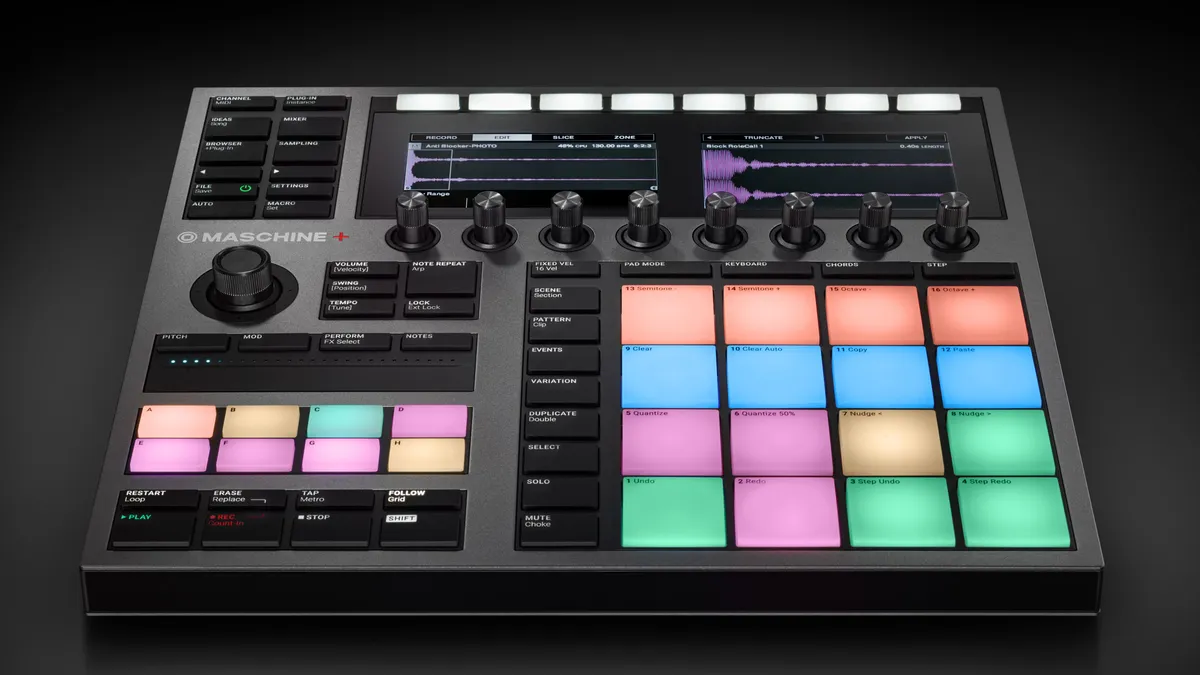
If you’re an aspiring drum and bass, jungle, breaks or dubstep producer, then, the Maschine ecosystem is calling your name. Maschines have been around since 2009, with a variety of hardware devices coming and going, but as it stands right now, three are on the market: Maschine Mikro 3 and Maschine 3, which act as controllers for software on your computer, and Maschine+, a standalone device. What they can do is the same; the difference lies in the amount of control and, in the case of the Maschine+, where the magic happens.
In much the same way that modern MPCs are essentially standalone DAWs, Maschine software is similarly capable, with sequencing, built-in instruments and effects, stem separation, modulation lanes, and more. Maschine+ lets you achieve all of this away from your PC, and even houses NI plugins and Play Series Kontakt instruments. Maschine+ is the way to go if you’re on the road often.

As powerful as the Maschine is, there may come a time that you want to dive into the analogue world. And for bass-focused producers on a budget, the number one choice for a low-end synth is Novation’s Bass Station II. There are quite a few analogue bass synths in this price range, but none are as flexible or fun to use as the Bass Station II.
Key to its power is the oscillator section. Oscillators generate the sounds, and with two of them, you can blend different waveforms like sawtooth and square for complex sounds, or even detune them against each other for extra fatness. There’s also a sub-oscillator for additional low-end weight. And, while most synthesizers provide a filter for tonal shaping, Bass Station II actually gives you two of them, letting you dial in some really unusual sounds. There’s even an Aphex Twin-designed mode that puts a different patch on each note. So many wild possibilities!
4. Ambient, experimental and soundtracks
Soundtrack composers and musicians working in ambient and experimental music typically have very different musical needs than beatmakers and dance producers. Drums are less of a focus, with sound design taking center stage. For the sonic explorer, a solid synthesizer will be of tantamount importance, ideally one that allows for easy editing of sound parameters.

Let’s start with something for the composer. Whether your medium is film, television, or video games, you’ll probably require an instrument with a little bit of everything. Samples of bread-and-butter instruments, orchestras, and special effects are all required. You’re going to need a decent keybed too. Put these requirements together and you arrive at Akai’s MPC Key 37 G2. Armed with both keys and pads, you can whip up whatever the job requires, and the generously-sized display makes it easy to sequence and arrange. Though it’s not exactly cheap, the MPC Key 37 G2 is probably more affordable than you imagine.

For the ambient musician, the focus will be on tone and texture: think drones, pads, and loops. Sonicware comes to the rescue here, with the aptly-named LIVEN Ambient Ø. Part of its LIVEN groovebox series, the Ambient Ø brings a novel sound engine called Blendwave Modulation Synthesis for generating fluctuating and undulating tones, a noise and loop section for adding texture, and of course effects like massive reverbs and delays. It’s pure outer space. Combine this all with the on-board sequencer and set it all in motion via the Relaxation Playback Mode, a feature that can be used to create your own personal sound bath or meditation music background player.
When it comes to making experimental music, Eurorack offers a wealth of exciting opportunities. Getting into modular synthesis can be very expensive though. Why not dip your toe in the pool with a two-piece set-up of Eurorack-inspired hardware from Stylophone? A drone oscillator and filter unit, the CPM DS-2 and CPM DF-8 pair up nicely to create the basic building blocks of synthesis.

In the DS-2, you get two oscillators, a sub-oscillator, and a filter, plus LFOs and patch points to experiment with creative modulation. Get the oscillators singing and ride the drone, then combine it with the DF-8. With its two filters, you can tonally shape the drones. And, should you wish to play the two together like a mini synthesizer, get the two envelope generators involved and shape the oscillators and filters over time. All you need is a controller to trigger notes and you’re off to the races. Should you decide someday to take the Eurorack plunge, you can discard the chassis and install the units in a case.
