


Few artists have suffered such a convoluted and disaster-strewn early career trajectory as Bronx-born singer-songwriter and pianist Billy Joel, whose early travails are the stuff of near-legend.
In 1969, two years before going solo, Joel formed Attila, a bizarre heavy psych/proto-metal duo featuring drums and an organ played through a heavily distorted guitar amp.
A review in All Music concluded that their self-titled 1970 debut was “undoubtedly the worst album released in the history of rock & roll – hell, the history of recorded music itself.”
One year later, Joel signed a ten-album record deal that was allegedly so exploitative that when he did eventually get signed to a major label, the legal and buyout costs of his first contract meant that it was years before he saw any actual profit.
Then, due to a mastering error, his 1971 debut solo album Cold Spring Harbor was accidentally speeded up, making his voice sound high-pitched and unnatural. “Like the Chipmunks” he remarked. It wasn’t until the listening party at his home on Long Island that he noticed the error.
“So, I’m gonna have this big party, right, and all my friends come over and this is my first album and we’re gonna have this listening party,” Joel recalled in 1996, as reported in Classic Rock. “And my friends are listening going … ‘Why do you sound like a girl?’. And I was, like, furious. I took the thing and I threw it like a Frisbee.”
Even when he signed a deal with Columbia Records in 1972 and moved to Los Angeles, Joel spent six months under the pseudonym ‘Bill Martin’ playing a piano bar called The Executive Room on Wilshire Boulevard just to pay the rent.
It reportedly took Columbia Records and his team six years and four albums of trial, error, and substantial financial losses before they successfully broke Billy Joel into the mainstream market with the album The Stranger in 1977. Songs such as Just The Way You Are and Movin’ Out boasted the kind of massive pop hooks that radio just could not ignore. The album reached No 2 in the US and top five in six other countries while the first four singles became top 40 US hits.
But one song from the album that was not released as a single would go on to become one of his most celebrated compositions. With a running time of 7:37, Scenes From An Italian Restaurant is a multi-sectioned epic that rapidly became a staple of his live set.
In an interview on The Late Show With Stephen Colbert in 2017, Joel said that this was his favourite of all his songs.

The Italian restaurant referenced in the song’s title was Fontana di Trevi, at 151 West 57th Street in New York City, across the street from Carnegie Hall. It was a place that Joel knew all too well.
“It was for the opera crowd, but the Italian food was really good,” Joel told USA Today in July 2008. “They didn't really know who I was, which was fine with me, but sometimes you would have a hard time getting a table. Well, I went there when the tickets had gone on sale for [my dates at] Carnegie Hall, and the owner looks at me and he goes, [adopts Italian accent] 'Heyyy, youra that guy!’ And from then on, I was always able to get a good spot.”
In the same interview, Joel explained how the original inspiration for the song was the three-song medley that ended side two of the Beatles’ Abbey Road album – Golden Slumbers, Carry That Weight and The End.
“I had always admired the B-side of Abbey Road, which was essentially a bunch of songs strung together by George Martin. What happened was The Beatles didn’t have completely finished songs or wholly fleshed-out ideas, and George said, ‘What have you got?’ John said, ‘Well I got this,’ and Paul said, ‘I got that.’ They all sat around and went, ‘Hmm, we can put this together and that’ll fit in there’. And that’s pretty much what I did.”
The first part of Scenes From An Italian Restaurant is a gentle, melodic 70 bpm piano ballad, written in the first person, about two old school friends reuniting in an Italian restaurant. “A bottle of white/A bottle of red/Perhaps a bottle of rosé instead” sings Joel in the opening lines, over warm, mellifluous piano chords. Subtle accordion, played by Dominic Cortese, imbues the track with a sweet, melancholic atmosphere.
A deep, mournful tenor sax solo from Richie Cannata enters the mix at 1:08 against a luxuriant backing track.
“The sax is supposed to represent a time change,” said Joel in a YouTube interview in 2018. “January, February 1975, 1972… going back in time and that seemed like a natural place to go with an instrumental piece.”
At 1:44, the song lurches into a much faster Dixieland jazz-style feel, with driving, staccato piano. There’s an upbeat, bouncy McCartney-esque feel here as the former classmates in the story reminisce.
“Things are okay with me these days/Got a good job, I got a good office/I got a new wife, got a new life/And the family is fine.”
A punchy, rhythmic piano solo follows and then it’s into the main section. Joel called this section The Ballad of Brenda and Eddie, and the narrative shifts to the third person. It’s a zesty, frenetic rock ’n’ roll vignette about high school prom kings and queens who peaked too early.
“That [section] is the main course,” said Joel during a 1994 Masterclass at Princeton University. “I use a lot of food analogies. I’m a food-oriented guy. What I was trying to get across is [that] we all know, I’m sure, there were people who peaked a little too early in life.”
Joel cited as an example the students everyone thought were “so cool” at school. “I thought, ‘Man, I wish I was that guy.’ He had the perfect pompadour. He always had great clothes, the coolest shoes. He always went out with the coolest girl, and he was always the most popular guy. Then, I saw him at the 10-year [reunion], and this guy was like a caved-in ashtray.”

This main section of Scenes From An Italian Restaurant is a driving piano-driven stomper with Joel’s pop sensibilities firmly to the fore. Lyrically, it’s pretty straightforward fare: “Brenda and Eddie were the/Popular steadies/And the king and the queen/Of the prom,” he sings at the start.
Joel’s piano has an infectious rolling groove and the core band – Steve Burgh (lead guitar), Hugh McCracken (acoustic rhythm guitar), Doug Stegmeyer (bass) and Liberty DeVitto (drums) – slot in seamlessly in and around it.
There is an unremitting attack to the whole thing, which reaches fresh heights when another sax solo from Richie Cannata comes blistering in at 4:30.
There are strong elements of musical theatre throughout. As Rolling Stone Australia put it: “Joel, the Irving Berlin of suburbia, packs an entire Broadway musical into seven and a half minutes, as he tells the story of Brenda and Eddie, popular kids who marry young, then flame out and divorce.”
Six minutes in, the song reaches its third section, the outro, with its grandiose string section and the same piano feel as the intro, signalling to the listener that the song has returned to the restaurant.
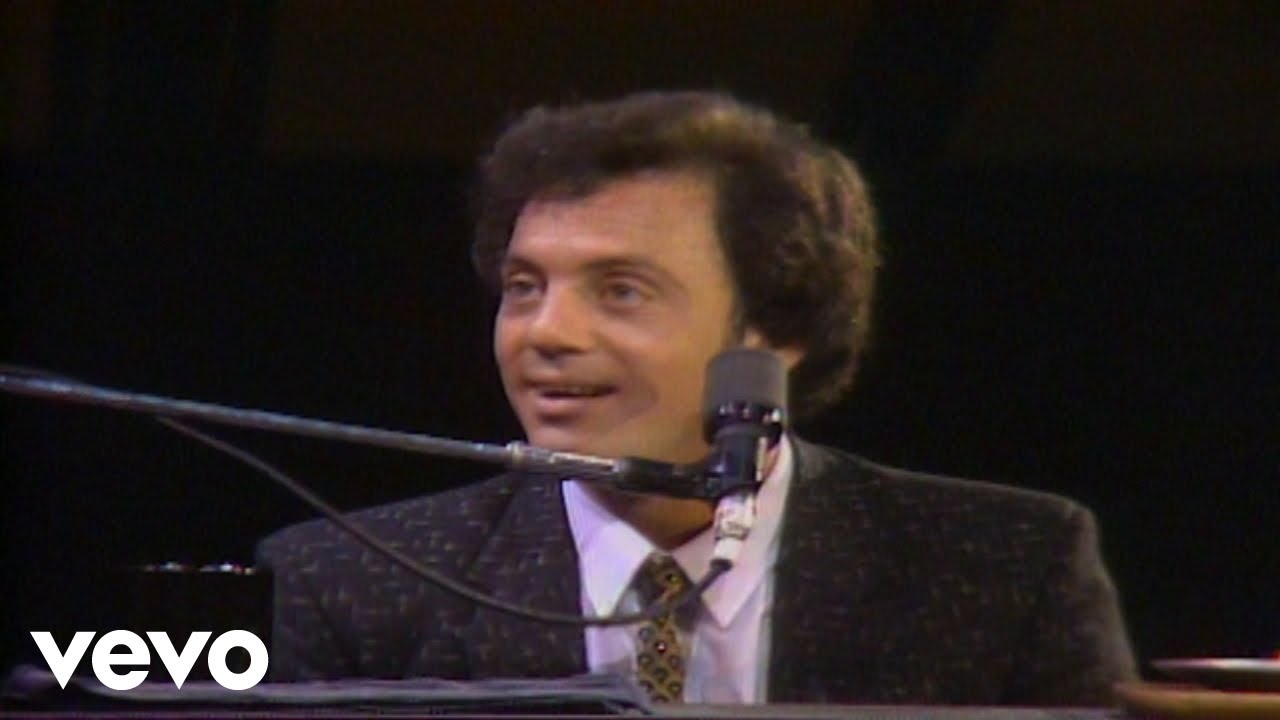
One huge asset on The Stranger album was the presence of producer Phil Ramone, who captured Joel’s raw, theatrical New York energy impeccably.
The song was recorded at A & R Recording in New York City and in an interview for Performing Songwriter magazine in 2008, Joel said it was recorded as one composition in “about seven takes”, with himself and the other musicians playing together live in the studio.
It was mixed by Jim Boyer, who said Scenes From An Italian Restaurant is one of the mixes he is most proud of.
“Generally we used as little EQ as possible when mixing Scenes From An Italian Restaurant,” said Boyer in Ramone’s 2007 book, Making Records: The Scenes Behind The Music. “Consequently the bass and drums are focused and tight, and the cymbals ring without being harsh. Each instrument occupies a meaningful spot in the mix; more importantly, the mix possesses the requisite clarity, spaciousness, and movement."
Scenes From An Italian Restaurant was released on The Stranger album in September 1977. Record World concluded that it was the centrepiece of the album while a retrospective review in Classic Rock described the song as “one of his [Joel’s] greatest musical and lyrical achievements”.
The characters of Brenda and Eddie would go on to become major characters in the 2002 Broadway production Movin’ Out, a dance musical conceived, directed and choreographed by Twyla Tharp and featuring the songs of Billy Joel.
Scenes From An Italian Restaurant was used in the documentary Three Identical Strangers and was sync’d to TV dramas such as The Sopranos, where it features in the ‘Everybody Hurts’ episode in the fourth season.

For Billy Joel, the song would remain a fixture of his live set right through to his monthly residency at Madison Square Garden from January 2014 through to July 2024 and at his last appearance at the Mohegan Sun Arena, Connecticut on 22 February 2025.
That year, Joel cancelled all subsequent live commitments after being diagnosed with a brain condition and being advised by doctors to stop performing. But at the time of writing he has announced a special intimate Q&A with a small amount of music at Florida Atlantic University in Boca Raton on 14 December 2026.
Rob Sheffield of Rolling Stone once concluded that Scenes From An Italian Restaurant was Joel’s equivalent to Bruce Springsteen’s Jungleland.
In an interview with Glenn Gamboa of Newsday in 2015, Joel said: “I don’t think I could do a show without performing that song.”
Scenes From An Italian Restaurant remains one of his most acclaimed compositions, a fact borne out by its enduring popularity and the rousing reception it has always received from fans every single time Joel plays its iconic opening chords.
