





MusicRadar Verdict
A singular instrument that refuses to choose between artisan craftsmanship and serious piano performance, the Kiyola series sets a new benchmark for what a digital piano can be in a modern home.
Reasons to buy
- +
Genuinely unique handcrafted cabinet.
- +
Outstanding key action.
- +
Organic sound modelling.
- +
Matching stool and pedal unit included.
Reasons to avoid
- -
App required for most functions.
- -
No line outputs.
- -
Only six onboard tones.
MusicRadar's got your back Our team of expert musicians and producers spends hours testing products to help you choose the best music-making gear for you. Find out more about how we test.
What is it?
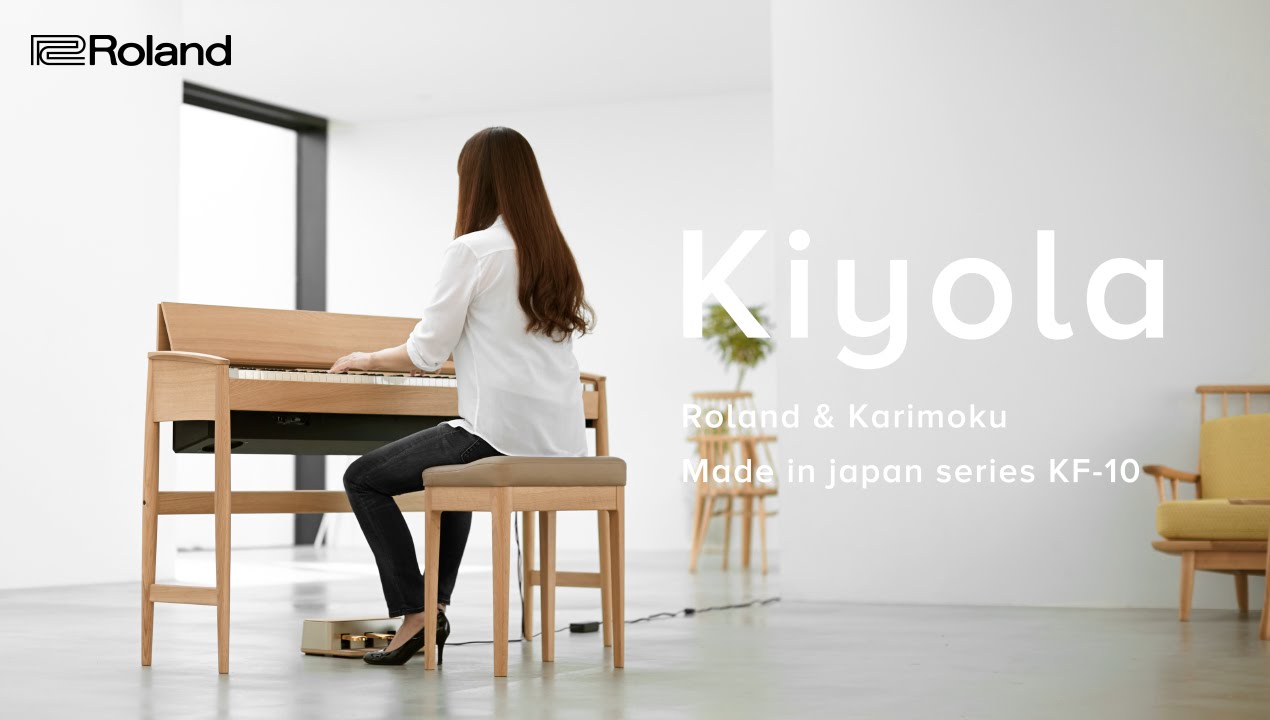
The Roland Kiyola KF-20 is not your typical digital piano. It is the result of a long-standing collaboration between Roland and Karimoku, one of Japan's most respected wood furniture manufacturers, combining centuries of Japanese woodworking craft with Roland's most advanced piano technology. The Kiyola line began in 2015 with the KF-10, and the KF-20 is its 2026 evolution.
Each Kiyola is a one-of-a-kind instrument, with unique grain patterns and natural ageing that make every cabinet distinct. The KF-20's rounded edges draw inspiration from Hikimono craftsmanship, a traditional Japanese method of carefully preparing wood to achieve smooth, organic forms. The result is an instrument inspired by 'wa', the Japanese concept of harmony, where aesthetics and function are given equal importance.
The new Kiyola line offers two cabinet designs: the KF-20 with smooth, rounded edges and gentle curves, and the KF-25 with a sharper, more angular style inspired by the Japandi aesthetic, a fusion of Japanese and Scandinavian design. The KF-20 comes in four finishes: Pure Oak, Walnut, Sheer White, and Celadon Green. The KF-25 is available only in Smoked Oak. Although the Kiyola series places a strong emphasis on furniture design, Roland has equipped it with many of the same core technologies found in its premium digital pianos.
The keyboard is built around Roland's PHA-50 action, a hybrid of wood and plastic with escapement simulation across all 88 keys, ivory and ebony touch surfaces, and high-precision sensors designed to capture even the subtlest playing nuances and deliver a genuine grand piano feel.
For sound, the Kiyola uses Roland's Piano Reality Modelling engine, the same technology found in the premium LX and GP grand piano series. Rather than relying on pre-recorded samples like most digital pianos, Piano Reality Modelling generates sound in real time by mathematically recreating the behaviour of an acoustic piano, from the vibration of the strings to the resonance of the soundboard. As a modelling instrument rather than a sample-based one, it also benefits from unlimited polyphony; every note sustains naturally without the cutoff that sampling engines can impose.

Roland has kept the onboard controls minimal, with just a few buttons giving direct access to six tones. Connecting to the Roland app opens the full picture; 48 additional sounds become available alongside Roland's Piano Designer, which allows detailed fine-tuning of tone and touch.
In terms of connectivity, the KF-20 covers all the essentials. Two headphone outputs make quiet practice straightforward, a USB-C port handles connection to phones, tablets, and computers for MIDI and audio, and a USB-A port allows for additional storage. Bluetooth MIDI enables wireless connection to the Roland app and compatible devices, while Bluetooth Audio allows music to be streamed directly through the piano's speakers.
The KF-20 comes with a matching piano stool and a three-pedal unit featuring wood detailing that complements the cabinet finish. What the KF-20 promises on paper is one thing; how it delivers in practice is another.
Performance
The KF-20 demands to be looked at before it is played. The cabinet is unlike anything else in the digital piano world, a genuine design object that would enhance any room it sits in. The quality of the woodwork speaks for itself up close, with smooth, rounded edges that give it a warm, organic character. It carries a quiet confidence that is rare in this category, where most instruments prioritise function over form.
Roland has made a clear choice to prioritise timelessness over technology, and the result is an instrument that looks as though it has always belonged in the room
Nothing here is accidental. The lid itself doubles as the music rest when open, a simple but neat solution that keeps the design uncluttered. The matching stool is equally beautiful, and the buttons are refreshingly minimal, positioned discreetly on the side of the cabinet rather than across the top, with a timeless, almost vintage quality that feels a world away from the busy control panels found on most digital pianos. Throughout, Roland has made a clear choice to prioritise timelessness over technology, and the result is an instrument that looks as though it has always belonged in the room. The KF-20 makes an unforgettable first impression before you play a single note, and it turns out the piano inside is equally impressive.
Beneath the woodwork, the Kiyolas mean serious business. They are built around the same core technology found in Roland's premium LX and GP series, instruments that sit at the very top of the digital piano market. Starting with the keyboard, the PHA-50 action makes an immediate and convincing case for itself.
The escapement simulation is particularly impressive; escapement is the subtle mechanical click felt on a grand piano key just before it reaches the bottom, a detail that experienced players rely on for precise control at low volumes. Here it is rendered with real delicacy, and acoustic pianists will find it immediately familiar. The sensor detection delivers an organic, responsive feel that rewards nuanced playing, and the ivory and ebony-feel key surfaces are comfortable across long sessions. Roland's actions tend to sit on the heavier side, which experienced players will welcome, though beginners may need a little time to adjust.


The piano sounds are a genuine highlight. Warm, detailed, and with an impressive stereo image, the Piano Reality Modelling engine delivers a sense of realism that is hard to match in the digital piano world. Through headphones in particular, the experience is remarkably convincing; the instrument simply feels alive in a way that sampling alone rarely achieves. The KF-20 may not have the physical resonance of a transducer-driven soundboard like the Kawai CA901, but for most players, it will more than hold its own. The additional voices are enjoyable and well-suited to casual playing, though none quite match the richness and character of the piano tones that sit at the heart of the KF-20.
The KF-20 holds its own on connectivity for the most part. Bluetooth MIDI and Audio are present as expected at this price, and the USB-C port for MIDI and audio is a welcome modern touch, putting it ahead of many rivals that still rely on the older USB-B connector. Dual headphone outputs cover shared practice and silent playing without issue.
That said, there are a couple of notable absences worth flagging. There are no line outputs, which most competitors at this price include, meaning connecting to external speakers or a PA system is not straightforward; something those wanting to integrate the piano into a home studio setup should bear in mind. The KF-20 is also more app-dependent than most rivals; where the Kawai CA901 offers a full touchscreen on the instrument itself, and Yamaha CLP-885 provides clearly labelled direct controls, the Kiyola’s deliberately minimal control panel means the Roland app is effectively essential rather than optional for accessing the full range of sounds and settings. It is a trade-off that keeps the cabinet beautifully clean, but one worth knowing about before you buy.


Verdict
The Roland Kiyola KF-20 and KF-25 make a convincing argument that a digital piano does not have to look like one. Roland and Karimoku have struck a confident balance between furniture design and serious piano technology, and the result is an instrument that holds its own on both fronts. The PHA-50 key action and Piano Reality Modelling engine would be impressive in any cabinet; in this one, they feel like a genuine statement of intent.
The PHA-50 key action and Piano Reality Modelling engine would be impressive in any cabinet; in this one, they feel like a genuine statement of intent
At this price, the competition is real. Kawai's transducer soundboard and wooden key action edges ahead on pure piano realism, and Yamaha is a strong alternative for those who prefer a more traditional approach. But neither looks like the Kiyola, and for a growing number of players, that matters. As always with instruments at this level, key action is a very personal choice, and we would always recommend trying each side by side before committing.
One thing worth noting is that the minimal, almost vintage interface will not suit everyone, and those used to a touchscreen or clearly labelled controls may find the app-dependent approach a little frustrating day to day.
For the intermediate to advanced pianist who wants to play seriously while also making a considered interior design statement, the Kiyola offers something that no other digital piano currently does, and it does it without compromising on what matters most.
Hands-on demos
RolandChannel
Alternatives
Specifications
Price |
£3,799 |
Number of Keys |
88 |
Keyboard action |
PHA-50 Hybrid, wood and plastic construction, escapement, ebony and ivory feel, high-precision sensing, fully graded |
Maximum polyphony |
Unlimited (grand piano tones, solo playing) / 256 notes (all other tones) |
Number of voices |
54 total (6 accessible directly from piano, 48 via Roland Piano App) |
Sound engine |
Piano Reality Modeling |
Amplifier output |
48W total (24W x 2) |
Speakers |
12cm x 2, 5cm x 2 (two-way stereo system) |
Headphone outputs |
2 (1x 6.3mm jack, 1x 3.5mm mini jack) |
Connectivity |
Bluetooth MIDI and Audio v5.0, USB-C (MIDI and Audio), USB-A (storage) |
Compatible apps |
Roland Piano app |
Pedals |
Damper (Progressive Damper Action, continuous detection), Soft, Sostenuto |
Recording |
WAV and MP3 to USB storage |
Cabinet |
Handcrafted solid wood, Hikimono technique, Japan |
Available finishes |
Pure Oak, Walnut, Sheer White, Celadon Green |
Included accessories |
Matching piano bench, matching three-pedal unit |
Dimensions |
Width: 1,396mm (54⅞") with lid closed |
Weight |
34kg piano / 2.1kg pedals / 4.7kg bench |
Contact |
