
In this frankly epic tutorial we're concentrating solely on chords and chordal ideas, and the following will act as a compendium of great chord fingerings.
The audio examples start with simple chords like triads and power chords and then build in complexity as we move on to extended, altered and slash chords.
We sometimes refer to various chords as 'voicings'. This is just a fancy name for how many notes there are in a chord and the order in which these notes are placed. For example, an A major chord contains the notes A, C# and E.
A guitarist can choose how to play (voice) this chord on the fretboard; notes can be repeated and placed in different orders to create new sounds.
Many of the examples in this feature sound good because of the voicings we have chosen so it's well worth learning them and including them in your playing.
For each chord type we have referenced iconic tunes and bands that have used the chord in question and this will help to put its use and sound in context.
Chord types

We have divided the chord types into the following types: triads, sus chords, add chords, 7th chords, extended chords, 9th, 11th, 13th, altered dominants and slash chords. Each chord example has a brief explanation of its intervallic construction so you can memorise the structure and experiment with your own voicings.
Many of the examples in this feature are created by harmonising the major scale in diatonic thirds. Take for instance the C major scale (C D E F G A B); if we stack thirds from C major we get C, E and G, which creates a C major triad. If we continue this process we add B (major 7th), D (9th) and so on, right up to A (13th). If we start on D then a D minor chord is created (D F A) and so on.
For slash chord notation, remember that the first letter is the triad and the second letter is the bass note. Therefore the A/B chord would be an A major triad (A C# E) with a B bass note. The other area the article touches on is the altered dominant chord. This has a standard root, major 3rd and minor 7th intervallic construction.
In addition to these three standard dom7 chord tones, we can add altered 9th and 5th degree scale tones, namely the b9, #9, b5 and #5.
Two note chords
Listen: examples 1-5
EXAMPLE 1A AND 1B: The power chord and the added 6th
Let's start at the top with a chord that contains two notes! It does get more interesting and tricky - I promise! If you combine the perfect fifth with the root you get the mighty power chord. Many bands of all styles have used the power chord to great effect. You can create a classic blues/rock rhythm pattern by alternating the 5th with the 6th (think Status Quo). This example is in the style classic rock bands like AC/DC.
Triads
Listen: examples 1-5
EXAMPLE 2: Eric Johnson style major and minor triads
The major and minor triads are three-note chords, as the 'tri' in the name suggests. You can however create plenty of colour with these simple chords if you finger them in an imaginative way. To create an Eric Johnson-style open voicing, simply finger the 3rd of the chord up the octave. Now instead of the third being in the middle of the voicing, it is on the top of the chord and it is now heard as the 'melody' note.
EXAMPLE 3: Augmented triad used by Chuck Berry and others
The augmented triad has a similar formula to the major triad, albeit the 5th degree is sharpened (root, 3 and #5) The augmented chord creates a dissonance that heightens the resolution in a V-I cadence. Chuck Berry uses the augmented chord to start his song, No Particular Place To Go; it's also in Billy Swan's I Can Help and Stevie Wonder's You Are The Sunshine Of My Life.
EXAMPLE 4: Diminished 7
The dim7 has a spooky quality that is useful to create tension - think of The Specials' Ghost Town. Due to the dim7 being built of minor 3rd intervals exclusively, you can take any fingering and move it around in three-fret intervals.
sus chords
Listen: examples 1-5
EXAMPLE 5: Tom Morello-style D sus 2
If we take out the 3rd of a major or minor triad and replace it with a major 2nd or perfect 4th it becomes a suspended chord (sus for short). The D sus 2 chord sounds great with distortion and if we drop the 6th string down a tone to D then a huge-sounding six-string Dsus2 voicing can be played. This example is in the style of bands like King's X (with guitarist Ty Tabor) and Rage Against The Machine (featuring guitarist Tom Morello).
EXAMPLE 6: Steve Vai-style C sus4
Listen: examples 6-10
Following on from the previous sus 2 example, this chord is the sus4 fingering that Steve Vai fuses at the start of Yankee Rose.
Triads with extensions (Add chords)
Listen: examples 6-10
EXAMPLE 7: Minor add 9 used by Metallica and Andy Summers
You can add various intervals to the major and minor triads to create what's known as an 'add' chord. So let's start with adding a major ninth to the minor triad. Bands like Metallica are fond of this concept for their quieter moments. Also Andy Summers likes to use this chord and you can hear it in several hit songs by The Police.
EXAMPLE 8: Hendrix-style add 9
Jimi Hendrix often used open strings to embellish his chords. This example uses a unison G (fretted on the 5th fret of the fourth string and the open third string) to create a lovely ringing sound. Use your thumb to fret the G on the sixth string just like Jimi did. You can move this fingering around the 1st, 3rd, 6th and 8th frets, with the open third string ringing as a drone.
EXAMPLE 9: Satriani-style add11
If you add a perfect 4th to the major triad it clashes with the major 3rd due to them being a minor second (one fret's distance, soundwise) apart. You can use this to your advantage to create, sparking arpeggio parts. Bands like Def Leppard are fond of the add11 as is Bryan Adams (think Run To You) this example is based on the fingering Joe Satriani uses at the start of Always With Me, Always With You.
EXAMPLE 10: SRV-style add 6
If we add the 6th to an A triad we end up with Aadd6. In this example an SRV or Allman Brothers-style blues accompaniment is created by sliding the same shape from the 5th fret to the 7th fret. This gives us an Aadd6 at the 7th fret and an A9 at the 5th fret - it's a cool move!
7th chords
Listen: examples 11-15
EXAMPLE 11: Van Halen-style minor 7
As you know, by stacking another harmonised third on the top of a minor or major triad we end up with a four-note chord called a 7th. If we add a minor seventh to a minor triad a minor 7th chord is created. This example uses an unconventional voicing for C# minor seven, which utilises open strings and is similar to the fingering that Eddie Van Halen used at the start of his track Panama.
EXAMPLE 12: dom7 used by Brent Mason
If we add the minor 7th to a major triad we end up with a dominant 7 chord. There are many great songs that use fairly standard dominant 7 fingerings. This example showcases how country players like Brent Mason outline the dom7 sound within a riff.
EXAMPLE 13: major 7, John Frusciante-style
If we take the major triad and add the major 7th then we create the major 7th chord. This example uses the same fingering as featured in the RHCP's classic Under The Bridge. You can use your thumb for the bass notes like John Frusciante does.
EXAMPLE 14: minor 7b5, Robben Ford-style
If we flatten the 5th of a minor 7 chord we create the minor 7b5. This is chord VII of the harmonised scale but it can also be used as a cool chord substitution. Players like Robben Ford use the minor 7b5 chord to create a dominant 9 sound by playing it of the third of the dominant chord. This example showcases three different Bm7b5 chord fingerings over a G bass note. This creates the G9 sound.
EXAMPLE 15: Beatle-ish dominant 7 sus 4
We can omit the third of a dominant 7 chord and replace it with a 4th. This creates a dom7 sus 4 chord. Fans of The Beatles will recognise it, but it's found everywhere in popular music today.
EXAMPLE 16: Zeppelin-style minor/major 7 chord
Listen: examples 16-20
The minor/major 7 chord has a spooky sound when used on its own. It is however a popular compositional technique to use the m/maj 7 in a descending bass line over a minor chord and many songs, including Stairway To Heaven, Something and Michelle use this concept.
9th chords
Listen: examples 16-20
EXAMPLE 17: minor/major 9 - The James Bond chord!
If you add a major 9 to the m/maj 7 it is possible to emulate the chord at the end of a certain popular British spy film theme. The open strings in this voicing give it yet more flavour, shaken but not stirred.
EXAMPLE 18: minor 9 as used by George Benson
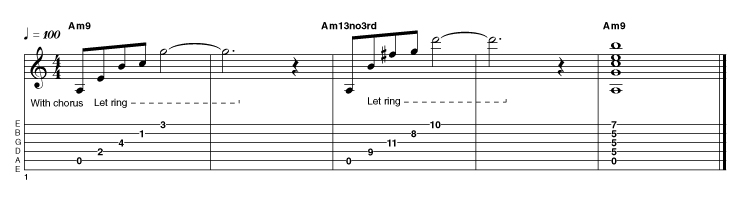
This example features two cracking fingerings for Am9. The voicing consists of two perfect 5th intervals separated by a minor 2nd. By moving the same shape up to the 8th position implies a minor13 (no 3rd). Jazz players like George Benson love this sound.
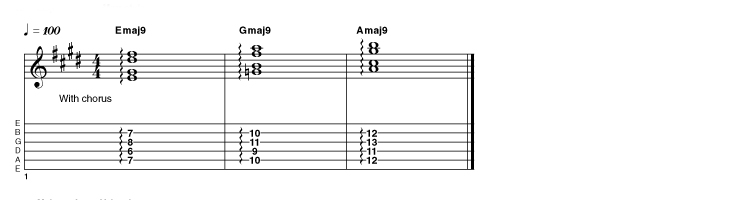
EXAMPLE 19: major 9, a Smiths' favourite
The major 9 provides a mellow and calming sound. The Smiths' guitarist Johnny Marr often used extended chords in his playing and the major 9 was a favourite.
EXAMPLE 20: major 9, Steve Vai-style
This example features a Steve Vai style fingering for the major 9 chord. Tracks on the albums Flexible and Passion And Warfare feature this voicing. Check out the fingerings on the tab as this chord will require all your fretting fingers and a full, first finger barre.
EXAMPLE 21: dominant 9, favoured by Jimmy Nolen
Listen: 21-25
The dominant 9 chord is useful in many styles, but it is particularly pleasing when used for creating funk parts. In the style of James Brown's guitarist, Jimmy Nolen. It's also a great fingering to replace more conventional dominant chords in a rock and roll.
11th chords
Listen: chords 21-25
EXAMPLE 22: pop-style minor 11
This minor 11 fingering is the same one as used for Walking On The Moon by The Police and Venus by Bananarama.
EXAMPLE 23: Sting-style dom 9#11
Dominic Miller is fond of the 7#11 sound (4th mode of melodic minor, Lydian dominant) and has used it in various Sting arrangements. If you use a judicious smattering of delay and chorus you can create some lush soundscapes with this chord.
EXAMPLE 24: dom 11, as used by EVH
Utilising open strings is a great way to create voicings that would otherwise be tricky or impossible to finger. The only drawback is that these shapes become key specific but you can always employ a capo should you need these sounds in other tonalities. This is an EVH-style F#dom11 shape.
EXAMPLE 25: major 7#11, used by EVH
By moving the previous shape down one fret you can create the Fmaj7#11 chord. Move down to E major afterwards for a Spanish flavour!
EXAMPLE 26: A minor 11
Listen: 26-30
Here is a great voicing for A minor 11. This one works well either clean or distorted. You can recycle the top part of this chord, and change the bass note to create new chords. Check out the next few examples for some of the possibilities.
EXAMPLE 27: Ab maj7#11
If the bass note is dropped down a semitone then the chord becomes a maj7#11.
EXAMPLE 28: G sus4
If the bass note is dropped down another semitone then the chord becomes a Gsus4.
EXAMPLE 29: C sus2
If the bass note is changed to a C then a Csus2 is produced. This voicing is popular with pop and punk bands.
EXAMPLE 30: E minor 11, Vai-style!
We can also recycle the fingering used in Example 20 for the Steve Vai-style major 9. If we play this shape with a first finger barre on the 2nd fret and leave the open sixth string ringing on the bottom, then a lush minor 11 chord is created.
13th chords
Listen: chords 31-35
EXAMPLE 31: G minor 13, Pink Floyd-style!
This is the chord that was used for that fabulous Pink Floyd guitar moment. It's a bit of a stretch if you include the low G as tabbed here, but well worth it. The original part had no low G but it helps to contextualise it for the GT version.
EXAMPLE 32: dom 13
This chord has a great sophisticated jazzy sound and can be a great substitute for the first two chords of a blues.
EXAMPLE 33: SRV-style major 13
SRV used this chord in his tune Lenny. The voicing is everything here so let that low E note ring out!
6/9 chords
Listen: examples 31-35
EXAMPLE 34: Bossa nova-style C6/9
The 6/9 chord is a great choice for bossa nova accompaniment. The 6/9 chord uses the same shape regardless of whether it's rooted on the sixth or fifth strings.
Altered dominant chords
Listen: examples 31-35
EXAMPLE 35: Beatles-style 7b9
You can hear the 7b9 chord in the jolting chord stabs in I Want You from The Beatles' Abbey Road, and in Nature Boy by George Benson.
EXAMPLE 36: Hendrix, Cream and Chris Rea 7#9
Listen: examples 36-40
The use of the 7#9 sound in a rock context was popularised by players like Hendrix and it sounds great with an overdriven tone. But you can find it in a hundred jazz tunes and it's also the third chord in Chris Rea's On The Beach. It's also the opening chord stab of Cream's I Feel Free.
EXAMPLE 37: 7#9 as used by The Average White Band
The 7#9 is also great for funk as used in the intro to Pick Up The Pieces by rhythm guitar ace, Hamish Stuart.
EXAMPLE 38: Pink Floyd-style 7#9 to b9 move
Pink Floyd keyboardist Richard Wright said he worked this chord move out from a Miles Davis record. When inserted in the Breathe chord progression it works a treat.
EXAMPLE 39: SRV-style 7#9#5
Stevie uses this chord before moving to the main riff after the intro in Couldn't Stand The Weather.
Slash chords
Listen: examples 36-40
EXAMPLE 40: D/F#, first inversion blues ending
When the bass note of a slash chord is in the triad then the chord is an inversion. This stock blues ending uses the D first inversion chord to create a smooth bass note run. You can experiment with all manner of slash chords by simply changing the bass note of any chord in your repertoire.
EXAMPLE 41: D/A used by Brian May
Listen: examples 41-45
This is the classic chord that Brian May uses in songs like Hammer To Fall and We Will Rock You. It's easy to move from the open A chord to the D/A and it sounds awesome.
EXAMPLE 42: Paul Kossoff-style D/A variation
This chord is a slight variation on the previous example in that it utilises open strings. The chord actually functions as a 13 sus 4 and is the fingering used for Paul Kossof's iconic opening riff in Alright Now. Try it fingerstyle with either A or E in the bass and you'll wind up in James Taylor territory.
EXAMPLE 43: E/A, as used by Randy Rhoads
Here's a cool way to link the chords in Example 41 to an open A5 power chord.
EXAMPLE 44: E/D, Nuno-style
This is the Lydian chord that Nuno uses for the intro in Extreme's Whole Hearted. You can move this chord around over the open D to find different tonalities with the minimum of effort. Wishbone Ash loved this idea too.
EXAMPLE 45: B/A, used by Satriani
This example is a similar concept to the previous one and is reminiscent of the opening chords in Satriani's Lydian drenched classic Flying In A Blue Dream.
EXAMPLE 46: C/D funk chords
Listen: examples 46-50
This chord is an easy way to access the dominant 9su4 sound and is the basis of many funk intros like Street Life, the Starsky And Hutch theme and many other pop/funk tunes. It is super easy to play and is very much a one-finger wonder that you can play all over the neck.
EXAMPLE 47: G/E, A/E and B/E
Used by Pete Townshend, some great sounds can be accessed by moving a chord shape around in conjunction with open string drones. Pete used this concept to create the shimmering chords in I Can See For Miles - try it with the open A shape too.
EXAMPLE 48: E/C, major 7#5
The major 7#5 is the third chord of the harmonised melodic minor scale. This chord has a mysterious character and is often used in detective films.
Other chords
Listen: examples 46-50
EXAMPLE 49: Natural harmonics chord
Here's Steve Vai's fabulous sounding chord from Sisters. Played in harmonics, it functions as a Cmaj9 chord.
EXAMPLE 50: Semitone chord
Used in Steely Dan's Bodhisattva. You can use both hands to finger this chord, which descends in semitones. It'll take some getting use to and you will need use the fourth finger of your picking hand for the strum.