





MusicRadar Verdict
This is a stunningly beautiful and exceptionally accurate model of the original Prophet, with a clutch of incredibly useful enhancements, from modulation, to overall voice count. We just wonder why it's taken GForce so long?
Reasons to buy
- +
Stunningly accurate software version of one of the all-time classics.
- +
The detailing, in sound, is exceptional!
- +
There are arguable advantages to a Prophet-5 in software form.
- +
Plenty of useful new inclusions, over and above the original, while keeping the ethos firmly in place.
Reasons to avoid
- -
Many of the new patches make considerable use of the onboard FX. If you’re a purist, you can always switch them off!
MusicRadar's got your back Our team of expert musicians and producers spends hours testing products to help you choose the best music-making gear for you. Find out more about how we test.
What is it?
The significance of the Prophet-5 synthesizer, in the evolution of commercial music and production cannot be overstated. Where the Minimoog brought pseudo-affordable synthesis to the masses, the Prophet-5 picked up the torch and single-handedly reinvented synth production, with real musicians in mind. All of this was courtesy of Dave Smith and his company Sequential Circuits Inc (now just known as Sequential).
Initially released in 1978, the Prophet provided 5-note polyphony, coupled with the ability to save and recall patches. This was a revelation for keyboard players, alongside a five-octave keyboard and the immediacy of hands-on control, thanks to the beautiful control panel. As one successful UK session keyboardist commented to us recently, “it was the only synth you needed!”. That might not be quite true today, but it certainly was back in 1978, with little choice or competition.
After three major revisions of the original instrument, production ceased in 1984. Dave Smith released several other synthesizers with a slight nod to the Prophet moniker, but it wasn’t until 2020 that he revisited the original format, with the release of Version 4, in both five- and ten-voice iterations.
There have been many software versions of this legendary machine since the dawn of the plugin era, but we have had to wait until now for synth behemoth GForce to offer its own model on the original. Impressively, its Prophet-5 is the only example with official endorsement from Sequential.

Performance
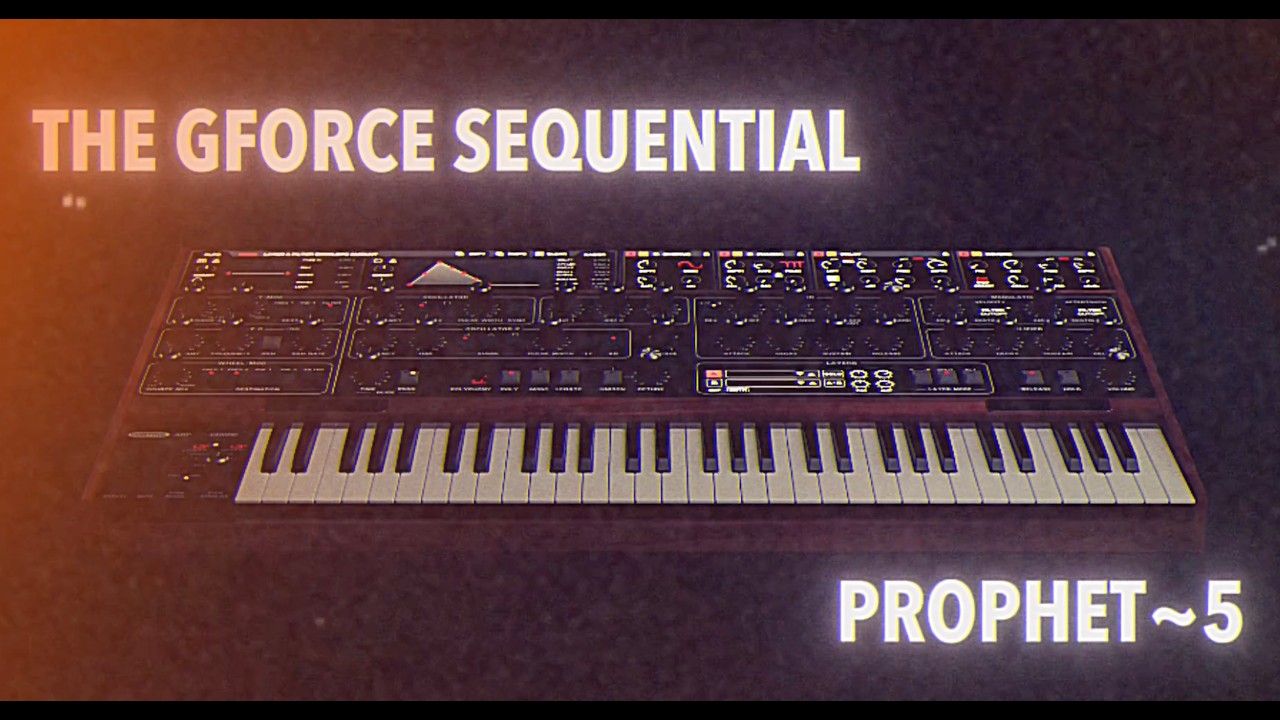
GForce has included all the usual plugin formats, as well as a standalone version. With its scalable interface, this allows you to get lost in the programming by blowing it up to the full size of your computer screen, and just playing… and playing!
We are fortunate to have a hardware Prophet v4 in our studio, which allowed us to place the two against each other for direct comparison. The software also includes all of the original patches, which are present without any additional layer of effects, so this was the perfect place for us to start.
We probably shouldn't be surprised by what we heard, given GForce’s amazing reputation. The attention at the sonic level is exceptionally good. The behaviour of the pots is a little different; the software pots tend to offer a greater level of detailing and accuracy, particularly with the lower values, which is just where you want the fine-tuning. By comparison, the hardware offers conventional, equally-measured operation from 0 to 10.
Reducing both synths to their basic waveforms equally provided no clues in our attempts to separate the two, in our blind testing. Maybe the filter section would reveal differences between the two? No! In fact, much like the v4 hardware, GForce has included the original Mk1/2 SSM filter, alongside the Mk3 Curtis chip filter, and other than a difference in pot position, there is nothing to choose between the two, sonically.
In fact, despite keeping our own hardware in V.4 territory (which should be very stable), our own hardware had a tendency to wander in terms of its pitch stability. A Vintage pot was introduced to allow users of the hardware to engineer how stable they would like their Prophet to be, and in a nice touch, GForce has included this pot, not that you will want the instability of a v1 Prophet-5!

More notes good
Despite the revelation of five voices in 1978, later polys did attempt to address the problem of note stealing, for more grandiose synth pads with long release tails. This is not going to be an issue here, as the software allows 10-voice operation, effectively like the Prophet-10. Where GForce goes further is with the ability to stack voices into layers, with both layers offering full 10-voice operation.
If we add this to the exceptionally good effects section, we can't be surprised that the overall stature of the effected output is stunning, and all of this with the ability to control parameters on screen, or using automation within the DAW. Like other GForce products, the mapping of modulations or control through MIDI CC is very simple. There are several hardwired modulation paths, just like the original instrument, but one of the most eye-catching is the inclusion of the XLFO and XADSR sections, which offer more flexible, capable and advanced sources for modulation. Assigning these elements is as simple as selecting the modulation destination and adjusting the settings in the ‘X’ section. We were even able to modulate the Vintage pot in this way, although it might be more useful to generate pulses and gates in the direction of the filter.
If working within a DAW, a dedicated CC button allows the assignment of MIDI CC to pretty much any parameter, and certainly all the ones you need.

The other Poly
One element which we have to pay particular attention to, is the Poly-Mod section. This was always a unique form of cross modulation, which quickly became part of the Prophet sound, allowing the generation of metallic tones and thunderous effects. Experience tells us that this can be very difficult to capture in software, but GForce has really nailed it. It is every bit as effective as it always was, but if anything, offers a greater degree of control, thanks to its software domain.
Located down in the performance control area, there are a number of other tasty tidbits that were never available on the original instrument. Firstly, the original Prophet only ever offered a mono audio output. Thanks to a pan mode, with spread amount, you can quickly generate stereo depth, before using the onboard effects.
There is also the addition of chord memory and the exceptionally useful arpeggiator. In standalone mode, the latter really does allow you to get lost in the sound, particularly when used alongside the hold control.
Verdict
We have to conclude that this is a pretty special release. Firstly, the Prophet-5 holds a very special place in people’s hearts as the first machine of its kind, and GForce has really looked after its legacy beautifully. If you are a purist and just want an original machine in software, you are firmly in luck. You can dial back any of the additional elements, and just use this like an original Prophet-5.
However, for more contemporary or stylised work, the software has an incredible amount to offer. With over 420 new patches, alongside the original 38 factory patches, the programming team has taken full advantage of everything this new iteration has to offer while truly respecting its heritage. The subtle detuning of the oscillators, with the greater control of the envelope section, means that you have the sound of an original, with extraordinary levels of control and greater depth of modulation. It is undoubtedly the best of all Prophet worlds, and an enormous testimony to the original machine and the brilliance of GForce for looking after the details in software.
Hands-on demos
GForce Software
Alternatives
Specifications
Price |
£99 |
Key features |
2 Oscillators per voice SSM and Curtis filter models Vintage control, to replicate instability XMOD section introduces new levels of modulation control to the Prophet Increased voice count of 10 voices, even in layer mode Over 420 new patches Full MIDI CC and MPE control available Onboard arpeggiator and suite of FX Stereo output |
System requirements |
MacOSX and WindowsPC : AU, VST2/3, AAX & Standalone formats |
Contact |
