





MusicRadar Verdict
Like Gemini, DMNO is a brilliantly crafted synth for synth heads. If you are a serious tweaker with an equally serious wallet, you should apply. Its sound is big, flexible and bold enough to overcome the lack of polyphony, and we think you will love the DMNO effect.
Reasons to buy
- +
Two amazing synths interacting as one.
- +
Super screen and workflow.
- +
Great layered sound with binaural girth.
- +
Play modes and extra modulation features.
Reasons to avoid
- -
Don't expect a full poly experience, all the time.
- -
Relatively expensive.
MusicRadar's got your back Our team of expert musicians and producers spends hours testing products to help you choose the best music-making gear for you. Find out more about how we test.
What is it?
UDO's Super Gemini is one of our favourite synths of the last couple of years, so we obviously have sky-high expectations for the company's new DMNO, or Domino, another double-timbre beast with a massive amount of onboard tweaking. This time, though, you get less polyphony in favour of more interaction between these engines, and a fabulous screen to help peel back the synth's many layers.
As with Gemini, DMNO is double the synth fun, but the end result is different enough to make it another ridiculously characterful UDO synth, and one aimed fair and square at proper 'synthusiasts'.
UDO is one of the most exciting synth brands around – and we’re not just saying that because (like us) it is British. The company has an obvious passion for creating cutting-edge synths that might sometimes borrow the best bits from the odd synth icon, but always deliver something completely new and without compromise, and machines that often feel alive and unpredictable – traits again shared with their vintage forebears.
Gemini, which we reviewed a couple of years ago, is a prime example: two synths in one, a nod to the Yamaha CS80, and with a signal flow between both engines that can create an all-new and awe-inspiring sound. The company’s new DMNO follows a similar path: two independent 4-voice synths, this time with design cues from the Oberheim 2-voice, but again resulting in a synth that delivers sound design options in spades.
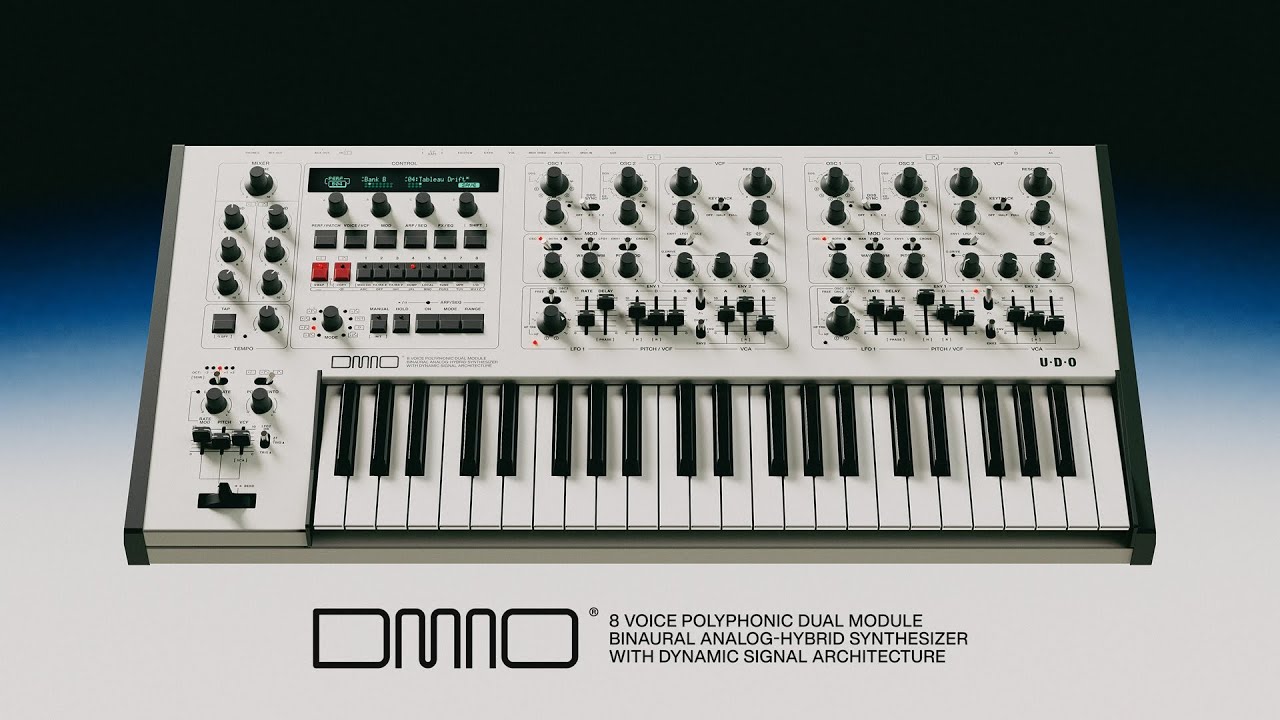
Unlike Gemini, DMNO has a superb screen to help you navigate around the all-important signal flow, which is all about the interaction between those two synth engines. DMNO also allows you to shift between eight different Play modes for extra performance versatility, but it still delivers a similar Gemini user experience where things might not always go according to plan, but they do always seem to go right.
And while DMNO lacks the polyphony of Gemini – four binaural/eight mono compared to 10 and 20 respectively on Gemini – it’s another gert lush synth from our local Bristolian neighbours which looks like succeeding in extracting cash from our bank account. But will it do the same to yours?


Performance
You can think of DMNO as two synths in one because that is exactly what it is: DMNO 1 and 2 have almost identical controls, sitting side-by-side on the front panel, and they each have their own effects, arpeggiators and modulation setups.
The hybrid workflow starts with two FPGA Digital Oscillators per voice, before going into an all-new analogue, dynamic multi-core analogue filter with parallel, series and stereo connection modes.
The digital FPGA-based 'super-waveform' oscillators deliver classic analogue waveforms and user selectable wavetables. They also feature six of what UDO call ‘sister oscillators' which come into play in ‘super mode’ where you can pretty much 'super trance' up any of your supplied waveforms, of which there are plenty.
With Osc 1 you get six basic waveforms and you can load in another six wavetables from 32 options. It's a similar story for oscillator 2, but here you only get three additional slots rather than six, as the other three are taken by Osc 2's 'keyboard off' options. This is where the oscillator can operate in LF mode as a sub or, handily, as an LFO and modulation source. And while DMNO is not a wavetable synth per se, you can morph between waveforms, upload your own, and generally tinker with your core ingredients beyond what you'd expect.
The filter section is pretty incredible with parallel, series and stereo modes, each with several filter setups to choose from. And with a dozen LP, HP, BP, all pass, and phase shifter filter types available – most with selectable poles plus two resonance choices for LP – there is a lot to choose from.
The all-pass mode is particularly worth auditioning, where resonance becomes the main operating parameter, driving certain sounds in a more unpredictable way, and great fun at extreme settings.
DMNO's screen is a real bonus, and while we didn't miss one on Gemini – with that synth it almost helped not having one as you focused on your hands-on tweaking – the one on DMNO kind of shows you what your were missing. It combines brilliantly with the four rotaries beneath, and certain parameters go brighter as you select them, very useful, especially great when modulating, as we'll see.
To the left of this is a mixer for the synth layers, with panning and effect sends to overall reverb and delay for your mix. There are other drive, chorus and EQ insert effects plus reverb and delay send effects within each layer. You can tweak up to four effect parameters at a time with those rotaries beneath the screen, and again the screen is a highlight, indicating graphical changes like EQ.


Extra performances
With DMNO's ingredients, then, you're already starting with something different, but it's the interaction between DMNO 1 and 2 where things start going on a tangent, and it's a path you will gladly follow – just make sure you have a few hours to pass, because this thing will eat your spare time, albeit richly rewarding you along the way.
Chief among these workflow extras are the eight play modes which we'll list simply because they tell you all you need to know, and reveal an insight of the leftfield thinking behind the synth. Single, Dual and Split are the most obvious. The first allows you to play either DMNO with maximum 8-voice (mono) polyphony; Dual plays both synth layers together, each with the polyphony halved; while Split simply puts each synth on a selectable range of the keyboard, as you might expect.
Fourth mode One-Two allows you to play the first synth with your first four notes of polyphony but switches to DMNO 2 for the rest; Cycle alternates between each engine, so press one note for DMNO 1 and the next plays DMNO2, then swaps back and so on. Random alternates between the layers randomly based on user definable probabilities; Chaos is Random plus random pitch changes (by octave, fifths etc); and finally Series is where the audio of DMNO 1 can be routed into 2.
Whether you'll use all of these modes is, of course, debatable – some might be a little too out there for you – but we love anything that adds performance variation, and particularly like Chaos mode, especially combined with the arpeggiator, as you can keep things relatively in control while sounding off-beat and a much more interesting player than (in our case) you might well be.


Modulation
Each DMNO layer has two LFOs, although, as we said above, Osc 2 can additionally be used as one in LF mode and one of the envelopes can be looped to act as an LFO – this doubling up of functions across DMNO is very 'on brand', if you think about it. Similarly there are two envelopes with a not-so-hidden third able to shape the VCA.
To the left of the keyboard there's a dedicated block for more performance/keyboard based modulation, and one other feature well worth picking out is the envelope follower. Here you can modulate with an external signal, a bit like side-chaining with a kick through a compressor, and it's yet another small addition with big dividends.
There's a lot of modulation to delve into here, and like Gemini, DMNO can be incredibly hands-on and instant, but its screen again adds another dimension. You'll be switching between fat, detuned super waves (not just saws) by way of several three-way switches to select more obvious sources and destinations, and the screen acts beautifully here, highlighting each options as you shift.
However, the display comes into its own when offering more complex modulations that can be set up by way of the modulation matrix, with seven slots, 10 sources, 15 destinations, and levels all controlled with the four rotaries beneath. Easy and plentiful.

Verdict
All of these features add up to a synth with a very big and layered sound, which is particularly suited to sound designers and, really, those after something a little different. Sure you can get huge, analogue-style leads, basses, sequences and the like, but it's really what happens when you combine your Dominos using either the play modes or straight audio routing.
Here DMNO stands out and, like Gemini, it seems to be another synth designed from the question, 'what can we make that would be really cool?' rather than 'what can we make that will sell?'. That's not to say it won't sell – it certainly deserves to – but this isn't yet another analogue synth, another wavetable or another wacky hybrid. We have enough amazing synths that fit the bill in all three of those categories, but DMNO tends to forge its own path around and through all of them.
In that sense it very much has its own character, but perhaps makes it a harder sell, especially if you are after the huge pads that we love about Gemini. For those, you might find DMNO's polyphony lacking – you're only getting the full eight voices in mono mode – but if you think of DMNO as a massively souped up dual mono synth or a twisted paraphonic, you certainly won't be disappointed.
So where Gemini is all about rich, massive and expressive walls of sound, DMNO is more like its rather unruly nephew – less to say, a massive attitude, probably a chip on its shoulder, but it talks the talk and you listen when it does.
Hands-on demos
UDO Audio
Alternatives
Specifications
Price |
£2,599 |
Key features |
8-voice (4 binaural) hybrid analogue/digital synth 2-part multi-timbral Two FPGA digital oscillators per layer Dynamic Multi-core stereo filter with parallel, series and stereo connection modes 2 x envelopes and LFOs per layer 7-part modulation matrix 32-bit DSP digital effects including delay, reverb, EQ, overdrive, distortion and chorus 8 selectable ‘Play Modes’ Multi-mode arpeggiator 44-note semi-weighted keyboard with velocity and monophonic aftertouch 2-in 2-out 24-bit USB digital audio interface Connections: Stereo external audio input, 2 user-assignable CV & gate/clock outputs via 1/8”/3.5mm , USB, MIDI in-out-thru Electroluminescent vacuum fluorescent display (VFD) |
Dimensions |
780 × 380 × 115mm |
Weight |
8.5kg |
Contact |
