
MusicRadar Verdict
Warp is a desktop effect clearly designed by a team that really understands the appeal of this sort of device. While there are deeper and more flexible multi-effects on the market, there are few as fun and creative as this.
Pros
- +
Excellent range of effect algorithms designed to encourage experimentation.
- +
Easy-to-use design with no screen, menu or shift functions.
- +
Output limiter can add subtle crunch to drums and group tracks.
- +
CV allows for integration with hardware synths and modular gear.
Cons
- -
Fairly expensive.
- -
Output level control/indicator relationship can be a little confusing.
- -
No tempo sync for rhythmic effects.
MusicRadar's got your back Our team of expert musicians and producers spends hours testing products to help you choose the best music-making gear for you. Find out more about how we test.
What is it?
To some producers, desktop and outboard effects probably seem like a bit of an anachronism. After all, in an era of cheap, abundant and endlessly flexible plugins, why would you bother wrestling with the limitations of physical ins and outs, particularly if the effects in question are digital processors that can be accessed for much cheaper in your DAW?
There are, however, aspects of working with hardware effects that make for a profoundly different experience to processing sounds with plugins: the physicality of modulating sound using tangible controls, the qualities imparted by converters, circuitry and gain staging, the finality of recording a sound with effects ‘baked in’.
The appeal of hardware effects is particularly obvious when working with a unit with a distinctive, creative personality. This is something that Warp, from the ever-original Soma Laboratory, makes an excellent case for.
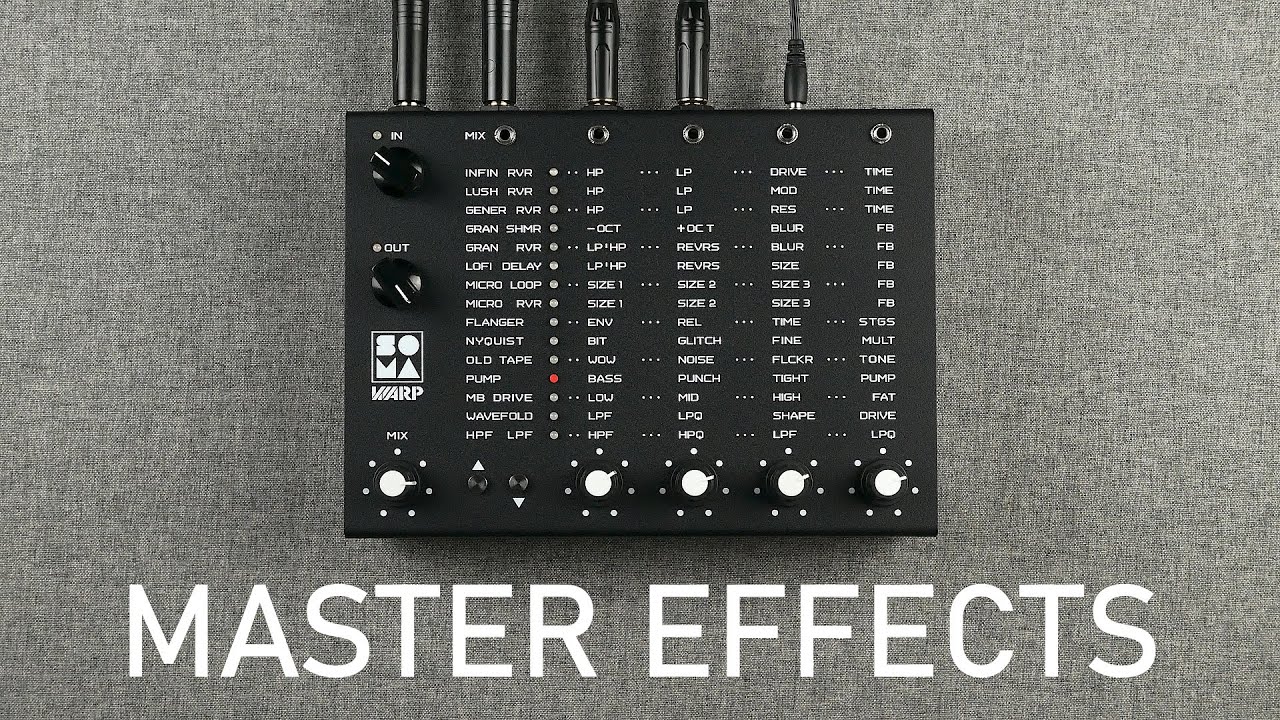
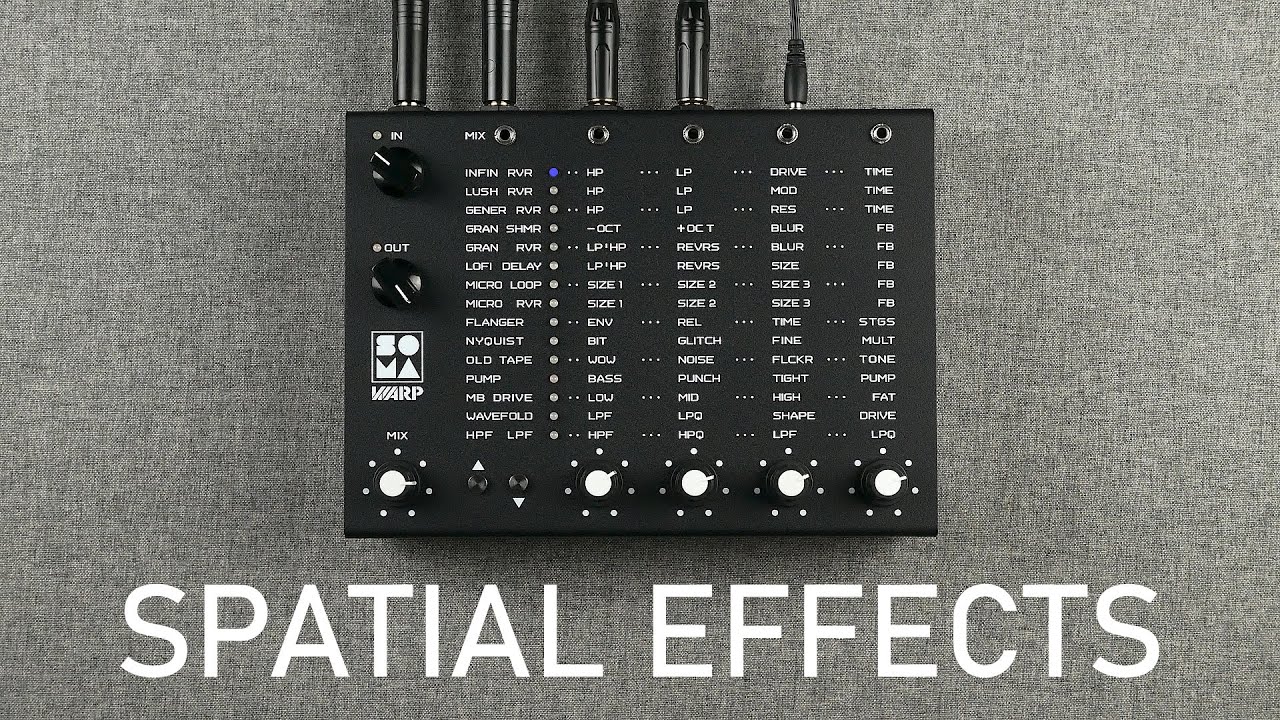
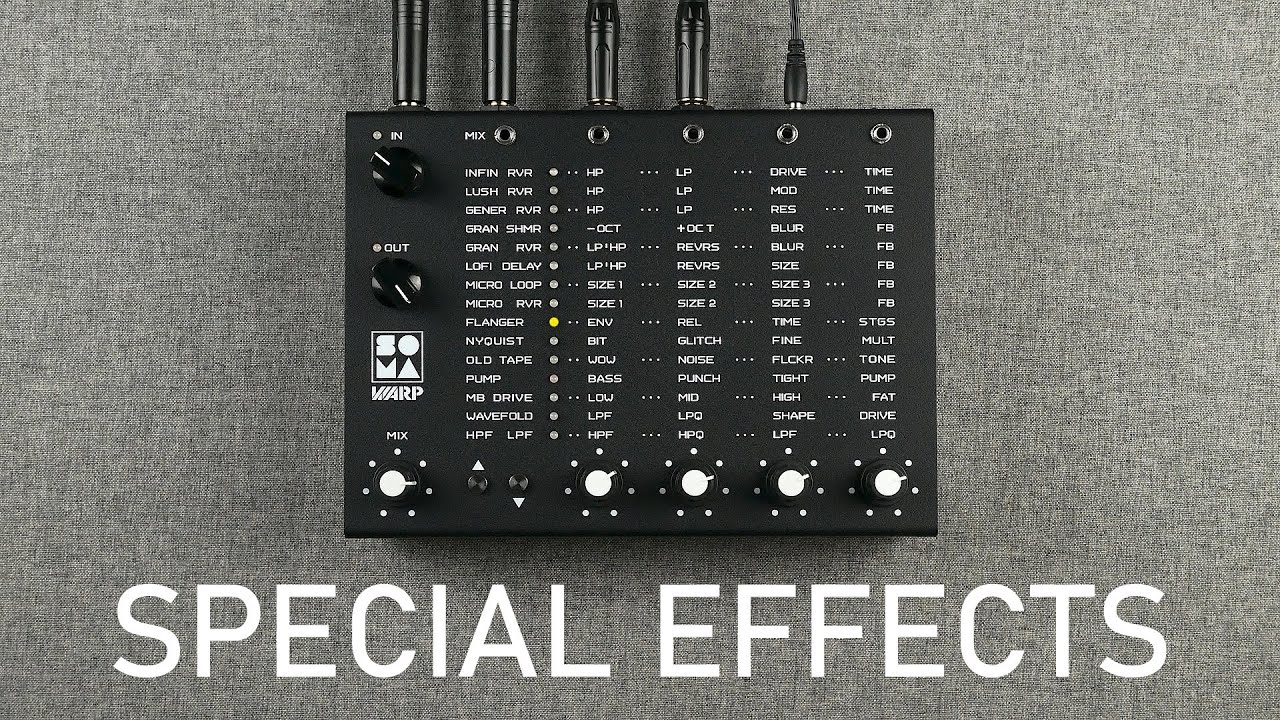
Warp is a stereo digital effect unit that houses 15 algorithms. Its effects are selected and controlled using a matrix-style interface, the labelling of which takes up most of the top panel. The selected effect type is displayed via a column of LEDs along the left edge of the grid. Each effect then has four parameters that can be altered and modulated using the four rotaries along the lower edge or the modulation inputs along the top.
Warp’s algorithms are divided into three broad categories, described in the manual as ‘spatial effects’, dealing with various reverbs and delays, ‘special effects’, which combine mod effects and distortion, and ‘dynamic effects’, such as compressors and filters, described as being designed for busses or submixes. But in typical Soma fashion, none of these are as straightforward as they initially appear.
Every algorithm has at least one parameter that can be pushed into experimental territory, whether that’s a reverb time that can create endless drones, dual low- and high-pass resonant filters that produce different effects when their cutoff points overlap, or a reversed lo-fi delay that degrades sound as it repeats.
Pricing
Launch price: £566 / €649


Performance
Warp is a device clearly designed by somebody who understands the appeal of hardware effects, and its design is full of little touches that put it in a league above many other similar devices.
The hardware design itself is simple, but the clear layout makes for a consistent and easy to understand workflow. Although having four controllable parameters for each effect type is far from exhaustive, there’s a simple immediacy to the design and it feels like the exact right level of editability in order to encourage hands-on experimentation.
Although the resulting effects can’t be sculpted as precisely as some other digital effects units, it’s to Warp’s credit that there are no shift-functions and no menus.
Warp also has a CV input for modulating each of the four effect parameters as well as for the dry/wet mix, which are ideal for incorporating the device into a Eurorack or analogue synth setup. Each CV input works in positive voltage values only (0-5v), which alter the parameter in relation to the placement of the front panel controls, meaning that it's possible to manipulate each by CV and by hand simultaneously.
The one slight bugbear I have with the control layout is that the touch-sensitive pads used to switch between algorithms are placed next to the parameter rotaries, meaning they’re very easy to accidentally nudge whilst manipulating effects (at least for left-handers like me). Soma has addressed this with an algorithm locking function, accessed by tapping the pads three times. It still feels as though it might have been easier just to place those selectors towards the top of the interface instead.
The analogue-to-digital signal path is well thought out too. Warp is stereo throughout, with dual TRS ports for the input and output. The front panel has level controls for each stage, each with LEDs to indicate the correct level of operation. There is a digital limiter placed on the output stage that can produce soft clipping when overdriven, which can sound great on drum tracks and percussive sources.
What is slightly confusing, arguably, is that the output LED indicates when this limiter is activated, but since the output level control is placed after the limiter, adjusting the control has no effect on the level going into the limiter. This means that there’s actually very little correlation between the output control and the LED placed next to it. The operation of these elements is clearly explained in the manual though, and having control over the output gain independently from the limiter is undoubtedly useful.

Effects
Thankfully, Soma has clearly put just as much thought into the algorithms within Warp as the hardware itself. While many of the effects on offer here are fairly conventional-sounding on the surface, in action it's clear that each has been calibrated for creativity and experimentation.
Take the reverbs, for example, which occupy the first five slots in Warp’s list of processors. Between them, they are certainly capable of conventional spatial effects, such as applying parallel room- or hall-sized reverb to instrument parts. However, several of the effects also have Time or Feedback parameters that effectively turn them into drone generators, allowing the user to turn simple sounds into a wash of ambience.
Of these, my favourite is probably the Generative Reverb, which creates extreme-length ambience combined with resonant high- and low-pass filters. Sweeping the cutoff of these with the Time parameter cranked to near maximum can conjure lovely shifting textures within the reverb.
Equally interesting is the Granular Reverb. Again, with the Time parameter near maximum and the Blur parameter turned up, this can turn simple sounds into washed out ambience. It also has a reverse parameter though, which introduces variations in how the grains are played back. With a short decay time, this can create some really interesting rhythmic effects that sound great for experimental percussion.
Another highlight is the Nyquist algorithm. This is a sample rate modulator that, when its Mult parameter is above zero, responds to the pitch of the incoming audio. The manual describes this functionality as “a unique function where the sample rate is dynamically altered by the harmonics of the dominant note detected by the algorithm.”

Honestly, I’m not entirely sure exactly what it’s doing, but it sounds great, particularly on bassy kicks and low toms. Modulating the Mult and Fine parameters results in some wonderful harmonic shifts that add a whole new dimension to the sounds being fed through it.
Although extreme and experimental effects are certainly a speciality here, Warp has some more conventional uses too. Used in moderation, the Pump and Multiband Drive modes, for example, are great for adding a touch of extra heft to hardware drum machines. The Flanger mode too – while also capable of some extreme sounds – works wonders for adding a subtle touch of extra movement at the end of a chain of other effects.
Verdict
With a price point equivalent to some hardware synths, Warp is certainly not the cheapest effect on the market. And while its effect algorithms are unique, it's certainly possible to experiments in a similar manner in the software realm for much cheaper.
Both of these criticisms miss the point of its appeal though. As a creative, expressive effect, Warp’s value lies in its ability to transform your existing sounds and instruments into something new and unique. In testing Warp I’ve tried pairing it with budget synths and drum machines from the likes of Korg’s Volca range and Teenage Engineering’s POs – its ability to turn these simple, affordable noisemakers into something altogether weirder, more characterful and richer is enough to warrant its price.
It is undoubtedly at its best when in motion though, modulated physically or via CV (or ideally both), when you embrace its hands-on nature and allow chaos to unfold through experimentation – although that unpredictability could arguably be seen as a weakness for some.

Compared to say, Hologram Electronics’ Microcosm pedal – which is probably the most obvious direct competitor – Warp lacks the ability to tempo sync parameters or save parameter combinations as user presets. Admittedly, sync would only really be applicable for the delay and looper algorithms here anyway, and the simplicity of the four-parameter setup effectively nullifies the need for presets. That said, it does result in a less predictable device.
Warp is an effect unit aimed squarely at those who want a fast, powerful way to experiment with their existing sound sources. It might not be the most versatile or deeply editable effects unit on the market, but for anybody happy to embrace unpredictability, it’s well worth the price.
Hands-on demos
Soma Laboratory
Alternatives
Specifications
Price |
£566/€649 |
Key features |
Number of algorithms: 15 Minimum input voltage: 0.35 V peak-to-peak Maximum input voltage: 8.3 V peak-to-peak Input impedance: 50 KOhm Output impedance: 100 Ohm CV nominal range: 0-5 V CV input impedance: 50 KOhm Sample/bit-rate 48 KHz / 24 bit Frequency range: 10 – 22000 Hz Power voltage: DC 12V* Power input polarity: Center positive Current: 0.25 A Dimensions: 220 х 170 х 70 mm Weight (without power supply and packaging): 1.5 kg |
Contact |
