

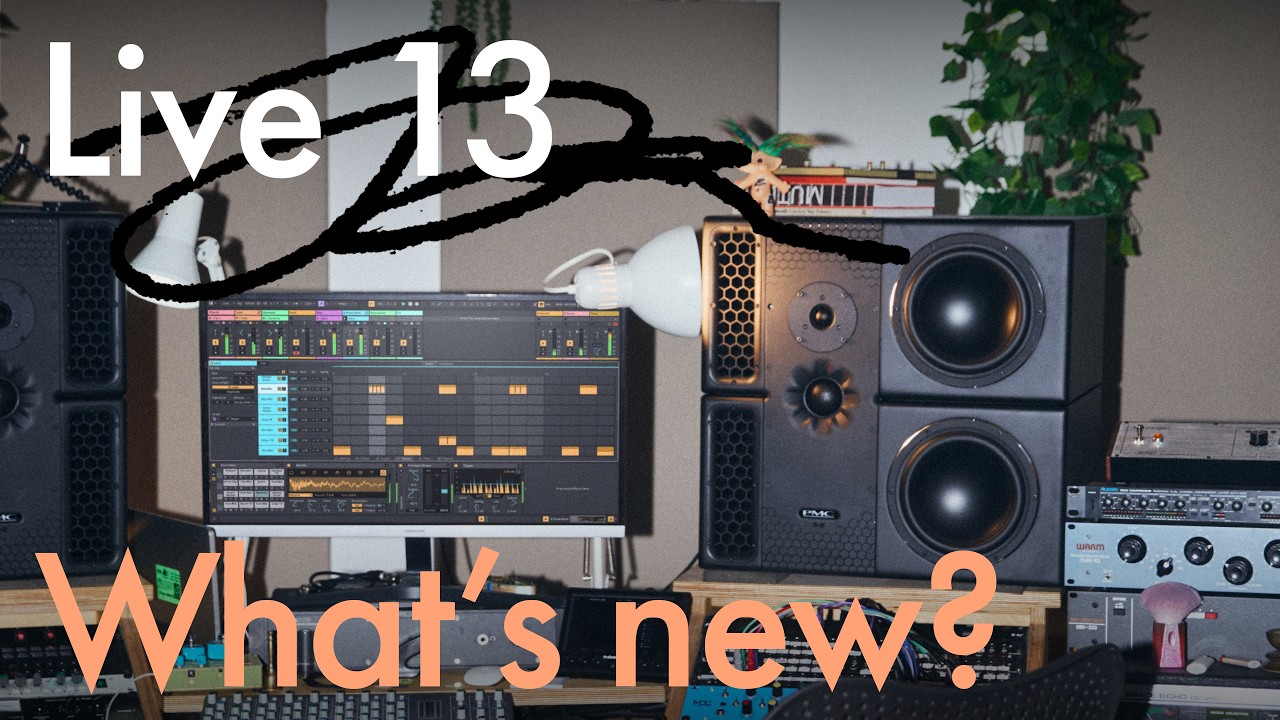
Ableton has unveiled the public beta of Live 13, the next version of its flagship DAW, a major update that the Berlin-based developer promises will “help music-makers keep ideas moving and shape sound in new ways”. There’s a lot to dig into in Live 13, from new instruments and effects to long-awaited workflow enhancements – here’s everything you need to know.
Let’s start with a crowdpleaser. Until now, writing MIDI patterns in Live was accomplished in the Notes window of the Clip View using a standard piano roll-style interface, but Live 13 introduces a Step Sequencer that offers an entirely new way to enter notes in a MIDI track.
Live’s new Step Sequencer is a classic X0X-style sequencer with a few twists. Patterns can range from eight to 128 steps, and each lane has its own settings for step count, playback rate, direction and swing, so you’re able to dial in polyrhythmic patterns that evolve and change as the sequence plays through.
Along with the notes themselves, five additional parameters are visualised on the sequencer, represented by the height of the rectangle that represents each step – the default is velocity, but you can also tweak offset, step length, step repeat, pitch bend and probability individually by adjusting the height. Clips can be converted from MIDI notes to the Step Sequencer format in one click, so you can jump between each view when it’s needed.

Step Sequencer is fast and intuitive to use and – for us, at least – has largely replaced the Notes window for drum programming. And though it’s great for drums, it’s also a fun alternative to the regular piano roll for melodic writing too, especially when using the Fold to Scale option that makes sure every lane is a note that’s in key with your project. This is something that could change the way that almost everyone, from complete beginners to seasoned producers, uses Live – it’s long overdue, if we’re honest, but very much worth the wait.
We’ve got a new sequencer, so how about something new to sequence? Drum Synth is a dedicated drum synthesizer device with 25 unique percussive presets spread across nine different categories, covering imitations of classic analogue drum machines like the TR-808, TR-909 and CR-78, synthesized recreations of acoustic percussion like the bongo, guiro and timpani, and a handful of more overtly digital, experimental and even melodic sounds.

Each category (Kick, Snare, Rimshot, Hi-hat, Clap, Tom, Percussion, Cymbal and FX) features a handful of drum synth models, each designed to produce a specific type of sound while offering some guided control over the details. Four dials let you tune each model, adjust decay, brightness and volume, and some models have a few additional model-specific controls: you can dial in the level of transient click on the 808 kick, for example, or add a pitch envelope to the 909.
Though these are the headline additions when it comes to instruments, we’d be remiss not to mention Looplet, a new Max for Live device for Live 13 Suite that’s one of our favourite things about Live 13.

Looplet is a four-track looper inspired by classic tape looping techniques. Load up a sample or record a loop, and you can play back a different chunk of audio on each of its four playheads, with per-playhead settings for playback direction, transposition and time-stretching, and a mixer section with panning, filters and routing. There’s even an authentic tape-style pitch glide effect when playback stops and starts, which is a nice touch.
Alongside the instruments, Live 13 features two new stock effects, both simple but effective dynamics-shaping tools that get their job done with minimum fuss. The Clipper device is well-equipped to tame peaks and boost loudness, with Soft and Hard modes and a Delta control for isolating artifacts, and the new Transient Shaper features sidechain functionality, allowing you to drive the effect using the attack and sustain from an external signal.

Along with these new devices, Live 13 introduces dedicated Racks for multiband and mid-side processing, making it easier to apply precisely targeted effects processing across different frequency ranges or portions of the stereo field.
Instruments and effects aside, there’s a whole host of workflow improvements in Live 13. The most significant of these is ARA 2 support, something that many Live users have been after for some time. ARA is an extension to VST3 and AU plugins that allows the plugin to edit audio on the timeline directly, rather than working on a stream of real-time audio that’s coming in through the DAW’s playback. Ableton says "most" ARA plugins now work with Live 13, with a few exceptions: check the release notes for details.

ARA plugins have a range of uses, but one of the most common is polyphonic note editing, using tools like Celemony’s Melodyne. Without ARA, working with Melodyne entailed capturing audio with the plugin, making edits and then playing it back to the timeline, a time-consuming process that forced many to do this kind of work in another DAW. With Live 13’s ARA 2 support, the editor can be opened up in the Clip View for any audio file, letting you make quick edits in real-time without opening a separate window or leaving the DAW. Live 13 Suite now comes bundled with Melodyne Essential, too, which is a major boost for Live's top tier.
Another handy workflow upgrade is Contextual Browsing, which lets you load up instruments, effects and presets from the Device Chain without navigating Live’s main browser: the menu can be opened up with the Option key and navigated with the arrow keys, so you can load up your most commonly used devices with a few keyboard strokes.

That’s a real time-saver, much like the new Capture Automation feature, which works much like Capture MIDI, except with parameter automation. Capture Automation records all your knob-tweaking in the background, so if you edit a few parameters and like how the changes sounded, but you didn’t hit record first, you can simply hit the Capture button and the changes will be laid out as editable automation on the relevant tracks.
Racks have received an upgrade, too, and they can now hold 32 macros (up from 16) that can either be dials or off/on buttons. Macro mapping can now be shaped using custom response curves, and a new Modulation mode lets you offset mapped controls using the Macro while leaving their underlying value open for manual tweaking.
Our favourite improvement, though, is the new Round Robin mode for Instrument and MIDI Effect Racks, which cycles incoming MIDI notes through multiple chains. This can be used to introduce subtle variations for realism, as you would in a sampler, or more creatively; send in a rapid arpeggio with Round Robin set to Random, for example, and each note can be routed to a different instrument in the chain with kaleidoscopic results.
That’s all of the major upgrades, but there are more minor enhancements to explore, including Device Slots in the Mixer that display all the devices on a track at a glance, Envelope Clips that hold automation and modulation for effects on Return tracks, and a bundle of new Core Library presets.
In an age when most DAW developers seem to be focused on shoehorning in AI-powered features that their users never asked for, Ableton is refusing to jump on the bandwagon, and Live 13 is all the better for it. The update is packed with smart, sensible improvements – big and small – and there’s something here for every Live user.
Live 13 is out in public beta today. Head over to Ableton's website to find out more and join the beta program.
