AI music platform Suno is rarely out of the headlines at the moment: in the past few weeks alone, the company was defeated in a landmark lawsuit brought by German performing rights society GEMA, introduced new download limits and audio watermarking technology, and inked a major licensing deal with BMG.
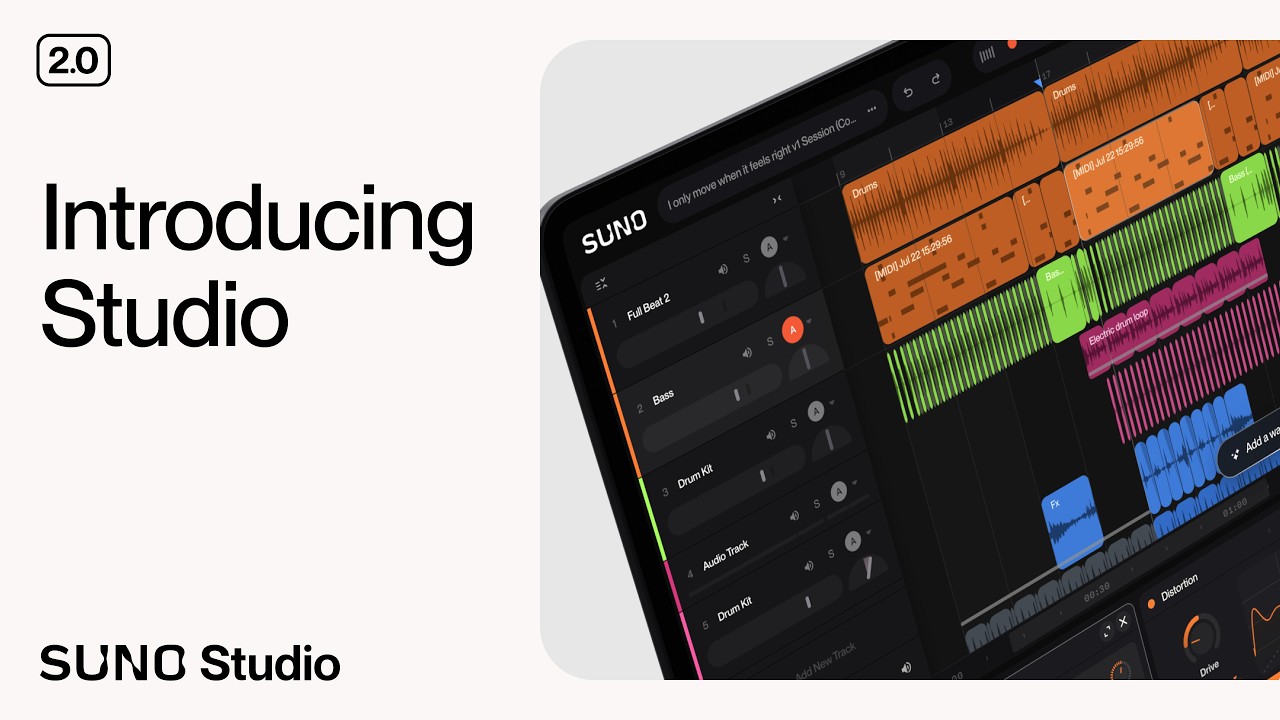
The latest news from the divisive brand is the arrival of Suno Studio 2.0, the second generation of the company’s browser-based DAW, which places the capabilities of Suno’s generative AI models in an environment that musicians and producers will be more familiar with, while offering greater creative control over their output.
While Studio’s abilities have previously been limited in comparison to conventional DAWs, Studio 2.0 finds Suno introducing standard features that you’d expect to find in more traditional music software, like MIDI support, parameter automation and latency compensation, alongside more advanced AI-based features, such as the new agentic AI chatbot Studio Chat.
Unsurprisingly, Suno says MIDI integration has been the most requested feature for Studio from its user base, and in its latest version you can import, record and edit MIDI on the timeline or in the newly-added MIDI editor, just as you would in any other DAW, and there’s audio-to-MIDI conversion onboard too.
Unlike most DAWs, however, Studio flips that on its head, converting MIDI to audio using Suno’s generative engine. This feature transforms, or “covers”, MIDI clips on any instrument track into audio clips that feature a different instrument, timbre or style (specified using the chatbot) while preserving the pitch, rhythm and dynamics from the original MIDI part.
New MIDI clips can also be created using Studio Chat, allowing you to generate melodies, chord sequences or drum patterns from text prompts.

Studio has also been equipped with a horizontal channel strip for each track that runs along the bottom of the interface – a familiar workflow for anyone that’s used a DAW before – which can be populated with software instruments, like the new Wavetable synth, or a number of newly-added stock audio effects, including reverb, delay, compression, distortion, EQ and noise gate.
Alongside the introduction of a more traditional music production workflow, Studio 2.0 brings a number of AI-powered features you won’t find in many DAWs. The most notable of these is Studio Chat, an agentic AI chatbot that can control the DAW in response to your instructions, generating sounds, organizing your project or editing MIDI and audio. (Image-Line launched something similar in the latest version of FL Studio with Gopher.)
Perhaps the most unique aspect of Studio Chat is its ability to build customized audio effects. AI-powered vibe coding tools that turn prompts into plugins are nothing new, but this is the first time we’ve seen this kind of capability baked directly into a DAW.
In the video demo embedded below, Suno’s Henry Phipps generates a basic rotary cabinet-emulating tremolo effect, but promises that the possibilities for plugin generation are “very broad”. (While plugin creation doesn’t currently require credits, Suno says that “a credit structure may be introduced in the future”.)
In a press release, Suno says that Studio 2.0’s new features were developed in response to lessons learned from user feedback. “Over the past year we have seen artists at every level spend hours at a time using our tools, and their feedback and ideas have shaped our understanding of music-making,” the statement reads.
Our biggest takeaway from spending time with artists is their deep appreciation for the instruments and tools that have earned a place in their studios
“Perhaps our biggest takeaway from spending time with artists is their deep appreciation for the instruments and tools that have earned a place in their studios. There is a long lineage of pre-AI music technology that many musicians (along with us folks building Studio) love and rely on.
“These modern music foundations, like guitars, drum machines, synths, effects and step sequencers are tried and true, and those familiar ways of interacting with sound ought to be available in the next generation of music software, including Suno Studio.
“Studio has always been about helping you turn a spark of inspiration into a finished work you can call your own. Studio 2.0 is the next step in that direction, giving you more ways to get inspired while providing access to the workflows you’re already most comfortable with.”
Suno Studio 2.0 is available now for subscribers to the platform’s Premium tier, which is priced at $30/month or $24/month billed annually. Find out more on Suno's website.