





MusicRadar Verdict
Hotone is proving you don't need to spend loads to get a seriously capable reverb pedal these days. The NC-200 is a stunningly good unit that sounds and operates like one twice the price.
Reasons to buy
- +
Superb sounds.
- +
Very easy to use.
- +
Clone and Freeze features are great extras.
Reasons to avoid
- -
Weird placement of the MIDI ports.
- -
The spring settings could be better.
MusicRadar's got your back Our team of expert musicians and producers spends hours testing products to help you choose the best music-making gear for you. Find out more about how we test.
What is it?
It’s just a fact that DSP in pedals is better than ever. It’s also way more accessible, too, meaning that it’s not only the big guns like Strymon or Eventide that can make impressive do-it-all reverb units packed full of studio-quality sounds.
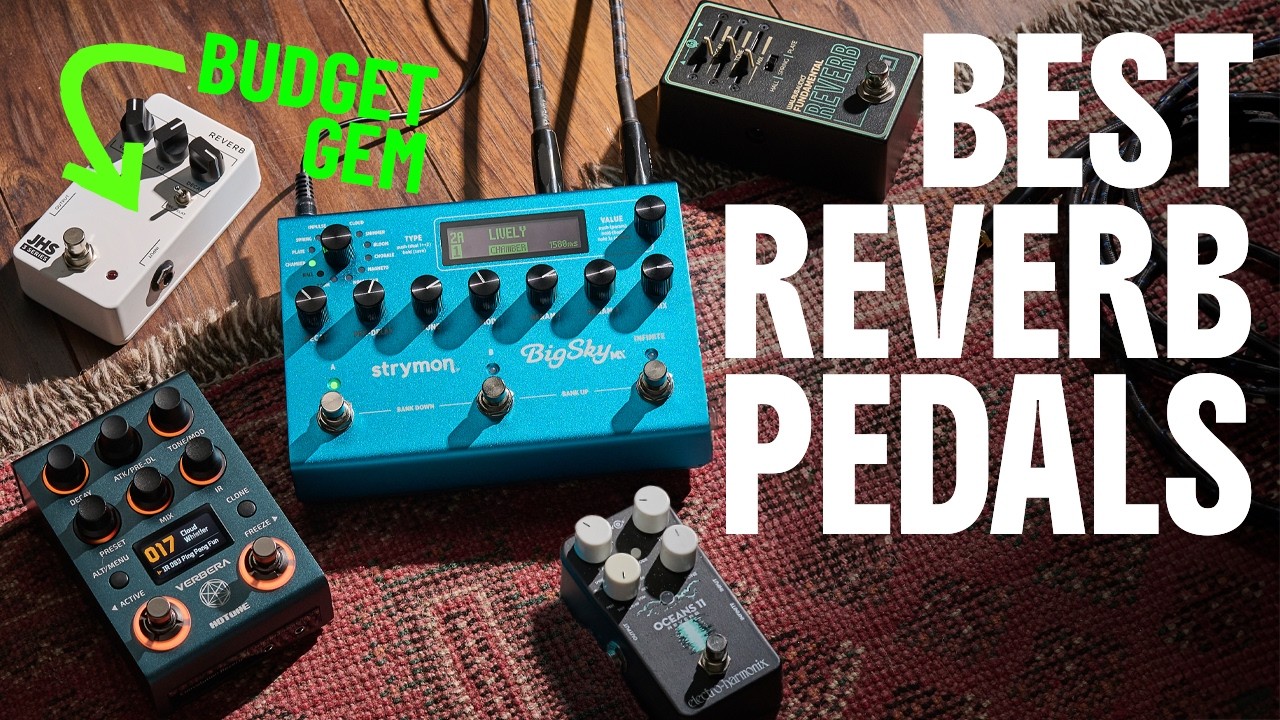
That’s where the Hotone NC-200 Verbera comes in. Packed with instant IR loading, superb tweakability, and a comparatively reasonable price tag, this is The Hunan, China-based pedal maker branching out and proving they can hang with the big dogs.

The Verbera is built around a rather unique dual-engine design, with one side capturing the nuanced reflections of real spaces through IR convolution, while the other offers XR, a sophisticated algorithmic reverb that is there when you want massive trails and epic ambient beds. Of course, combining the two is where things get very interesting indeed.
In case that wasn’t enough, you can also clone your favourite pedal and use it to create custom IRs, storing up to 1024 within the unit – arguably way more than anyone would ever need. Of course, as you'd expect, there is a companion software, Neon Collector, that makes managing your IRs and presets a little easier.
Using dual-colour LED rings for quick status checks, intuitive one-touch IR sorting, dual footswitch mode, and full MIDI and expression pedal support, the Verbera offers a host of contemporary features at a very reasonable price tag, indeed.
Specs

- Launch price: $299 | £249 | €299
- Type: Digital reverb pedal
- Controls: Decay, ATK/PRE-DL, Tone/Mod, Preset, Mix, IR, ALT/Menu, Clone, Active, Freeze
- Features: 120 impulse responses pre-installed (saves up to 1024 IRs and 200 presets)
- Connectivity: Input: 6.3 mm stereo jack, Outputs: 2 x 6.3 mm stereo jack, MIDI/EXP: 2 x 3.5 mm stereo mini jack
- Bypass: True Bypass
- Power: 9V, 1000 mA (1A)
- Dimensions: 84 x 126 x 63 mm
- Weight: 485g
- Contact: Hotone
Build quality

Build quality rating: ★★★★½
I must say, this is a pretty good-looking pedal. With its neon-glowing lights, it could easily be a part of the inner-working mechanics of the Death Star, but they serve a practical purpose, too, but we will get to that later.
To me, the build quality feels solid too, which is what I’ve come to expect from other Hotone pedals I’ve tried in the past – I’m a big fan of its volume-and-wah hybrid, the Soul Press.
The unit itself is robust and sturdy, with smooth controls. It’s genuinely satisfying to dial in your settings on this pedal. The twin footswitches are pleasantly light and soft underfoot, making them incredibly easy to operate – they are pretty close together, though, so if you have large feet, you may find it a tad cramped.

Now, if I were to have one major complaint about this pedal's build, it’s the downright bizarre positioning of the MIDI Thru and MIDI IN/EXP jacks. For reasons only known to Hotone, they’re situated at the bottom of the pedal, directly beneath the footswitches.
Considering there’s ample space on the sides of the unit, it makes me wonder why Hotone couldn’t have placed the MIDI jacks there. Perhaps the internal circuitry simply wouldn’t allow it?
Whatever the reason, the jacks being there make me very uncomfortable. Not only are they easily knocked, but on a tight pedalboard, this placement makes even less sense. That said, if you don’t plan to take advantage of the MIDI functionality, then it won’t be a problem at all.
Usability and features

Usability and features rating: ★★★★★
This is a packed pedal, so it's easy to assume it could be challenging to operate. However, that’s simply not the case.
This pedal can be used in two main modes. Right out of the box, the dual footswitches are used to scroll through the numerous presets, with the right pedal cycling up through the presets, while the left one allows you to go backwards. Pressing both switches simultaneously transitions to a mode that more closely resembles a traditional stompbox.
In this configuration, the first switch is a dedicated toggle for the effect, while the second activates the very fun Freeze function. Both modes have their advantages, but for the sake of this review, I found the second mode suited me more.
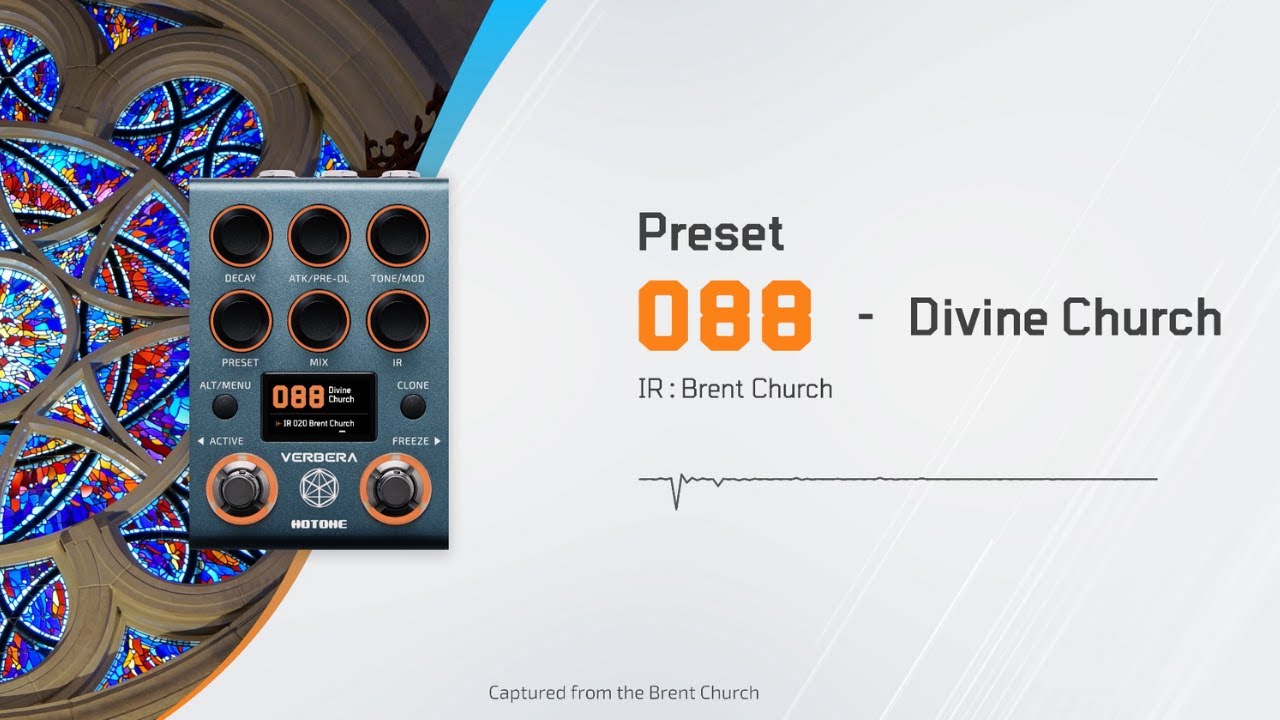
As I said up top, there are two different styles of reverb in this pedal, and thankfully, Hotone has gone out of its way to make sure it’s as easy to operate as possible. When the pedal is amber, you’re in the realm of IR reverb; switch to blue, and you're exploring the algorithmic reverb options.

Positioned directly above the easy-to-read screen, you'll find an encoder dial for navigating through presets, a mix control to fine-tune the intensity of the effect, and an IR encoder that lets you scroll through the extensive range of impulse responses loaded within the unit. One standout feature of the IR encoder is its ability to allow you to reorder the IRs by simply pressing it down, which significantly streamlines the process of locating the perfect sound – trust me, with so many IRs to choose from, this was a welcome addition.
Further up, you'll find controls for Decay, Attack, and Tone – a pretty standard affair for any reverb pedal. However, these controls do change when you engage the Alt button, switching you over to the algorithmic side. In this mode, the top controls become Decay, Pre-Delay, and Modulation.
With so much going on inside this pedal, I genuinely felt like I was going to get a bit lost, but I never did. Each dial is clearly labelled, and the coloured lights surrounding the knobs provide continuous feedback, ensuring I am always aware of which settings I am tweaking.
Sounds
Sounds rating: ★★★★★
Okay, I won’t beat around the bush, this pedal sounds mega. The sounds here are massive. Seriously, that’s the best way to describe this pedal. The way it mixes realistic room sounds from the IRs with the wild, modulated tones of the algorithmic verbs is honestly impressive when you get the settings just right.
Yes, it’s easy to go overboard and drown your sound in too much verb. But if you find the right blend of long trails and keep enough attack to hear your notes clearly, this pedal is truly engaging.
For testing, I used my beloved Fender Strat, which has low-output '54-style pickups, into a wide open and clean Fender Twin, with the reverb turned off. I wanted a fairly neutral starting point for the pedal so I could hear every detail of the verbs.
A couple of standout presets for me were the Arena 5000, which, unsurprisingly, was captured from a 5000-seat stadium. This verb is huge and super fun to play with, especially if you dial in the mix just right. Both cave settings are also wild, and Brent Heaven, which is captured from a church, is, well, heavenly.
We even have a Ping Pong Fun setting that comes directly from the Peavey Dual DeltaFex Multi Effects processor and a superb-sounding Plate captured from the legendary Universal Audio EMT 140.
I love the Freeze feature, too. Press it once, and the pedal holds your reverb trail, giving you an ambient background for lead parts that can almost become synth-like.
If I were going to nippick, I’d say the basic spring sounds are a bit bright for my taste, but you can adjust that with the tone knob. If you want a classic ‘60s spring reverb, this might not be it. This pedal is for lush, modern reverbs with huge, endless trails, and it really delivers on that front.
Verdict

This pedal remains very intuitive to navigate
If you’re after a basic reverb for a tight spring or a general sense or ambience, this is not the pedal for you. To me, this is a creative, inspiring, and genuinely useful, do-it-all verb that sounds so good, it should be making the industry leaders, Strymon, sit up and take notice.
Despite boasting a colossal number of presets and a myriad of fancy modern features, this pedal remains very intuitive to navigate, with a layout that’s clear and even beginner-friendly. Honestly, it’s a breeze to dial in, and it certainly helps that the vast majority of presets are instantly usable straight out of the box. Okay, so I’m not the biggest fan of the spring settings, as they simply don’t measure up to the ethereal, spacey options onboard, but the rest are pretty killer.
My only real gripe with the unit is the downright weird placement of the MIDI jacks. Honestly, I just don't understand the choice here; they just seem too easy to knock loose. Perhaps we can convince Hotone to change this in future versions.
Test |
Results |
Score |
|---|---|---|
Build quality |
Sturdy, well made and solid feeling - it's just a pity about those MIDI jacks. |
★★★★½ |
Usability and features |
Super easy to navigate and smartly laid out. |
★★★★★ |
Sounds |
A superb clutch of tones, although the spring settings let it down very slightly. |
★★★★★ |
Overall |
A stunningly good reverb pedal that sounds and operates like one twice the price. |
★★★★★ |
Also try
Hands-on videos
Hotone Audio
Guitar World
- Best reverb pedals: Our pick of reverb effects for your pedalboard
