MusicRadar Verdict
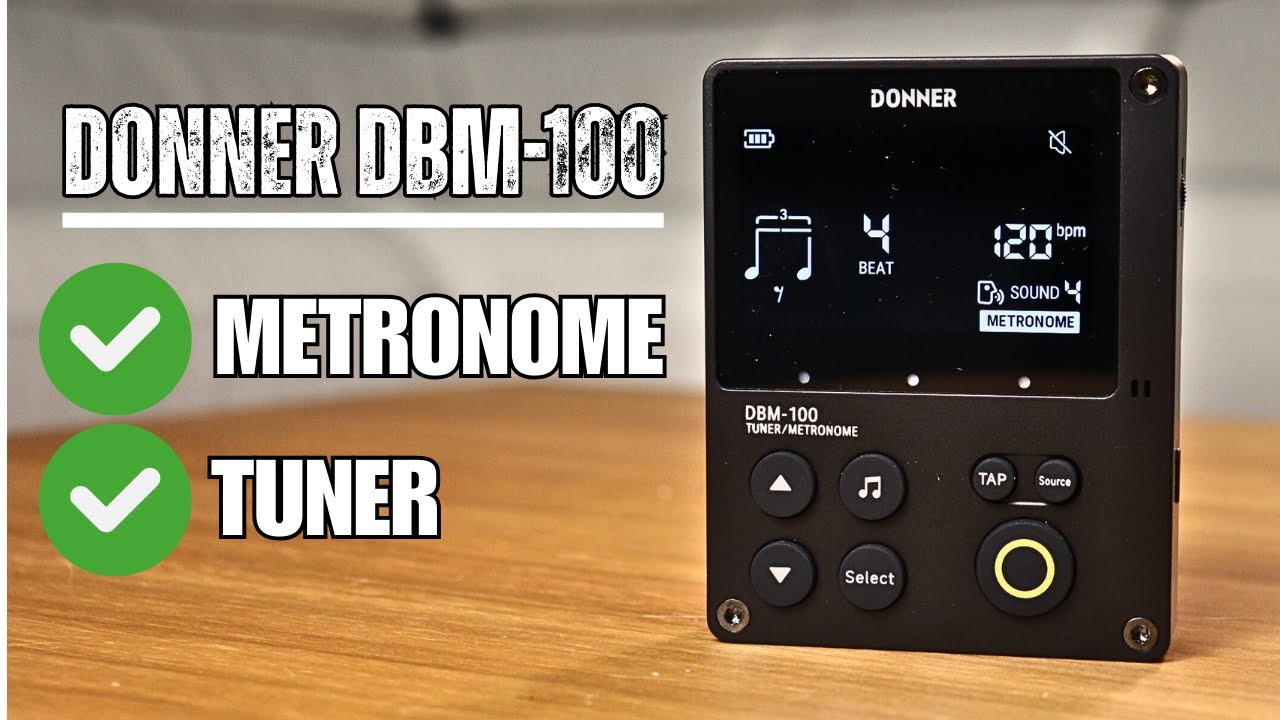
Donner’s DBM-100 is an interesting little box of tricks. It offers a handy onboard tuner, a full-featured digital metronome, and a trainer mode that seems more like an afterthought than a feature. It’s a clever device that hamstrings itself with some strange choices - a welcome entrant to the world of portable metronomes, but not without some small shortcomings.
Reasons to buy
- +
Affordable price
- +
Extensive beat subdivisions
- +
Comprehensive tuner mode
Reasons to avoid
- -
Semi-inscrutable controls
- -
Battery life quite short
- -
The manual could be more useful
MusicRadar's got your back Our team of expert musicians and producers spends hours testing products to help you choose the best music-making gear for you. Find out more about how we test.
What is it?
Donner is a breakout name in the budget guitar-accessory market – the brand that launched a thousand Amazon storefronts. First famed for its affordable micro-format guitar pedals, it’s since collaborated with Ruben Wan and Jack White’s Third Man Records, and broken guitar-pedal containment entirely to sell a suite of instruments and accessories. Among these, a small, handy, Game Boy-shaped box of a musician’s friend: the Donner DBM-100, a three-in-one digital metronome, guitar tuner and rhythm trainer.
Truth be told, it’s not the most exciting product on the planet. Metronomes rarely are, but they are useful. It’s a feature-packed little box of (relative) fun, with four sound banks, tap tempo, and a variety of time signatures and beat subdivisions to choose from. There’s tap tempo, an on-board microphone for detecting your own timely playing, a 3.5mm out for headphone metronome-ing, and a built-in, USB-C-chargeable battery with 11.5 hours of life to it. And there’s a neat little kickstand on the back, too.
On paper, it’s a pretty solid one-stop answer to most of the instrument-practising questions you might have - and a very convenient little box accordingly. It’s a reasonably priced accessory (around $35/£25) too, but does it walk the walk?
Specifications

- Battery Life: 11.5 hours
- Modes: Tuner, metronome and trainer
- Tempo Range: 30-280bpm
- Tuning Modes: Chromatic, guitar, ukulele, bass, and violin
- Extra Features: Tap tempo, four metronome sounds
- Contact: Donner
Performance

In the hand, the Donner DBM-100 feels like a very well put-together object. It’s got some reassuring heft, and the plastic chassis feels robust enough to withstand more than a few fumbles. The buttons are pleasingly soft and firm to press; for something you only handle a few seconds at a time, it’s very ergonomic to handle and operate – much like the handheld games consoles it seems designed to resemble.
When turning the DBM-100 on for the first time, I reflexively looked for a slider switch on the side, much as I would with those game consoles. After a minute of dumbfoundedly turning the thing over, I came to realise there’s nothing of the sort – and that, in fact, power is a matter of pressing or holding the big yellow-circled button on the front.
Does this speak to the quality of the DBM-100? No, but I do feel a weight of responsibility to share the exact moment when I was outmatched by an unfeeling technological object. That said, this moment of shame does become somewhat relevant, foreshadowing, as it does, the DBM-100's vague inscrutability in certain instances.
Features

The DBM-100 has three modes: tuner, metronome and trainer. The tuner mode is easy to use and decently accurate. As well as the LCD display, there are three LEDs beneath the screen that light up to indicate sharpness, flatness, or perfect tuning. It has five settings to cycle through - chromatic, guitar, ukulele, bass, and violin - and an adjustable pitch standard ranging from 430 to 450Hz.
In metronome mode, there are four sound banks to choose from: a classic pitched woodblock, a clap, a bicycle-style bell with a click beneath it, and a robotic female voice counting upwards to a maximum of nine. There’s a button to advance the number of beats in each bar from 1 to 9, and a separate button for subdivision beats, which cycles through a dizzying variety of note lengths, rhythms, and feels, including triplets with rests, dotted notes, and other syncopated patterns.
That last counting-up sound bank demonstrates some secret cleverness under the hood; it counts the beat subdivisions separately from the overarching beat. However, if you have the BPM set even remotely at pace, the voice rushes to cut itself off with each new count. The resulting cacophony is distracting at best and actively painful at worst. Best in most cases, then, to stick to that classic woodblock.


Using the DBM-100 is extremely easy, but only once you’ve got to grips with what is quite an esoteric control interface
Finally, the trainer mode seems a bit more like an add-on than a core feature of the DBM-100. It plays you one 4/4 bar, subdivided by a beat or pattern of your choice, then asks you to sound the same rhythm back, in time, with only a visual indicator for the tempo. Every beat you sound in time is heard by the built-in mic and registered by the supportive flash of a green LED. In my view, the mic could stand to be a bit more sensitive here - it was either clapping, banging the table or flicking the mic aperture itself that registered, but nothing remotely quieter. And you can’t change the underlying time signature either.
Using the DBM-100 is extremely easy, but only once you’ve got to grips with what is quite an esoteric control interface. The buttons are semi-intuitive, but still require some experimentation before you figure out exactly what they mean.
For instance, ‘source’ refers to the various metronome sounds you can cycle between, not ‘select’, which actually advances the time signature by one beat with each press. ‘Menu’ on the side doesn’t take you to a menu (not that it could – the screen is a static LCD screen, cycling through pre-etched displays), but instead toggles you between the tuner and metronome modes; to access the training mode, you have to hold it down.
My final gripe is the dedicated subdivision button, which asks you to cycle through nineteen different note values and rhythms in one direction. No easy reset to the crotchet beat; just go round, and then round again when you overshoot. It’s illustrative of a device that could be so much smarter than it is, but which gets in its own way a bit here and there.
Verdict

For the money, the Donner DBM-100 is a perfectly viable little musician’s friend. I wouldn’t trust the tuner in an orchestral pit, but it’s a handy thing for a quick sit-down practice session at home. I wouldn’t use the trainer function for more than five minutes at a time, but it’s a nice little between-drills exercise for resetting your internal rhythm.
The metronome function is the best bit, with its comprehensive array of beat subdivisions to play along to - but it’s slightly let down by a limited library of metronome sounds. For me, I’d say, ultimately, the Donner DBM-100 is an affordable metronome that does its main job well enough. For the price, and if you want a physical metronome rather than an app, the DBM-100 is inarguably worthwhile.
MusicRadar verdict: Donner’s DBM-100 is an interesting little box of tricks. It offers a handy onboard tuner, a full-featured digital metronome, and a trainer mode that seems more like an afterthought than a feature. It’s a clever device that hamstrings itself with some strange choices - a welcome entrant to the world of portable metronomes, but not without some small shortcomings.
Also try
Hands-on demos
Steven Kambach