MusicRadar Verdict
The Orange Outlowd ES3 feels like a quality bit of gear that is built to last. It’s surprisingly full-sounding for a small amplifier, and does a good job moonlighting as a Bluetooth Speaker. The highlight is the lovely reverb, pleasingly adding some space to your acoustic home sessions. We don’t need to amplify our acoustic guitars for home use, but this amp makes it fun to do so.
Reasons to buy
- +
Fantastic reverb.
- +
Very portable.
- +
Long battery life.
- +
Surprisingly full sound for a small amp.
- +
A capable little Bluetooth speaker.
Reasons to avoid
- -
Those signature Orange icons may confuse beginners.
- -
If you don't use the reverb, there may be little benefit for some in amplifying an acoustic at home.
MusicRadar's got your back Our team of expert musicians and producers spends hours testing products to help you choose the best music-making gear for you. Find out more about how we test.
What is it?
There aren’t many who don’t know at least a little about who Ed Sheeran is. With his own album sales totalling over 200 million, and having written/collaborated with the likes of Taylor Swift, One Direction and Justin Bieber, he is one of the most recognisable musicians on the planet.
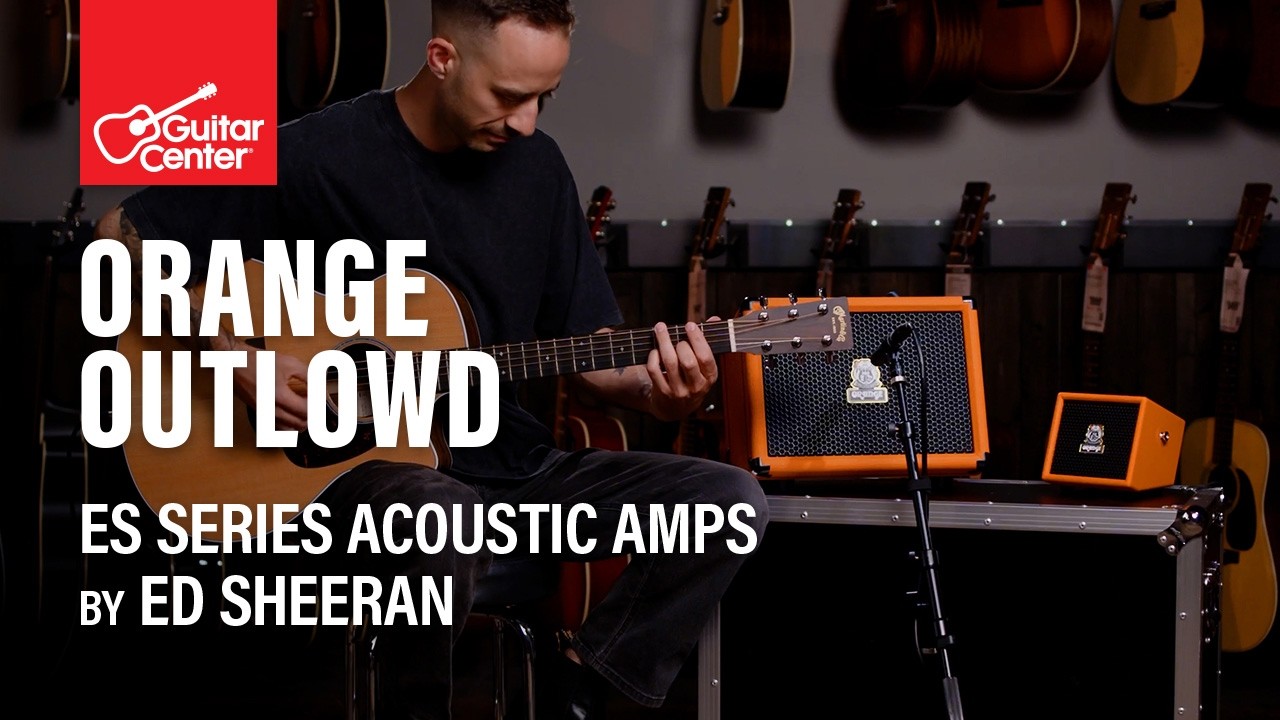
He is also a pretty handy acoustic guitar player and has delved into the world of gear with products such as the Sheeran by Lowden guitars and the Sheeran Looper. Now it’s acoustic amplification that is getting his attention, this time in the form of a collaboration with Orange with the Orange Outlowd range of acoustic amplifiers.

The range features 3W, 60W and 100W amps named the ES3, ES60 and ES100 respectively. It's the diminutive ES3 that I have in front of me for review - an amp with very few bells and whistles, built to facilitate home practice with your acoustic guitar.
You may be thinking, as I am, what is the point here? Acoustic guitars are, for the most part, more than loud enough to use at home without an amp, and generally speaking sound great on their own too. So, why would anyone need an acoustic amp designed only for home practice?
Well, let's keep an open mind and find out.
Specs

- Launch price: $199 | £149 | €179
- Type: Acoustic amplifier combo
- Origin: China
- Output: 3 Watts RMS
- Speaker: 4” full range
- Channels: 1
- Controls: Volume, Reverb, Shape
- Connectivity: ¼” input, Bluetooth connectivity
- Power: Rechargeable battery, charged via USB-C
- Weight: 3.18Lbs/1.44kg
- Dimensions: 165x145x125mm/6.5”x5.71”x4.92”
- Contact: Orange
Build quality

Build quality rating: ★★★★½
For something that measures only 165x145x125mm, the amp is surprisingly weighty. At 1.44kg, it's not problematic, but instead gives me confidence that the ES3 is built to last. The three controls and single button (for Bluetooth) follow suit and feel robust in use, as does the leather strap that the amp comes with. So far, so good.
The amp sports the classic bright orange finish associated with the brand, and it’s an aesthetic that pleasingly oozes the iconic nature of Orange Amplifiers.
The thick sides are finished in a rather bougie feeling tolex, and the tough metal grille on the front makes the unit feel like a real amp. I point this out because a lot of products of this size can come across a little toy-like, but not the ES3. It feels like a high-end, miniature version of a quality amp, rather than a budget version of something nicer.
Lastly, looking at the bottom of the unit, there are thick rubber feet to stop the amp from sliding about a desk. Alongside those feet is a join in the Tolex that could perhaps be a little neater; however, this is definitely within nitpick territory. What we have is a little amp that is very well put together, and perhaps importantly, won't look out of place in your front room.
Usability and features

Usability and features rating: ★★★★½
In use, this amp is almost as easy as it gets. Three controls: Volume, Reverb, and Shape. Volume is self-explanatory, and Reverb adjusts the overall reverb level without cluttering ther mind with more in-depth parameters. This works as long as those parameters have been calibrated well, which, in this case, they have.
Shape is a little interesting, as Orange says that turning clockwise reduces mid-range frequencies and brightens the sound, whilst turning anti-clockwise adds mid-range and reduces brightness. Honestly though, most are just going to approach this like a tone control.
I say ‘almost as easy as it gets’, because indicating what each control does, are Orange’s trademark icons rather than text. These are a long-established part of the Orange brand, but, to be blunt, I'm not a fan.
There is a whole suite of these icons across the gear in the Orange catalogue. Some are easy to figure out; others use things such as sine waves that beginners won't understand or abstract symbols that are annoying in the, admittedly small, amount of thought they take to translate.

I know that it saves space and gives the amps something that is aesthetically interesting, but other brands have no problem using words or abbreviations to get the function across in similarly tight spaces. Let’s just do that.
On the ES3, the speaker icon above the Volume control is pretty clearly indicative of the control's function, but I’d argue that the use of a spring icon to indicate the reverb may not be obvious to some beginners, and the shape used to indicate the Shape control even less so.
Having said that, it won't take long for anyone to figure it out, and if you do find yourself stuck, a quick gander at the manual will see it concisely explained to you.

Beyond its function as an amp, it also operates as a Bluetooth speaker and is dead easy to connect to a device. Press the Bluetooth button, find it in your chosen device's list of Bluetooth connections, connect, and go. Handy for playing along with tracks, or as a standalone way to listen to music.
The ES3’s battery-powered nature makes the amp super portable, which, combined with the carry handle, gives it a massive tick in the convenience column. I didn't need to recharge the battery at all during the multiple hours of testing, so there is plenty of juice here too.
And that is it. Very few 'extra features', but as a result it’s a pretty straightforward piece of gear.
Sounds

Sounds rating: ★★★★½
Testing with my Taylor 214CE and my Faith Venus, the general tone is surprisingly full for a 4-inch speaker. As expected with an amp of this size, there is not a ton of low end, but there is enough to keep the guitar sounding big when strumming those open chords.
With the Shape control set in the middle, it is a relatively full sound, with a nice midrange body that I find is often lacking in acoustic guitar amplifiers. The high end does not sound too ‘plinky’ at this setting, which is impressive for such a small thing.
Turning that shape control clockwise does exactly as earlier described, but I find that it quickly gets into the aforementioned plucky, thin high-end thing often associated with acoustic pickups.
Similarly, turning anti-clockwise quickly gets too dark, resulting in a loss of definition. So, for best results, keep that shape control in the middle and make only small adjustments to suit your guitar. In my case, I left the control untouched for my Taylor's impressive ES1 system, but turned slightly anti-clockwise to roll off some highs for the Faith's Shadow pickup.

The reverb is the highlight for me, as it is a lovely, bright-sounding hall-like 'verb that wraps the guitar in a very rewarding sense of space. Even at the higher settings, which is more than most will ever need, the reverb manages to stay out of the way of the dry signal. Impressive, and a lot of fun.
Furthermore, it’s the reverb that answers my earlier question - what is the point here? The amp starts to distort the signal on both guitars with the Volume control around 75%, meaning that while it’s enough to get over the acoustic sound of the guitar, it's not enough for anything more than home practice.
As acoustic guitars project plenty of volume on their own, arguably we don’t need an acoustic amp at home unless it’s adding something inspiring or extra to the tone. And that’s where the reverb comes in.
I can see many finding the space that it adds to be an inspiring sound to play with, leading some to get more out of their home acoustic sessions. For those people, this amp will be worth it.
I can see many finding the space that the reverb adds to be an inspiring sound to play with
As a Bluetooth speaker, it again does an impressive job for its size. With my Google Pixel 9 Pro on full volume and streaming from Spotify, the speaker begins to distort with around 75% of the volume dialled in. Enough to fill a small room for casual listening, or a solo jam session.
Just like with the guitars, there is not an excess of low end here, but there is more than you would expect given that it’s a small 4-inch speaker. I also felt that, in this context, the midrange sounds a little scooped - hyping the hi-fi listening experience a bit too far. But, again, impressive for its size and a pleasant listening experience.
Verdict

From my own experience and a previous life as a guitar teacher, it didn’t take long before I concluded that the biggest hurdle for a lot of players is in the gap between the thought of playing and the action of doing so.
Whether you are getting some practice in or just playing for fun (I’d argue the latter is more important than the former), that gap usually involves some form of setup, for example, digging out the leads and amplifier for an electric guitar. One of the joys of an acoustic guitar is that it amplifies itself; you can just pick it up and go, therefore minimising that gap.
Plugging an acoustic guitar into an amp at home removes this benefit.
Whether this amp is worth it for you will depend on how much of a kick you get out of that fantastic reverb and the extra volume
But the other side of the coin is that a good sound is always more motivating and inspiring to use. The Orange Outlowd ES3 undeniably improves the experience through its excellent reverb, and although it’s only loud enough for home use, it’s still loud enough to increase the volume of the acoustic you are using. As the simple creatures most of us are, more volume usually equals more fun.
So, whether this amp is worth it for you will depend on how much of a kick you get out of that fantastic reverb and the little extra volume. Some will find it pointless; others will find it to be a brilliant addition to their home setup.
MusicRadar verdict: The Orange Outlowd ES3 feels like a quality bit of gear that is built to last. It’s surprisingly full-sounding for a small amplifier, and does a good job moonlighting as a Bluetooth Speaker. The highlight is the lovely reverb, pleasingly adding some space to your home sessions. Yes, we don’t need to amplify our acoustic guitars for home use, but this amp makes it fun to do so.
Test |
Results |
Score |
|---|---|---|
Build quality |
A high quality build that maintains a premium feel in miniature form. |
★★★★½ |
Usability and features |
Those Orange icons will be slightly divisive, but on the whole, an easy product to use. |
★★★★½ |
Sounds |
A surprisingly full bodied sound considering the amps small size, plus an excellent reverb. |
★★★★½ |
Overall |
A great product, well built with sounds that can add a little extra to a home acoustic set up. |
★★★★½ |
Also try
Hands-on videos
Thomann

Guitar Center
Orange