
MusicRadar Verdict
All three ID:X Floor units should attract the attention of anyone who wants to get into the world of modelling processors, but this model is the one that is most capable of making the graduation from bedroom to stage.
Reasons to buy
- +
Affordable.
- +
Rugged build.
- +
Good range of sonic capability.
- +
Ease of use.
- +
Integral treadle.
- +
Practical footswitching.
Reasons to avoid
- -
The onboard tuner isn’t the best we’ve used.
MusicRadar's got your back Our team of expert musicians and producers spends hours testing products to help you choose the best music-making gear for you. Find out more about how we test.
What is it?

Following on from its ID:X series of modelling amps, Blackstar has expanded the ID:X range with a release of three floor processors, the ID:X Floor One, Two and Three. All of these have the same onboard DSP so are capable of the same sounds, but each delivers it in a different way.
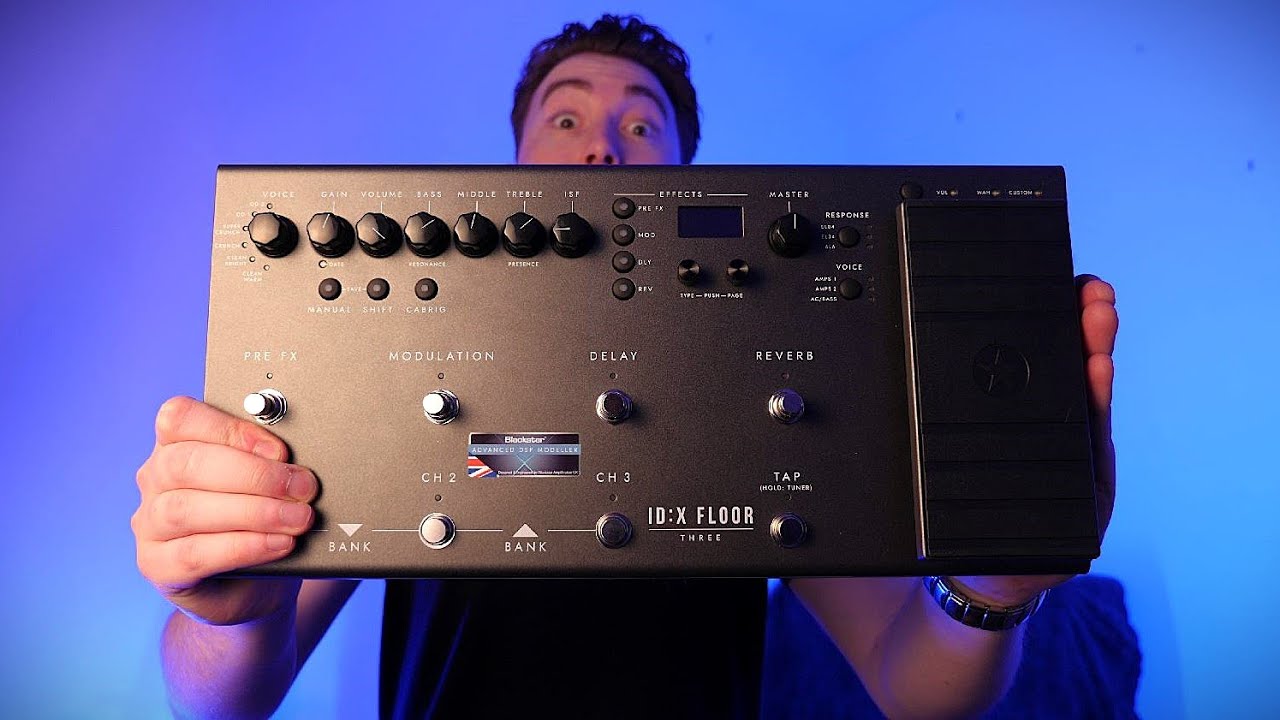
The small One unit features three footswitches as does the Two, which adds a treadle for control of wah, volume or effect parameters. But our focus is the Three here, which ups the flexibility quota by having eight footswitches and adding an effects loop among other features.
The ID:X Floor Three gives you amp and effects modelling with 99 onboard patches to store your sounds. It features 12 guitar amp models, three bass amps, two acoustic voices and an acoustic simulator. In addition, there are 35 onboard effects in various categories.
While the (very) affordable price is a major factor of its appeal, another is that it is gloriously easy to use with a proper hands-on aesthetic: there are some screen parameters to navigate, but there’s no deep diving into the menu, and operation is really intuitive.
Specs

- PRICE: $399 | £279 | €279
- ORIGIN: China
- TYPE: Amp and effects modelling floor pedal
- FEATURES: Buffered bypass, 99 presets, tuner, tap tempo, noise gate, hardware FX loop, 2 in/4 out audio interface
- CONTROLS: Voice switch, Gain, Volume, Bass, Middle, Treble, ISF, Master, 10x buttons, 2x turn/push encoders, footswitches (Channels 1, 2, 3, Tap, Pre FX, Modulation, Delay, Reverb), treadle
- CONNECTIONS: Standard instrument input, Standard Send, Standard Return, Standard ‘To Amp’, XLR Outs (L/Mono, R), TRS stereo line out/phones, 1/8” stereo line in/streaming, MIDI In, MIDI Thru, USB
- POWER: Supplied 9V DC adaptor, 500 mA
- DIMENSIONS: 397 (w) x 195 (d) x 68mm (h)
- RANGE OPTIONS: ID:X Floor One ($269 | £169 | €189), ID:X Floor Two ($319 | £219 | €235)
- CONTACT: Blackstar Amplification
Usability and sounds

Although the treadle is plastic, the ID:X Floor’s bent sheet-steel chassis offers confidence that it’s rugged enough for use underfoot, and has the connectivity to take care of all the common onstage, studio and home tasks.
There’s a single guitar input with a pair of main XLR outputs for connection to a front-of-house mixing desk or PA, plus a single output to connect to an amp or FRFR speaker.
You also get a stereo line output that’ll take headphones for silent practice and, tied in with that, there’s a stereo line input for an external audio source – Bluetooth streaming is not supported.

Send and Return sockets allow you to connect external pedals into the system (with the option of having them pre- or post- the amp modelling), and there’s a pair of MIDI sockets for implementing MIDI control.
A USB-C socket enables connection to a computer to take advantage of the unit’s audio interface capability for recording, along with Blackstar’s Architect software editor and librarian, which offers a quick way to set up sounds with a few mouse clicks, and also gives you access to any firmware updates.

The onboard patches are arranged three to a bank and are instantly recalled with the first three footswitches on the lower row, which are also used for scrolling through the banks by pressing two simultaneously – something that requires a slight angling of the foot. The fourth lower row footswitch offers tap tempo or calls up the tuner. The footswitches in the upper row turn the effects in a patch on and off.
These are arranged in a fixed but logical order with one effect before the amp block, and modulation, delay and reverb effects coming after the amp.
There is a choice of two compressors, auto wah and envelope filter to select before the amp, as well as a comprehensive range of dirt options that includes models of Tube Screamer, Klon, Rat and Big Muff, among others.
The modulation slot offers chorus, flangers, phasers, tremolos, UniVibe and vibrato, while there are five different types each of delay and reverb.

The amps are chosen by a six-way rotary Voice switch allied to a button that selects one of three banks of six. The first bank has signature Blackstar amp sounds including various St James models, and the second bank features the company’s Ampton models, which cover classic tone builders: a Fender Twin, Vox AC30, Marshall ‘Plexi’ and JCM800, Mesa/Boogie Dual Rectifier, and Peavey 5150.
The usual array of controls (Gain, Volume, Bass, Middle, Treble) are available as easily grabbable knobs for the amps, but you also get some extra tonal variation from the ISF knob, which is designed to morph from British to US sound. On top of that you have a selectable choice of modelled output valves – EL84, EL34 and 6L6 for Vox, Marshall and Fender flavour respectively.

Each amp has the CabRig IR-based speaker simulation that offers a selection of cabs with adjustable mic’ing and room options, or ITR (In The Room), which gives you more of a feeling of playing through a real amp in a real space, rather than listening to a mic’d cabinet.
What you get is an effortlessly usable unit that delivers dynamically playable amp sounds
Plenty of options, then, to dial in a range of tones. But it’s worth starting with the factory-programmed patches that have been carefully curated to be usable for common guitar tasks straight out of the box. Alternatively, you could switch to Manual mode where the sounds are purely down to the position of the physical knobs and switches.
What you get is an effortlessly usable unit that delivers dynamically playable amp sounds. The complementary effects are suitable for a wide range of styles, and also give you a passable simulation of acoustic guitar that will fit in nicely with a band mix, as well as alternative acoustic voices if you use an electro-acoustic.
Verdict
Verdict: ★★★★½

The ID:X Floor Three costs just £279. Just think about that – there are plenty of boutique dirt pedals that do one simple task and cost around the same.
There are plenty of boutique dirt pedals that do one simple task and cost around the same
With the Floor Three you get a full amp/cab and effects chain, fully footswitchable. It can be used as your sole onstage item if required or fulfil the at-home roles of being a practice tool and the source of all your recorded guitar sounds when connected to a computer.
Where’s the catch, then? Well, there isn’t one. Okay, you can’t experiment with the effects order and the sounds aren’t quite in the same class as the (much more expensive) Neural and Fractal units, but they are good, eminently playable sounds from clean right through to high-gain.
MusicRadar verdict: All three ID:X Floor units should attract the attention of anyone who wants to get into the world of modelling processors, but this model is the one that is most capable of making the graduation from bedroom to stage.
Hands-on videos
Blackstar Amplification
The Studio Rats
Cameron Cooper
- This article first appeared in Guitarist. Subscribe and save.
