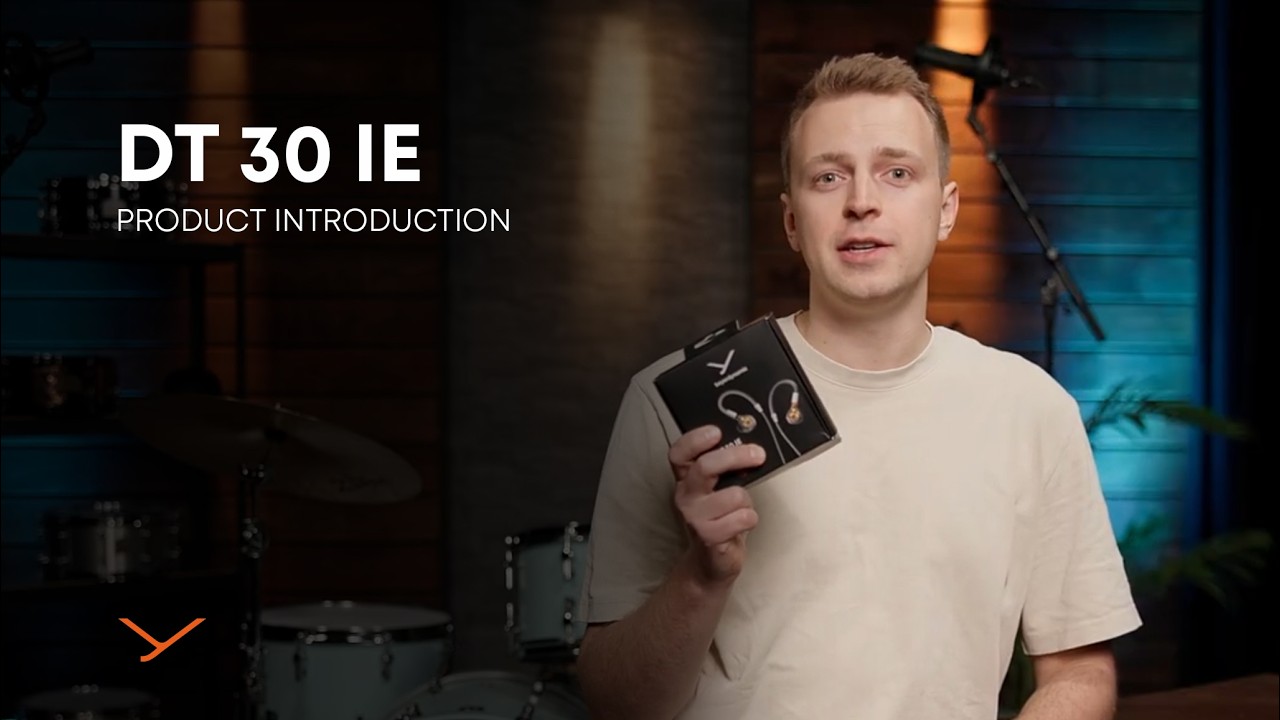
MusicRadar Verdict
The Beyerdynamic DT 30 IEs perform admirably for a set of in-ears at this price point. Yes, you can tell that they are a budget set thanks to the slightly plasticky feel and a sound that could do with a bit more high-end clarity, but they boast a good bass response and a smooth overall tonality. Perfect for someone who is looking to get started with in-ear monitoring, or for a seasoned gigger in the market for a backup.
Reasons to buy
- +
Good low-end response.
- +
Smooth overall audio.
- +
Affordable.
Reasons to avoid
- -
Slight plasticky feel.
- -
Lacks some high-end clarity.
MusicRadar's got your back Our team of expert musicians and producers spends hours testing products to help you choose the best music-making gear for you. Find out more about how we test.
What is it?
Monitoring is often a contentious subject. It gets easier with more gigging experience as we learn to set our gear properly and communicate what we need from our bandmates and sound engineers. The ultimate in control is having an in-ear monitoring set up that allows us to independently tweak our own mix without having to worry about getting in anybody's way.
It’s a different world from that of floor wedges, and one that doesn’t suit all. However, the rise of silent stages, decibel meters and the use of backing tracks have changed how we monitor ourselves, instigating many a headache for musicians, with in-ears often being the most practical solution. Thankfully, getting started with budget in-ear monitors is more affordable than ever.
One such example of a low-cost entry into the world of in-ears is the Beyerdynamic DT 30 IE, which I have in my hands for review, coming in at a very reasonable $150.
To test them thoroughly, I figured I would take them to a real-world gig and see how they do. I’m not about to compromise the show, though, so if they are not up to scratch, they won't make it past soundcheck.
Specs

- Launch price: $150 | £99 | €119
- Type: In-ear monitors
- Origin: China
- Driver: Single 11m dynamic
- Connectivity: MMCX
- Frequency range: 5Hz to 20KHz
- Max SPL: 137dB
- Impedance: 18 Ohms
- Protection class: IP54
- Case: Yes
- Contact: Beyerdynamic
Build quality

Build quality rating: ★★★☆½
A glance at the specification will reveal a single 11mm dynamic driver. For anyone buying their first set of in-ear monitors, you will often see the driver count being pushed as an indicator of quality. The general implication being that more drivers equals better performance.
This is not necessarily true. While having multiple drivers that handle different parts of the frequency spectrum is beneficial in aiding clarity and general performance, this only works if those drivers are well-tuned and well-built.
A single, high-quality, well-tuned driver can outperform six cheaply put-together drivers. Most single-driver IEMs will be utilizing a dynamic driver, and that is what we see here. We’ll get into sounds later, but spoiler alert: this driver does a good job.
In the hands, both the cable and the buds feel a little bit plasticky, which is what I would expect at this price point. The important thing is that it feels solid enough that I’m not worrying about any fragility.

We have a mouldable section of cable at the tips that allows the cable to wrap and stay-put around the ears. It doesn't retain its shape as well as some only slightly more expensive models, but having it at all is still a plus. The cable is removable, and therefore replaceable should it break, and also sports a little bit of rubber strain-protection down by the 1/8” TRS jack, which will help with longevity.
The case is fabric wrapped around a harder interior. It will protect the headphones as they are chucked in and out of a gig bag, but flexes a bit when squeezed and takes a moment to return to its original shape, making it feel a little less than premium.
It is important to remember, however, that we are not paying high-end money. At this price point, the most pressing thing is that the product feels solid enough to last a significant number of gigs. In lieu of a long-term test, first impressions are that the DT 30 IE’s will.
Usability

Usability rating: ★★★★★
Headphones aren’t that complicated. The most annoying thing is getting those tips onto the earbud, but they slide on fairly easily and securely here. Beyerdynamic provides small, medium, and large tips in both silicone and foam form, which is standard and should fit most preferences.
To get the full bass response that the earphones are capable of, it is important to find a snug fit, so it's beneficial to experiment here to see which tip suits you best. Also provided are spare earwax guards, which is something we don’t always see, even in more expensive units.
If you are new to in-ears, Beyerdynamic has you covered with a concise leaflet that explains the process of assembly and maintenance in a beginner-friendly way.
Left and right connections are well indicated in color (red for right) and with the letters L and R on the MMCX connector themselves. This type of connector (in contrast to the two-pin alternative) allows the earpiece to rotate in place, which helps users find that important tight fit while also reducing stress on the cable.
Sounds

Sounds rating: ★★★★☆
As I mentioned earlier, I am testing the DT 30s in the format of a real-world gig, with the caveat that they need to be at least good enough to not compromise my experience of the show. To cut a long story short, I was more than happy to use them for the entire gig.
The low end is well represented, with both the kick drum and bass guitar coming through nicely. Mid frequencies are a similar story, and what results is a smooth sound that is easy to listen to without fatigue.
Where the DT30’s are left behind by my usual Shure 425s is in high-end clarity. This is important in gaining proper separation of instruments in a dense mix, and the DT30’s smooth nature means that things can get a little bit muddy in comparison.
However, I am speaking relatively here. The level of mud is far from problematic, as I am able to adjust my mix to compensate. You might struggle if you are in a big band with lots of instruments, but in a four-piece as I was, this is an issue that is easy to deal with after some proper mixing.
Pro tip: stereo mixes are a little more involved to set up, but totally worth it to facilitate panning in these circumstances. Some musicians don’t like to pan things in their in-ears; if this is you, it might be worth investing in something with a little more clarity.
It’s worth remembering that the aforementioned Shure 425s are, while relatively humble in the world of in-ears, twice the price of the DT30s. At this sort of budget, the DT30’s are hard to beat.
Verdict

While it is apparent that we are looking at an entry-level model here, the Beyerdynamic DT30 IE’s do a great job. They feel like they will last, are easy to use, and sound surprisingly good for a budget set of earphones.
They sound surprisingly good for a budget set of earphones
While I would have preferred more clarity, when I was testing them, I was able to forget that they were not my usual set of in-ears and just enjoy the gig. So, if you are looking for your first set of in-ears, or a decent backup for a pro-level set, these are a good choice.
Music Radar verdict: The Beyerdynamic DT 30 IE’s perform admirably for a set of in-ears at this price point. Yes, you can tell that they are a budget set thanks to the slightly plasticky feel and a sound that could do with a bit more high-end clarity, but they boast a good bass response and a smooth overall tonality. They are perfect for someone who is looking to get started with in-ear monitoring, or for a seasoned gigger in the market for a backup.
Test |
Results |
Score |
|---|---|---|
Build quality |
While the plastic feel gives away the budget credentials, they also give the impression that they will last. |
★★★☆½ |
Usability |
A simple set of headphones that, as a result, are equally as simple to use. |
★★★★★ |
Sounds |
A good bass response and a smooth tone that can be listened too all day, but lacking some high end clarity. |
★★★★☆ |
Overall |
A decent set of entry level in ears that are hard to fault at this price. |
★★★★☆ |
Also try

Hands-on videos
Beyerdynamic