


At the end of 1974 Glen Campbell’s career was on the slide. He hadn’t had a hit single for years. The movie offers had dried up. His network TV show The Glen Campbell Goodtime Hour had been cancelled in 1972 and even a reunion album with Jimmy Webb, the songwriter who had provided him with Wichita Lineman and By The Time I Get To Phoenix, hadn’t reversed this decline – it could only reach an embarassing 166 on the Billboard charts.
He was now in his late 30s and it looked as though the best years of his career were behind him.
Larry Weiss also had cause to worry that he’d passed his peak. In the 1960s he’d written Bend Me Shape Me, which had been a hit for The American Breed and Amen Corner. He’d also penned Hi Ho Silver Lining, which had been a hit for Jeff Beck. Both were now years in the rear view mirror.
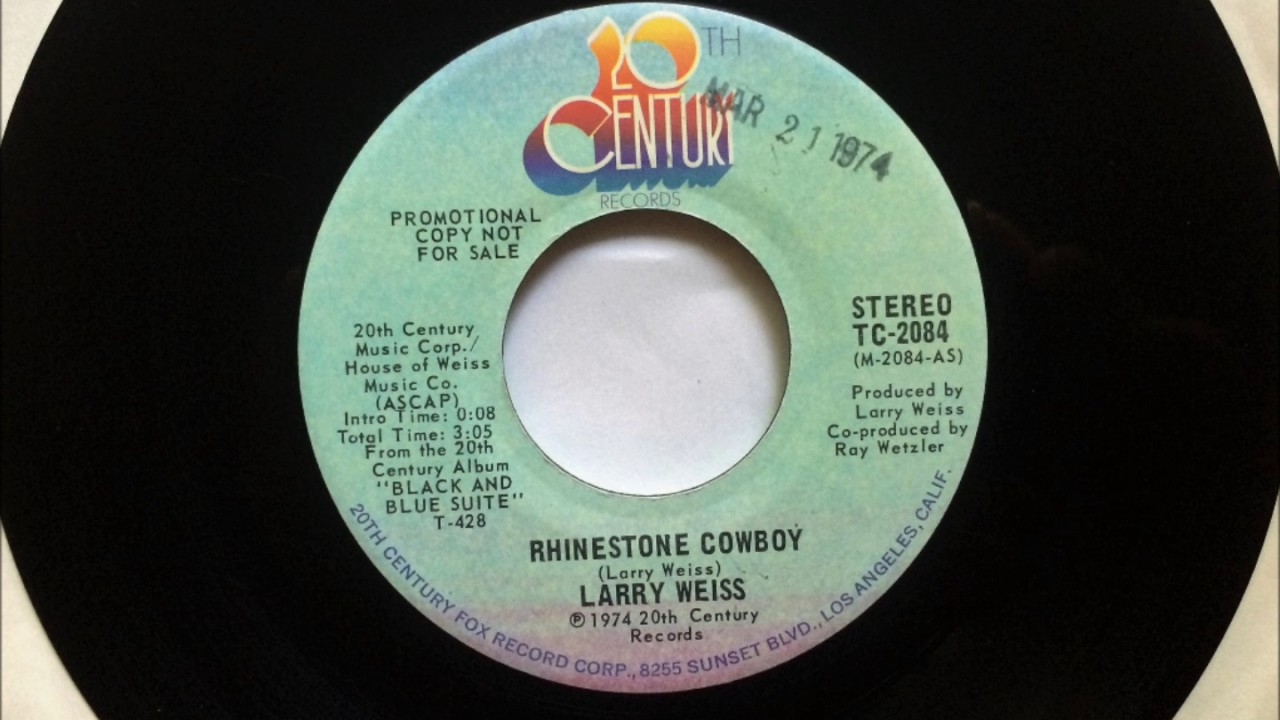
He’d tried to launch himself as an artist with his 1974 album Black And Blue Suite, but it hadn’t been a success. Weiss was seriously considering quitting music and opening a furniture store.
The lead single from the album was a quasi-autobiographical song called Rhinestone Cowboy. The lyrics tell the story of a character who is down on his luck and refuses to be beaten down by fate or the elements.
The verses depict this person’s struggle – the hours spent walking in vain, the compromising that is so often essential in order to get to your destination, whilst the chorus is one great crescendo as Weiss describes their dream: to be the star attraction, a cowboy in a ‘star-spangled rodeo’.
Speaking to the Guardian in 2013, he remembered how he came up with the image. “I had heard the phrase ‘rhinestone cowboy’ somewhere, and it stuck. When I moved to Nashville 20 years ago, I finally found out that it meant rhinestone-studded country singers of the 50s and 60s. But I gave it my own spin.
“When I was a kid, I'd loved cowboy movies: Roy Rogers, Gene Autry and Hop-Along Cassidy. To me, the singing cowboys were the rhinestone cowboys.”
Weiss was also probably thinking about a singer called David Allan Coe. This country artist – who died earlier this year – had adopted a gimmick early on in his career.
Performing at the Grand Ol’ Opry, he’d wear glistening rhinestone suits that at a distance gave the impression that his stagewear was more expensive than it actually was, and thus he was a star.
Coe would even sign autographs as ‘The Mysterious Rhinestone Cowboy’, a phrase he used as the title of his album, which was released in June 1974.
Still, Weiss was undoubtedly thinking too of his own situation. "The idea for the song was also a crying out of myself,” he told American Songwriter in 1984. “It was the spirit of a bunch of us on Broadway where I started out - Neil Diamond, Tony Orlando - we all had dreams of making it."
The imagery for the chorus was directly inspired by the 1944 western Buffalo Bill. “In the last scene, he rides out on a white horse, in a white outfit, with long white beard and hair, and he thanks everybody for giving him such a great life.
“There's another scene where he's at his lowest point, sat on a stuffed horse in a penny arcade holding his hat in the air.”
The song was released as a single in August 1974, but could only reach Number 24 in Billboard’s Adult Contemporary chart. But despite this Weiss was convinced of its potential.
He offered it to Elvis Presley, who turned it down. He even gave David Allan Coe the chance to sing his own theme song. “I thought it was a great song,” Coe said in a 2004 interview with The Review magazine, “but I thought it would be too egotistical to record since I was calling myself the Rhinestone Cowboy at the time.
However, it did reach the ears of Glen Campbell. The singer had heard it on the radio whilst out driving one day and was so moved by it, he had to pull over to the side of the road.
As it happened, Campbell’s record label, Capitol, was already one step ahead. Dennis Lambert was brought in to A&R for the singer.
In a 2013 Guardian interview, he remembered the sequence of events that led to the singer recording the song. “Glen was a product of the LA recording system and understood what went into making hit records.
“We'd been talking about his feelings, writing and bringing him songs, when Larry Weiss came to play me some tracks from his recent album. One of them was Rhinestone Cowboy.”
“I said, ‘Larry, this is amazing,’ and my mind was racing, because I was already thinking about Glen. Larry wasn't that excited to hear that we were going to be producing Glen, I think because he was more concerned about his own album, but he gave me permission to play him the song.
“At the same time, (Capitol Vice President) Al Courey had somehow got a copy. A whirlwind happened within the space of a few days.”
Campbell said he loved the song and so he and Lambert went down to Sound Labs in Hollywood to record it in February 1975.
“We didn't copy Larry’s version, but took the essence of it, which was right on the money,” remembers Lambert. “Why fix something that isn't broken?”
The producer convinced the singer to play acoustic guitar on the track. “His (Campbell’s) pitch is impeccable; he's got the soul of a true musician.
“He doesn't read music, but he is a virtuoso guitarist, and it transfers to his voice. In the studio, he didn't wear headsets: he liked a little speaker instead.
“When he started singing, he'd drown out the track, and that's how he was able to finesse his vocal. He'd give you one or two great takes, and you knew you had it.
“For Rhinestone, I made him play guitar because I knew the other musicians [one of whom was future Toto man David Paich on piano] would be excited to be sitting there playing with Glen Campbell.”

The single was released in May 1975 and instantly rebooted Campbell’s career. It gradually rose up the Billboard charts and reached the top in September that year.
Indeed, it pulled off the feat of topping both the Billboard country charts and the Hot 100 simultaneously, which hadn’t been done for 14 years.
It also hit big all over Europe – reaching Number Four in the UK and going Top Ten in Belgium, The Netherlands and Ireland. It would become the second most played song on American radio that year, second only to Captain and Tennille’s Love Will Keep Us Together.
Why did it hit so big? Well those lyrics are something so many of us can relate to, but in Campbell they found their supreme interpreter.
His background, of growing up poor in rural Arkansas – his family were, literally, cotton-pickers and there was no electricity in the house – meant he was able to deliver them sincerely and with authenticity.
“He understood it as a metaphor for anyone trying to make it,” Lambert said in 2013. “He'd expressed disappointment with the way life was unfolding for him.
“He was recently divorced, estranged from his family, drinking, and involved with drugs a little too much – and yet he was this beautiful soul who we got to know and really love.
“That song became his signature tune. When you can make that happen, it's very powerful.”
Over the years, there have been numerous covers. You’d expect country artists to have tried their hands at it – Charley Pride, Slim Whitman and Loretta Lynn all recorded their own versions - but Rhinestone Cowboy has such a universal message, it’s garnered covers from the unlikeliest of places.
It was a feature of Radiohead’s early live sets, and it’s also cropped up in Belle and Sebastian’s setlists too. David Hasselhoff recorded a faithful version on his Sings America album.
There have been versions in French, Danish and Flemish and the song has not been immune to the Europop treatment either - in 2002, a terrible dance version reached Number 12 in the UK charts credited to Rikki and Daz featuring Glen Campbell. Campbell even appeared in the video.
But as a song, Rhinestone Cowboy is sturdy enough to withstand any such indignities. One of Campbell’s last public performances of it was surely the most poignant.
The singer had already been diagnosed with Alzheimer’s when he appeared at his own tribute section at the 2012 Grammys and brought the house down.
“My only regret is not going to there, for its tribute to Glen,” remembered Weiss in 2013. “I watched it, of course.
“When Glen walked out singing in a rhinestone outfit designed by my dear friend Manuel Cuevas (who created the outfit for the song's original video), the place just blew up.
“I suddenly realised: ‘My God, I've written an American anthem.’"
