

It’s one of the most famous synth sounds in dance music history, but it turns out that the person who created it didn’t even know it was his – until he was asked to make it again.
We’re talking about the so-called Hoover sound, which was popularised by European dance music producers in the early ‘90s. It was created, unknowingly, by Eric Persing, now the creative director at Spectrasonics. However, between 1984 and 2004, he was also the Chief Sound Designer at Roland.
In a lengthy interview with Anthony Marinelli, Persing explains that the Hoover sound name only came onto his radar when he was working on the Roland JP-8000, which would end up being released in 1996.
“When we got to the JP-8000, some of the European distributors, they were worried that the taste [in sounds] had become too American,” says Persing. “And so the Japanese, because the dance music thing was so big, they were saying, ‘We really need a European sound.’ And so I'm like, as a session guy, just tell me what you want, because I work with all different kinds of people, I can go where you want. What kind of sounds do they want, what are they looking for? And they said, ‘They want Hoovers. And so I'm like, ‘What's a Hoover?’ They said, ‘We don't know, but everyone wants a Hoover.’”
Confused, Persing started doing some research on the then nascent internet. “I found somebody had made a site about the Hoover,” he remembers. “I'm like, great. I'll research it. I'll figure out how to do it. You know, bring that colour to the thing, then I'll prove that we can do that too. And so I was really looking at it as a challenge.”
Persing, though, was about to make a remarkable discovery: “I see this website, and it's like, OK, what is the source, and all these records that it's on? And the source is an Alpha Juno synth! It's like, I made the sounds for that! I was the guy who made the Hoover! It was already done!”

Indeed it was. In fact, Persing had done the job a decade beforehand – the Roland Alpha Juno was released in 1985 – but the patch that he made back wasn’t called the Hoover. In fact, it wasn’t even intended to be a serious piece of sound design.
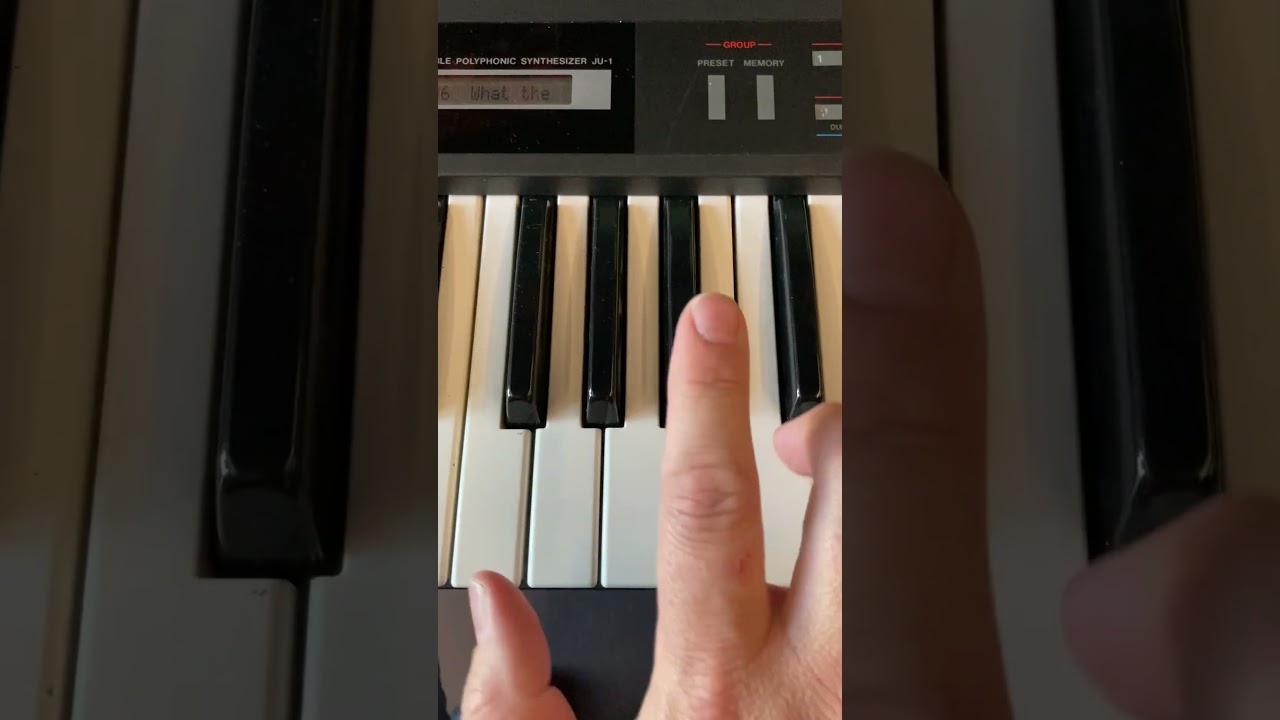
“It was a joke sound that I made for the engineers at the end of the list that,” says Persing. “I didn't know what to call it so I just called it ‘What the’. Like, what is that?”
As has often happened in synth history, though, this throwaway preset took on a life of its own.
“The British people heard that, and people started sampling it, and all these drum and bass guys started using it,” says Persing. “They called it Hoover because that's what they call vacuum cleaners in the UK, and it sounded to them like turning a vacuum on and off.”
He’s correct, and with the help of its SuperSaw waveform, Persing also designed some legendary dance music sounds for the JP-8000. The Hoover sound remains an enduring favourite, though, and can be recreated in any number of soft synths.
AudioRealism’s ReDominator is one such instrument – hardly surprising given that it closely resembles the Alpha Juno. Discussing the Hoover sound in 2019, its creator, Mike Janney, told us: “Any plugin synth that has a multi-stage envelope should be able to do the job. NI’s Massive is one example, but keep in mind that the Alpha Juno envelope is unusual in that it has linear and exponential sections.
“Also, the PWM Saw [the Alpha Juno’s unusual shape-modulatable sawtooth oscillator] is pretty special - I’m not sure if any off-the-shelf synths have this feature.”