


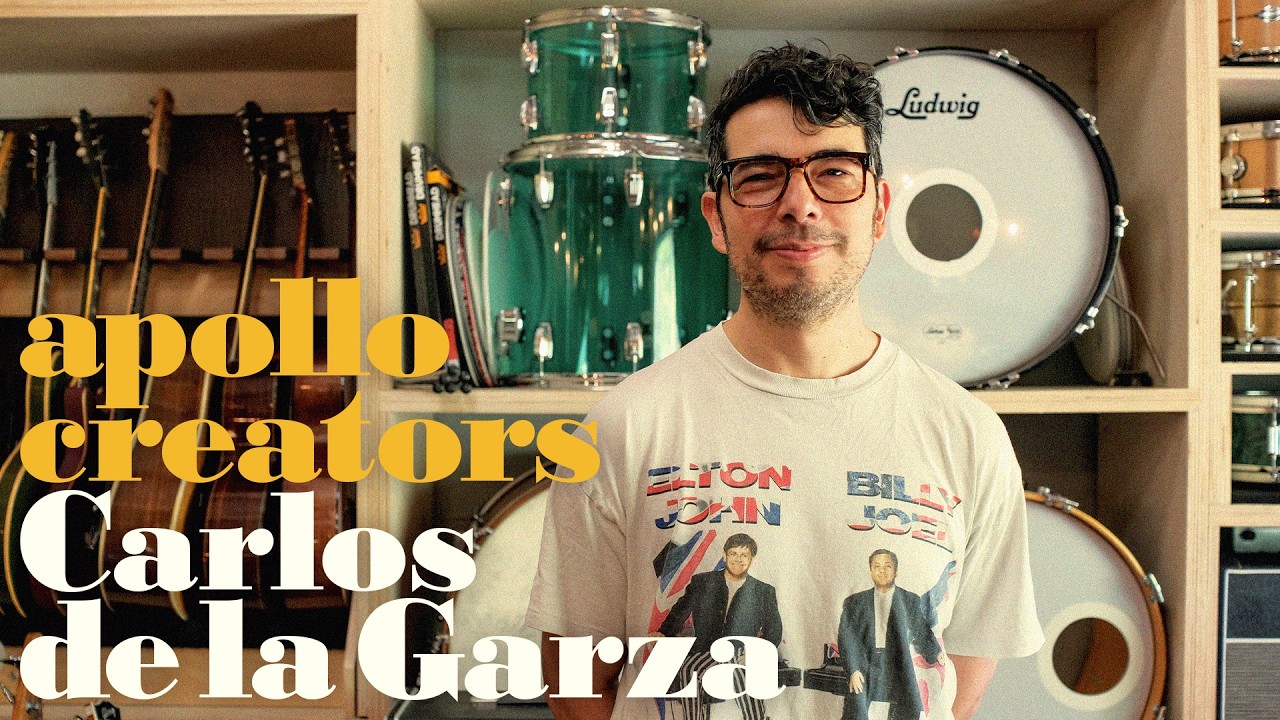
Based in Los Angeles, multi-platinum producer, mixer, engineer and songwriter Carlos de la Garza started his musical life behind a drum kit, cutting his teeth in Southern California’s DIY punk scene.
Raised in Cerritos, he dove headfirst into music as a teenager, playing in high school bands before joining punk outfit F.Y.P. and later hitting the road with ska favourites Reel Big Fish.
Those early years weren’t just about performing, though: de la Garza quietly harboured a broader ambition to build his own recording studio. That vision began to take shape in the mid-2000s at Capitol Records, where he honed his engineering skills before going it alone as a producer, subsequently collaborating with the likes of Paramore, Ziggy Marley, M83, Wolf Alice, and Young the Giant.
Despite reaching Grammy-winning success, de la Garza continues to push for a deeper impact on the industry. Drawing inspiration from trailblazers like Quincy Jones, he expanded his creative scope in 2024 by signing as a songwriter to Warner Chappell Publishing.
Today, he fluidly moves between producing, mixing, engineering and co-writing, with recent projects including indie-rock favourites Death Cab for Cutie and punk prodigies The Linda Lindas, a group featuring two of his own daughters, Lucia and Mila.
Following the publication of Universal Audio's Apollo Creators episode with Carlos de la Garza, a documentary that offers viewers an insight into his creative process, we sat down with the multi-hyphenate maestro to hear more about his diverse career, his go-to gear, and his work on the new Death Cab For Cutie project.
Like many who begin working in a recording studio, you began life as a runner for Capitol Records. How long was it before you could finally get your hands on a mixing desk?
“Luckily for me, Capitol had full-time janitorial staff, so I never had to clean toilets or take the trash out, but I definitely had my fair share of making coffee and fruit baskets and all the wonderful things that go along with being in an entry-level position at a studio like that. I got in at a time when Pro Tools was definitely becoming more standardised, but a lot of people were still tracking drums and bass on tape so it wasn't as ubiquitous as it is now.
“Luckily, my first break was one of those moments where opportunity meets preparedness and I was able to edit a session to prove that I could do the job. From then on, my studio manager, Paula Salvatore, started calling on me to do more sessions as an engineer. The Capitol experience was fantastic. I learned so much and was able to observe the greatest of the great producers and mix engineers, absorb it all and cherry-pick things that I thought would help form my own vision about the best way to record.”
What sort of projects were you working on independently?
“At first, I wasn't working on too many records of consequence - it was friends’ bands and a lot of random things. I’m grateful that a lot of that never saw the light of day. We all have musical skeletons in our closet, but that was the time to learn and make mistakes. Like anything in this world, you get good by practising over and over and putting in your 10,000 hours.”
What sparked your interest in learning how records are mixed or engineered?
“There are two types of people – those who are cut out for touring and those who aren’t, and I was one of the latter. Reel Big Fish was an amazing opportunity, the band were friends of mine and it paid good money, but I never really connected with the music and knew that I wanted to move on to something else. Production seemed unrealistic until I got my foot in the door at Capitol, but as soon as I had that job lined up I left the band and focused on the studio world.
“I’ve always had a genuine affection for record-making and a passion for understanding how things worked. I also think that drums are the most difficult instrument to record because, generally speaking, the mic placement is so particular. No-one in a band hears drums like a drummer does, so we have a leg up when it comes to recording. Some of my favourite producers, engineers and mixers were drummers, including Al Smith who was working at Capitol at the time.”

Did setting up a recording studio still make sense at a time when people no longer needed a £200,000 mixing desk?
“It's funny because I’d bought these pristine Studer A27 and Ampex ATR-102 tape recorders in 2006 and they just sat in the corner because nobody wanted to use them or pay for tape. Now, tape’s back in vogue, but I still think those machines are probably too clean for what most people are looking for because when they hear the word ‘tape’ they want something that's very gritty and maybe even slightly lo-fi.
“But I think you're right that the advent of digital recording and the availability of plugin emulations that are so incredible means that you can essentially have a studio in a box. A Universal Audio Apollo x8p has eight ins and outs, a headphone amp, monitoring, mic preamps, and plugins, which is like a one-stop shop for everything you need to make a record.”
When you started engineering for Paramore they'd already topped the charts in several countries with Brand New Eyes. Your association seems to have endured?
“It was a huge step up, but I went into a unique situation. The band were in a little bit of flux because they’d lost their primary co-writer Josh Farro, and Taylor York was writing songs with Hayley Williams for the first time and they were working with producer Justin Meldal-Johnsen for the first time too.
“They’d also lost their drummer, so we brought in Ilan Rubin, who’s now in Foo Fighters, but we had a mix of all these people who had never really worked together. I look back fondly on making that record and how it all went down; it really paved the road for a lot of future collaborations between us and a lot of success.”
On subsequent Paramore LPs, you heavily relied on the AMS Neve RMX16 NonLin reverb. Was that an early example of a plugin replacing a role that would traditionally be taken by quality outboard?
“It's tricky, because I think there are times when plugins are the right thing and hardware is the right thing. The frustrating, but also beautiful, thing about vintage gear is that there's so much variation from unit to unit. Universal Audio has faithfully recreated some amazing stuff, but I have a vintage 175 tube compressor and a Blue Stripe at home and they don't really sound like the Universal Audio ones. That doesn't mean that they sound better or worse - they're just different.”
So it’s horses for courses?
“I use both, but the great thing about the UA stuff is their speed and efficiency. Recall has always been the problem with hardware, so my first instinct is to print through the hardware and commit to a sound. Ultimately, I'm a big fan of committing because that’s how great-sounding records have always been made and I think that's how you create a sonic imprint or vibe on a record.
“It's about having the vision and the confidence to say, this is it, let's record it and move on, and hardware definitely plays a role in helping to achieve that. The plugins are great for when you're mixing or quickly jamming through a songwriting session. I really like the new Universal Audio Paradise Guitar Studio plugin - that thing’s pretty incredible for getting great guitar sounds really easily.”

What’s your strategy for committing to sounds when working with punk or rock bands?
“The first ideas are often the best, and sometimes artists try to second guess or beat a part they did and end up going down a rabbit hole of uncertainty. I try to avoid that and generally believe that the inspiration or genesis of an idea comes within the first few takes - then you should have a limited amount of takes to figure out the best way to execute by subtly changing some nuance about the sound or performance.
“By take three, the performance locks in and takes four, five and six are generally the best ones before things begin to start going downhill. One of the interesting things about production is that it's not a one-size-fits-all approach. You have to tailor it to every artist and situation because they all have different strengths and weaknesses, and being able to identify those and adjust accordingly is part of what makes a great producer.”
Is that something you learned early on, or did it evolve over your 10,000 hours of practice?
“One of the things I learned at Capitol from watching so many different producers and engineers is how they adjust to every type of situation. Take, for example, live band tracking. Some producers really love doing that because they feel it brings a performance aspect to things and there's something magical that happens when people are all in a room reacting against each other.
“I also believe there's some truth to that, but it doesn't work for every band. Some bands operate better if you multitrack, focus on one thing at a time and build with overdubs, so being flexible and able to adjust to whatever makes sense for every situation is critical for success.”
In 2016 you mix engineered Ziggy Marley's self-titled album and he interviewed candidates for specific roles. Is that typical?
“There was a little bit of a mix shootout for that and it's become more common in the last 5-10 years to have anywhere from three to five candidates be a good fit for a record with each person mixing a song. Fortunately, I won the mix for that, the self-titled Paramore record and the one I just did for Death Cab for Cutie.
“So these things are a little more common, especially when records have budgets. Nobody likes to work for free, so the label will pay for, say, three to five mixes even though they’ll only use one. In the case of the Ziggy record, it worked out fantastic because I threw my name in the hat and we ended up winning a Grammy.”
In recent years, you seem to be doing less engineering and throwing yourself more into mixing, production and co-writing. Have you outgrown engineering in favour of more creative roles?
“You're exactly right. I hate to generalise, but in terms of creative input, engineering is probably at the bottom of the totem pole. With mixing, you have a little bit more creative freedom, there’s much more with production and writing is the ultimate expression. That’s the transition I’m going through and that path has been very intentional.
“I see mixing as an extension of production, but songwriting is the newest frontier and I'm trying to set my sights higher each and every time. It's funny how the initial goal was simply to have a job at a studio like Capitol Records - even as a runner, and here I am 20 years later and those goals have very much changed.”
You've co-written with bands like Destroy Boys and Cold War Kids. In those cases, we’re guessing your input starts at the conception point and is a little more pressurised?
“Everyone's trying to make something great, but sometimes you feel the pressure to write a hit or even just include a song on the record out of the 50 demos being thrown around. As a producer or engineer, you're taking a song or idea and moving it around or shaping it, but creating something from zero is the final frontier.
“As I get older I want to create something lasting that has weight and become as much a part of that process as possible. The gold standard for a producer is to write, produce, mix and engineer a song, and throughout the history of recorded music, the people doing that were multifaceted giants like Quincy Jones. That's what I'm trying to hold myself to, but even if you're flying just below Quincy you're doing pretty good, right?”
Lately, what technologies have you found replacing others in the studio - maybe unexpectedly?
“My approach to gear is to cherry-pick the best of vintage and whatever’s new and put it together in a delicious stew. Right now, I’m using a Rupert Neve 5088 console, which is a gamechanger. It's a newer addition to my setup, but I haven't been mixing on it - I just want to do a lot more guitar and drum tracking at my studio. I knew I was going to like the preamps and EQ on it, because I've had a Shelford Channel and always liked that.
“The other added benefit is that I'm trying to use hardware inserts in my setup. One of the things I see happening in pro audio right now is that everyone's using the same plugins and virtual instruments. Some plugin companies are starting to do really unique things outside of the box, but if you can get your stuff sounding unique, by any margin, while still being very professional it’s going to give you an edge.
“My UA X16 has been another phenomenal upgrade for me because the processing power and sound quality are a no-brainer. I come from using Avid HD I/Os, which were great for their time, but it's a big difference in quality and you’re getting the added benefit of the plugin processing power.”

We understand that you’ve also upgraded your speakers?
“My monitoring has been upgraded to ATC 100s with dual subs (also ATCs), and I have room correction, which is really integral to my setup. It was a big decision because the setup I have now cost close to $40,000. The decision was two-fold. First, I’ve probably had close to 15 different brands of speakers in and out of my studio and although I really got to know which ones were working for me, I wanted to finally get the be-all-and-end-all speaker if price wasn't a factor.
“The other thing is that I'm working with artists every day and you have to have something that sounds impressive in the room - something that makes them feel confident and comfortable about making sonic decisions that are not only accurate, but sound big, fun, exciting and inspiring. That's a tricky balance because oftentimes what’s accurate is the cold, harsh reality, which is not always inspiring, but I think I've hit a sweet spot with the ATCs and I'm not looking around anymore.”
These days, what tends to inform your decision regarding who to work with and why?
“The first question I ask artists is: ‘What’s your vision for the record?’ That doesn't mean it has to be a concept record, although it's cool if it is, but I love it when bands say we did this on our previous record, but now we want to create a slightly different version. I have to feel we’re aligned, while also feeling I can contribute and help.
“The producer’s role is basically to help focus the artist’s vision and help them, logistically or creatively, to amplify and fully realise that and reach the finish line. I'm operating in a certain sphere of genres, like alternative, indie or punk, and feel comfortable working on something that is pop-adjacent, so it’s about integrating what they do into my world. The Ziggy record was a great example of that, because he wanted an outsider's approach to making a reggae record.”
Are there any specific artists that you'd love to work with regardless of the vision?
“Hayley from Paramore is always fantastic to work with, but one of my favourite bands of all time is the Yeah Yeah Yeahs and I'd love to work with The Strokes, even though those are not younger bands per se. I think that Ecca Vandal is also doing some really interesting things and there’s a really cool band called Julie signed to Atlantic Records. There are also some icons I'd love to work with, like Tame Impala or Radiohead, but I don't ever see that happening.”
You mentioned working with Death Cab for Cutie, although it’s John Congleton in the producer’s chair?
“I'm friendly with John and he's a great producer. It was a case of the band wanting to have a different take on things, so I came in to take notes and mix the album. It’s had its challenging moments, but Death Cab for Cutie is another one of those bucket-list bands because I was such a huge fan of the handful of records they first put out.
“To be able to work with and mix one of their records is definitely one of those full-circle moments and I’ve been very lucky to have a few of those in my career. When I hear Ben Gibbard’s voice on a song that I'm mixing, he already sounds great, but carving it up and trying to make it feel otherworldly is such a rewarding experience.”
You mentioned challenging moments. What represents a challenge at this point in your career?
“All records have mixes that you nail on the first or second pass, but there are always a few songs where the vision isn't quite aligned and that require multiple passes to get to the finish line. Those are the challenging moments I'm talking about, because people don’t always hear things the same way.
“With Death Cab for Cutie, there were a couple of mixes that took longer because they really loved the rough version. It was a challenge trying to get them back to that point, but that happens on pretty much every record. Cracking that code is part of what makes this job so interesting and fun, but I'm really just trying to serve their artistic vision.”
Visit Carlos de la Garza’s website or check out Universal Audio’s Apollo Creators series.