London-based, Wrexham-born artist and producer Polly Mackey began her musical career as frontwoman for shoegaze five-piece Deaf Club before founding the solo project Art School Girlfriend.
Recontextualizing Deaf Club’s atmospheric influences and introspective lyricism within self-produced, organic electronica, Mackey has steadily refined a singular brand of emotionally charged, synth-driven dream-pop that’s evolved in both tone and texture over the course of three full-length projects.
Mackey’s third and most recent album, Lean In, finds her looking even further inwards to unpick existential themes of grief, love, joy and anxiety through reflective, reverb-drenched songs that bring together the two sides of her musical practice - DAW-crafted electronics and live instrumental recording – in a hybrid sound that showcases the best of both worlds.
We visited Mackey in the studio to find out more about the making of Lean In and shoot a track breakdown of new single The Peaks, and she was kind enough to share the stems for that song with our readers. If you'd like to try your hand at producing your own remix of Art School Girlfriend's The Peaks, click here to download the stems.
Take us back to when you very first started making music. What kind of set-up were you working with, and how did you learn?
“I started playing drums when I was nine and started the guitar when I was about 10. I was a skater, and this was 2002 and I was very into nu-metal. Me and my friend would just play in my room, Slipknot covers and Nirvana covers. Then when I was a teenager I started becoming more of a singer-songwriter, and played my first gig when I was 16 in a local pub.
“I was self-producing in my room, and actually what I feel like is having this studio the last few years, I’ve got back to that idea of just messing around with sounds. Before I had a laptop I used to have this little Roland digital four-track, which was an absolute nightmare to use, but that was the start of me getting into production and arranging songs myself, rather than just having it on one instrument. I’ve essentially come full circle of being a bedroom producer, moving into studios, and now I’ve kind of upgraded into whatever this is.”
Moving forward a bit, tell us about the background to Lean In. Where were you at creatively following the release of your previous album, Soft Landing, and how did that lead up to this project?
“My last album was very much about the idea of people playing instruments in a room in a physical space. It was recorded at Church Studios and I co-produced it with my friend Riley MacIntyre, who is an amazing person to bounce off. Every time you make an album it’s a reaction to the last thing you’ve made, and it also came at a time in my life where I was feeling quite existential and reflective and a bit more philosophical.
“My previous album was all about joy, and being outside, and nature and loved ones, but this project was very much about my emotional interior, and what I was thinking about. I felt that it needed to be a really personal approach to the creation and production, so I essentially was like, I'm going to fully produce and engineer and record this on my own in this room. It was about going down a lot of the sonic routes, but also emotional routes that I don't think I would have been able to do with another person in the room.”
Tell us a bit about this studio space. I know you used to work in a home studio, when did you make the transition?
“I went from bedroom production to what I called living room production; in the corner of my living room we had a big desk, and my wife's a musician as well, so we kind of shared that a little bit, but it was just getting too much. We had too much equipment to store. Before that, I was really fortunate to be able to get access to Church Studios when I started Art School Girlfriend ten years ago, because I was signed to Paul Epworth’s label that was based out of there.

“So I've always needed a place to go to feel like I can make noise, and we've had this place for three years now. My wife and I share it with another musician called Cam Khan. It's just this idea of having a place to go that you can make noise that no one else can hear, and it's just full of stuff that's always plugged in.
“That's the main thing, that when you're chasing an idea, it obviously all happens really quickly, and I don’t want to be spending time unplugging and plugging stuff in. Whereas we’ve essentially spent three years getting this place to be super streamlined, and also it’s a place to collaborate, having friends in and having other artists in. I want to start producing for other people a lot more, and having a space to do that is also really important.”
Could you talk us through one or two pieces of equipment that were really important to the making of the new project?
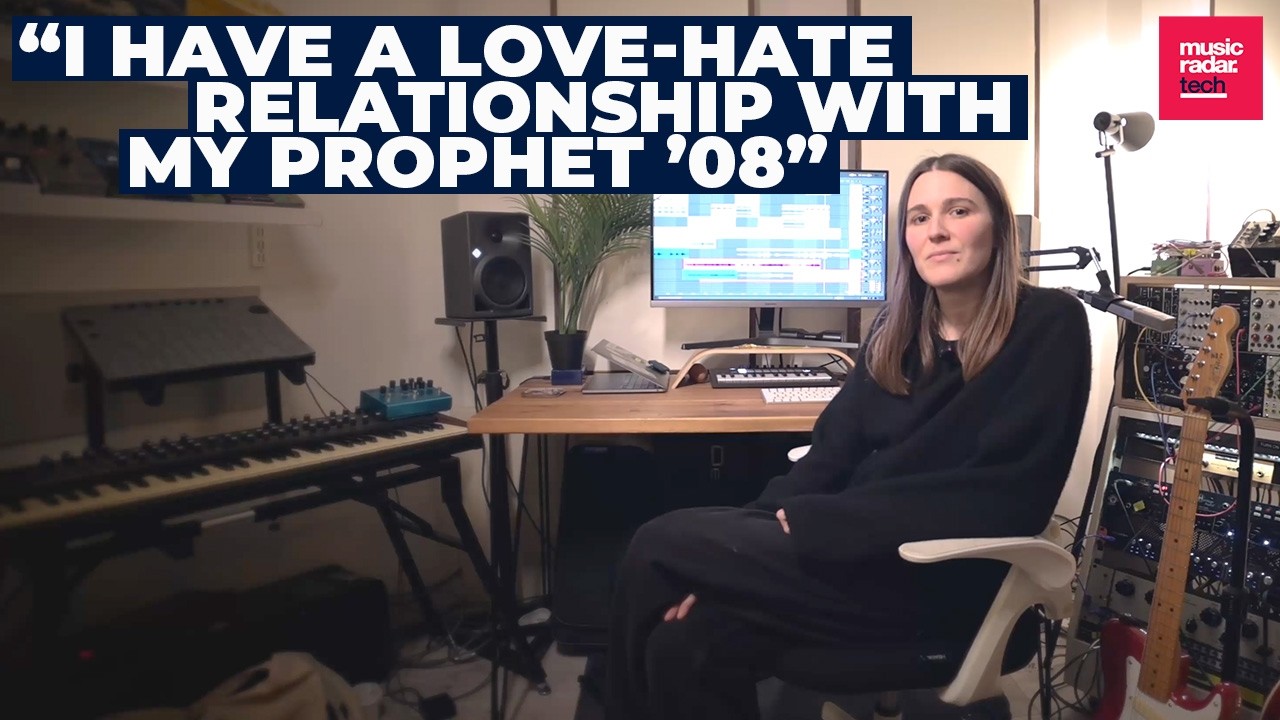
“My Prophet ‘08. I have a little bit of a love-hate relationship with it. I love synthesis, but I find it a little bit annoying in terms of its nerdy potentiometer stuff that doesn't quite work all the time. But the sounds that come out of it, they're all over this record. They’re these really sad, dusty, ambient synth sounds from this one bank called Prophecy in it, which is amazing.
“From a technical point of view, because I always have a lot of synths and things plugged in, this DI box was amazing for having all of my synths plugged in. This dial along the top, you just pick which synth you want to have at that time, and then that's just hardwired into my interface. So that was a huge thing, because I would always get really annoyed about having synths going through a patch bay; it just made me feel a bit uncomfortable.”

How does a track typically start for you? Is it different every time?
“One of the ways that I mostly start making a song, because I produce and write at the same time, is just hearing a cool sound. Flicking through presets is really cool for that. You can be playing a chord over and over and then something just clicks. But I’ve got no patience, when I'm in the middle of the process and I can think of a certain sound, to be flicking through presets at all. So I'll dial something in – the Minilogue is really cool for that, or Serum, for example.
“I've used Serum a lot for the kind of stuff that needed a heavy low-end or something. Then Roland SE-02 bass synth as well, just for sculpting out those sounds. And actually, drum synthesis was something that I did a lot on this album. The Behringer Edge is essentially a cheap version of the Moog Drummer From Another Mother, and a lot of the hi-hats that I've got on this album are just sequenced white noise oscillators that are changing throughout.”
Are songwriting and production two distinct processes for you, or just two sides of the same coin?
“They are now. They used to be two distinct processes when I was younger, when I would just sit in my room playing on my guitar, and then take it to a band, and we'd figure out how to arrange it, or then I'd transfer it into Logic or something. Whereas now they are just so embedded together, but I try to keep one eye on the idea of not just relying on sounds too much.
I spend too long trying to make something sound cool, and actually, there's not really a song underneath
“Sometimes, and I definitely go through this sometimes, the production side of my brain takes over and I spend too long trying to make something sound cool, and actually, there's not really a song underneath. So I'm still very much coming from a songwriter's point of view, when it comes to the question of ‘is this a good enough song, rather than just something that sounds cool?’”
You work with a lot of electronic sounds and textures but there’s a really organic feeling and a sense of humanity to your productions. How do you achieve that in the studio?
“It doesn’t sound that profound, but a lot of it is just playing the synths. Sometimes I'll try and do it for the full length of the song, so I'm actually responding to the dynamics of the track instead of just copying and pasting. I think a lot of people get too enamored with the idea of perfecting the MIDI then sending it to the synth, whereas just playing it like an instrument, weirdly, is quite an important thing. And actually not worrying too much about timing – there are so many times I've hit a wrong note that stayed in the track.
“I also do a lot of sampling of organic instruments, so I'll often sample my guitar, or sample piano and textures, and I use field recordings as well, which I feel like is a way to capture a memory and put it in a song. So I use a lot of field recordings I use as well. Then also, things like noise oscillators just have this inherent noise floor in them, and this idea of texture, and re-amping in rooms. Microphone choice as well. Everything feels quite a small decision, but when you pile that up over the whole song, all these things can help to make it all feel human.”

Can you talk us through one or two plugins that you find yourself using frequently?
“I'm sure a lot of people know about it already, but Portal by Output is one of those things where it's just an ear candy creator – you can just send anything through it and it will give you an amazing result. Whilst I'm playing around on it and sending things through it, I tend to just record what I'm doing as I'm changing settings and moving the parameters around, then you can just take little snapshots of whatever's come out of it and use it for little moments throughout the track.”
How often are you buying new gear? Are you someone that likes to try new things out often or do you tend to stick to what you know?
“I’ve had a few years of selling a piece of gear in order to buy another piece of gear. I feel like I'm at the point now where I've definitely got enough, and it's a really good palette of stuff that I enjoy. Anything that gives a sense of randomness, so guitar pedals or samplers or things like that which can present new ideas to you.
“Recently, though – because I spend so much time in Ableton watching these tracks evolve, and it can be quite a slow but really intense process – one of my favorite things to do on the side is record bands in a studio. They’re amazing players who've got these amazingly arranged songs, and I'll decide how to mic them up and how to record them and capture the space. So I’ve been buying old freaky microphones recently, so a lot of ‘60s Beyerdynamic things on eBay, which is really fun.”
You teach Music Production at ICMP. How has the experience of teaching others informed your own approach to music-making?
“By having to think deeply about your own practice in order to present it to people. So when I teach music production, for example, I do a lecture on field recording, and there's an academic side that you have to cover, but then there's also an artistic side, and I'll show examples. It stops you being passive about things or doing things in an automatic way. It's been really good from a philosophical point of view in terms of understanding why I make music.
“I love having a job that allows me to make music as well. Obviously, music doesn't pay very well, so I'm always going to have to have a day job, but I feel so privileged that it's something that has this feedback loop with my practice and informs it and helps me understand it. Seeing young people who are just starting out, and their approach and like their lack of cynicism is really a good reminder in terms of how you should feel so lucky to be doing the thing that you want to do.”
