Olivia Dean's rise has felt nothing short of meteoric. The release of her debut album Messy in 2023 was that rarest of things in the current era - an album (remember those?) that became instantly iconic amongst young people.
But Dean's talent-timeline started much earlier than 2023, as she began writing songs at the age of 16 while also busking on the Southbank in London and attending the prestigious BRIT School.
Attention soon followed from the likes of BBC Introducing and Amazon, for whom she won their Breakthrough Artist Award of April 2021. But between those milestones, the road to recognition was long; “I think it’s easy for people to think that things happen overnight, but nothing does. It’s just a lie. It takes time and life experience to make something that will last a long time,” she told Dork.
Signing to EMI, Olivia released a genre-hopping first album; the aforementioned (and quite brilliant) Messy. With it came a staggering amount of publicity, most of it praising the fact that a pop artist was working on a wider stylistic canvas than was typical.
“When I titled my album Messy, I wanted precisely to explore different musical genres,” Dean told Numero in 2023. “I think what I really fear is the day I will stop having fun. When I will no longer feel anything while I sing. Sometimes artists lose themselves a little, and their passion for songwriting fades away. It’s a kind of breakup. Before I signed with a label, I was simply writing songs at home for my own pleasure, without ever imagining that people might actually listen to them.”

Released on March 28th 2023, The track Dive was the third single from Messy, and soon became a contemporary neo-soul classic.
Penned by Dean herself alongside songwriters Bastian Langebæk and Max Wolfgang (who also co-wrote additional single, The Hardest Part), Dive was an obvious love letter to her formative influences, with a modern, buoyant energy that became infectious.
“This song is just one of those honest songs,” Dean said of the song’s lyrical theme in an interview with Genius. “It's really pure and from the heart. I think people like to fall in love even though they say they don't. I was listening to Diana Ross. I was listening to the Supremes. I'm very like a Motown-head. I went through a phase of writing a lot of quite sad breakup music and I was like, 'I want to write something light'. I was falling in love which is, you know, crazy. But a nice feeling and it's just really changed my mindset. I think I'm happier because of it."
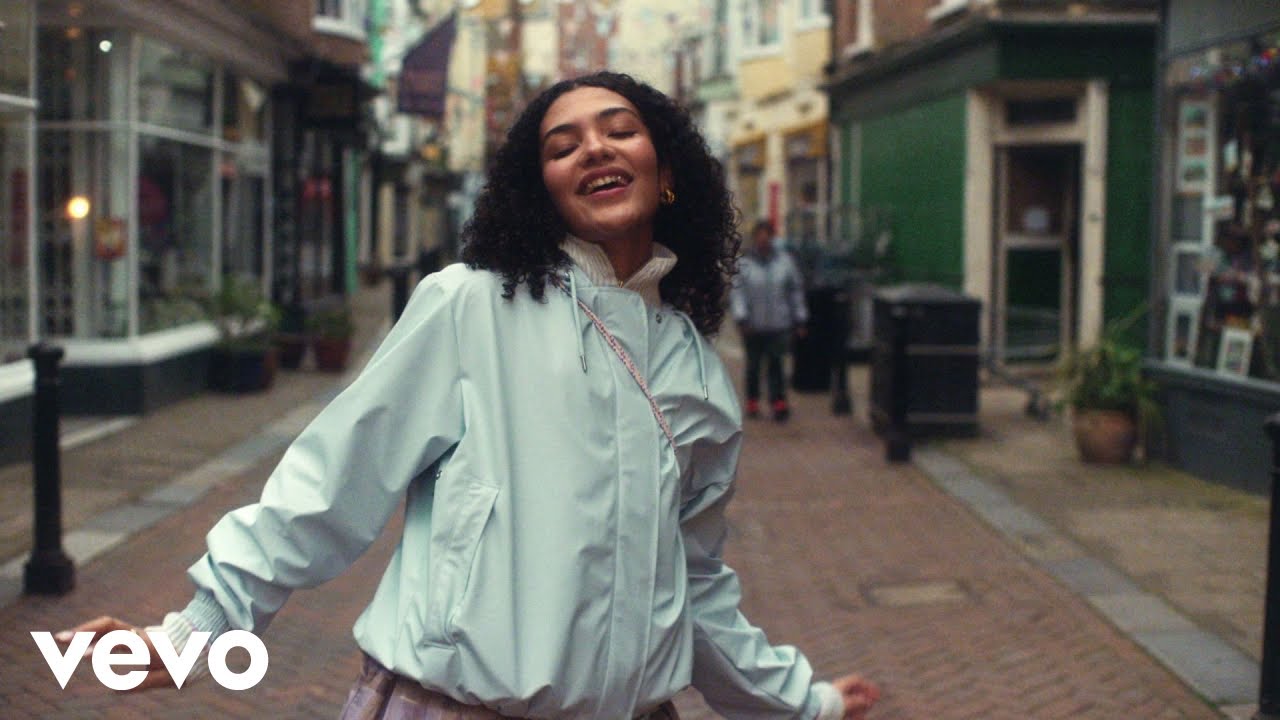
It’s obvious that Dean’s personality and lyrical frankness are big components of why Dive became such a success, and the reason her devotees adore her so much more generally. “A barometer is if I wouldn’t say it out loud, then I probably wouldn’t use it as a lyric,” she told Dork. “I like to base everything in reality. I’m not a great abstract person.”
But beyond the giddy euphoria of the song’s love-infused lyrical theme, just why does Dive work so well?
Let’s take a closer look at what’s going on in its arrangement.
The first overarching element, is that it has an innate sense of familiarity; it feels like we’ve heard it somewhere before.
Feeling sunny and optimistic, Dive is very much a sum of parts. By Dean’s own admission, she took influence from artists such as Carole King, Diana Ross and of course the Queen of Soul, Aretha Franklin. High benchmarks, but there is an extra element that resonates through Dean's vocal delivery. Herself.
The instrumentation reflects music from the classic era of soul. The rhythm section has been treated with a degree of lo-fi processing and EQ that provides a fittingly retro flavour, in much the same vein that Mark Ronson engineered with Amy Winehouse on the sublime Back to Black.
The drums are imbued with a vinyl crackle that also nods toward the DIY, sampling scene. Meanwhile, the song’s kinetic bass pins down the song’s movement, and adopts a pseudo-muted tone, straight out of the 60s.
Of course there is a horn section providing the odd stab and harmonic accompaniment; a sensibility normally reserved for big band or string section writing. With a further nod to Motown, an upright piano punctuates eighth-note chords, reflecting the halcyon age of Motown.

The instrumentation only forms part of the picture, as the uplifting harmony adopts an extraordinary sense of familiarity too.
Dive does rely fairly heavily on chord IV moving to chord I, and it does so using extension harmony - a trick that is common in jazz and soul.
The home key of the song is G Major, but Dive opens with the prolonged use of the extended chord Cm6. The horns sustain the chord, with a swell into the first bar of the verse, accompanied by a sampled repetition from the drums.
The chords used in the first four bars of the verse adopt a degree of ambiguity, as the piano is quite far back in the mix, performing in a relatively improvised way. There is certainly an implication of C Major9, followed by G Major9, which is then repeated, as each chord plays for a bar each.
The next few bars break up the movement, by employing Bm7 and Em7, both for two beats at a time, before landing on Am7(9) for a full bar.
Once again, there is familiarity to this pattern, which repeats three times before we hear the return of the opening chord Cm6, leading to the final bar of the sequence, on C/D.
One musicological characteristic employed throughout Dive, is the sense of movement from major chords to minor chords, and back again.
Anyone familiar with the classic Cole Porter standard Ev'ry Time We Say Goodbye, will know the lyric; “From major to minor’, in which Porter references the song’s harmony very literally. There is similar harmonic movement in here, and given Dean’s fondness for the classics, we would put some fairly serious money on the fact that she was influenced by Ella Fitzgerald's amazing interpretation and delivery of this song. If you don't know it, you should definitely give it a listen. In a time long before autotune, Fitzgerald's performance will stop you in your tracks!
As we hit the chorus section of Dive, we are treated to some beautifully simplistic vocal harmonies, adopting a basic triadic formation, with a chord sequence which repeats from the previous section, albeit with an abridged ending.
As we get further into Dive, we hear an incredibly unique and subtle bridge section, in which the instrumentation breaks down, before building back up again.
Quiet and subtle repeating notes occupy the horns, while the same rhythm is doubled in the backing vocals, albeit at a higher pitch.

In actual fact, the bridge is heavily dependent upon a device which has been around for hundreds of years, and was a key device used in the work of composers such as Bach. A dominant pedal, as it is known, is where the dominant note (in this case the note D) is held or repeated continually, over a series of bars.
The idea behind this popular compositional device is that it creates tension, which is exactly what we hear in Dive’s bridge. Of course, what goes on above the pedal adds to the build, and in this case, we hear a repeating of the chord C/D (or even C Major7/D) for a bar, and a chord of Bm7/D.
In other words, the note D remains the constant in the bass, while the harmony moves around above it. Throughout this section, the instrumentation builds, leading us back to the final chorus.
The beautifully lilting nature of this song’s central vocal melody - supplied by Olivia’s characterful voice, coupled with its joyously familiar instrumentation and harmony, helped Dive to bed itself in the minds of millions. It quickly became a radio and playlist staple, and with good reason.
It paved the way for her 2025 follow-up, The Art of Loving, and its similarly ebullient hit, Man I Need.
If neo-soul is part of the future of pop, we are all in!