
Amid the legions of new bands and artists that descended upon Brighton, UK for last week’s Great Escape festival, London-hailing four piece Saint Clair were perhaps the act that most singularly captivated us.
Balancing a tortured urgency with a thunderous live heft, it's obvious that Saint Clair have been students of indie’s greats, packing their influences into the foundations of a sound that feels authentic.
Delightfully out of step with mainstream indie's sprechgesang fixation (i.e, the talking/singing trend), Saint Clair's 23 year-old vocalist Toby Bardsley stretches his seriously ambidextrous vocal chords in every direction, making - as the old cliché goes - his voice into an instrument.
Some have previously pointed out that Bardsley's acrobatic style sounds eerily similar to a young Thom Yorke. And, yes, they’re not entirely wrong on that count, but seeing the band perform live at Brighton’s Green Door Store last week, it's clearer that Toby's impressive pipes can’t be reduced to just one influence.
His expressive vocal range is certainly Yorkeian, but it's a style of vocal delivery that was arguably defined much earlier with the emotive drama of Jeff Buckley - and later adopted by Muse’s Matt Bellamy (prior to the stadiums and the space-rock). It's a style that's also perfect for the type of wide-ranging musical universe that Saint Clair are well on their way to establishing.
Pixies-esque dynamic shifts also play a major role in their sound, as do occasionally sludgy, occasionally crystalline, guitars, propelled by Earth-shaking beats.
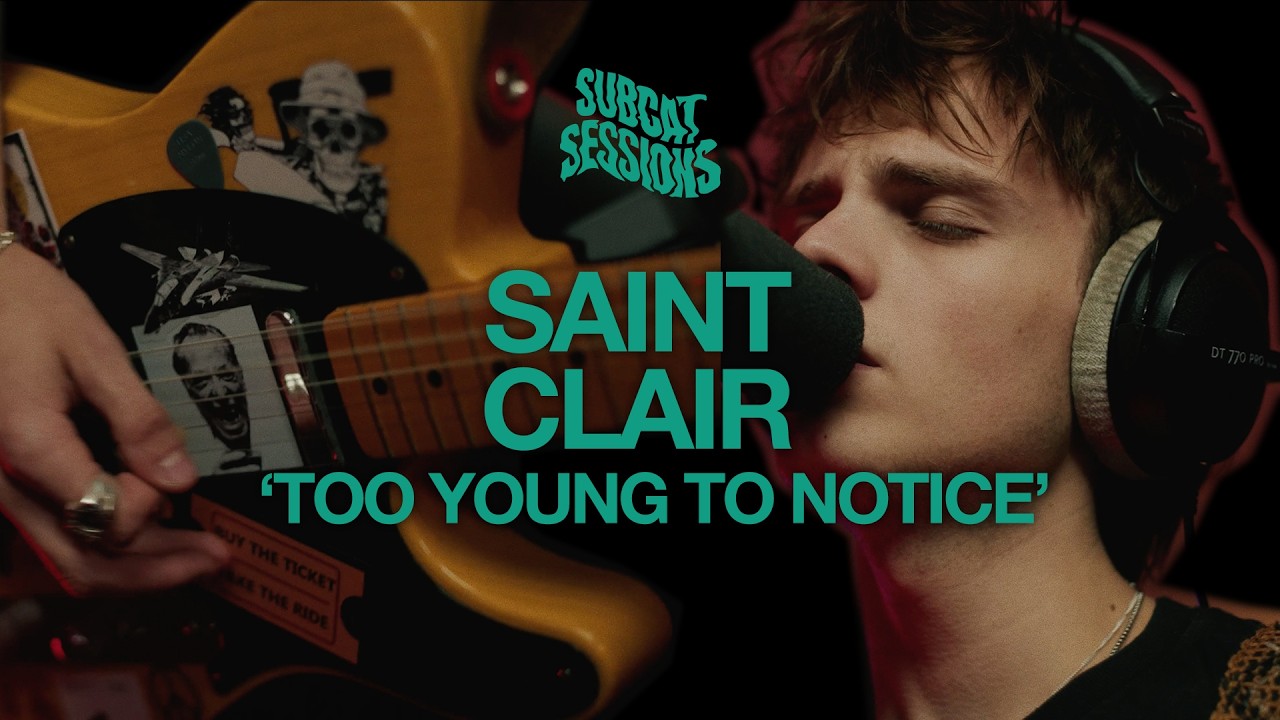
Signing to Black Butter Records earlier this year, the band’s first single (and, at time of writing, their only song on streaming platforms), Too Young to Notice is a hard one to shake. But why would you want to? It’s the kind of impassioned artful indie that you can imagine will inevitably soon become a rallying cry.
Both sullen and triumphant, it feels like voice has been given to the dejected, beaten-down youth of 2020s Britain.
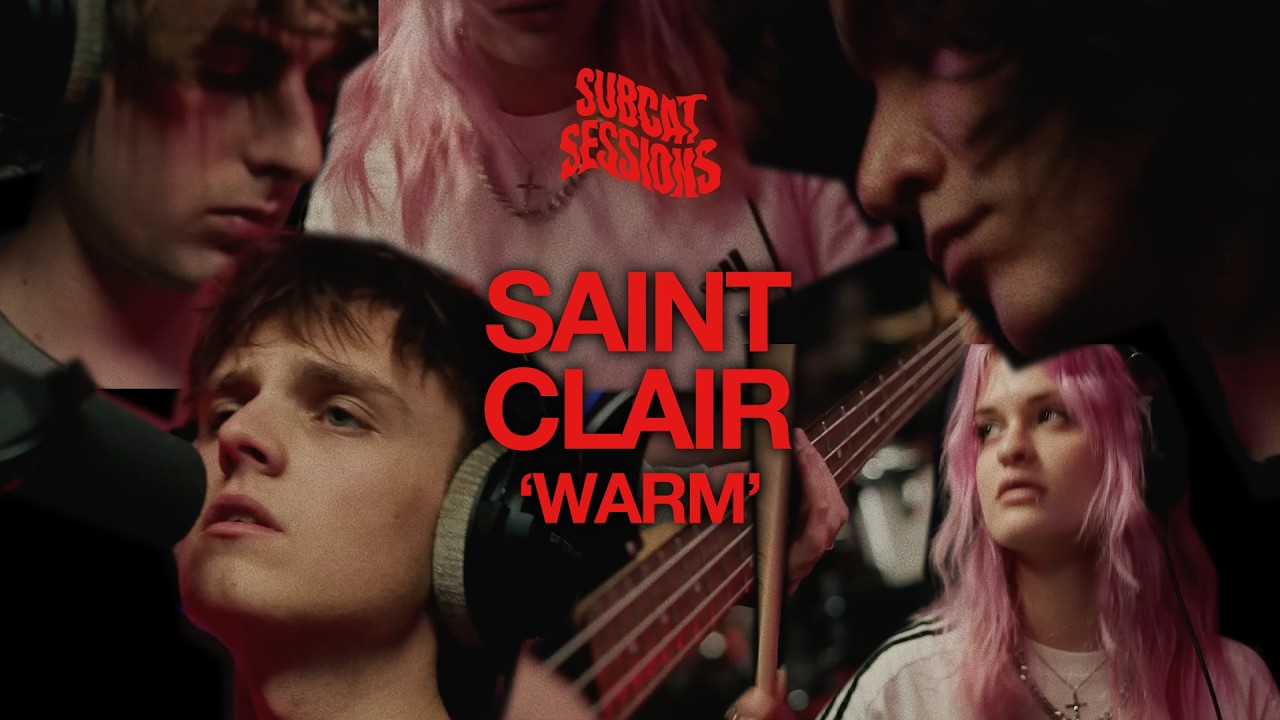
Working with other band members, guitarist Lawrence Bordean, bassist Adam Anderson and drummer Beth Diana, Saint Clair's songwriting has been branching off in a range of directions, from the vaulting intensity of Warm to the stirring, reflective hope of Gretchen.
It's a growing songbook that's diverse but consistent. With an EP currently in the works, hushed mentions of a debut album can’t help but tantalise…
I caught up with Saint Clair ahead of their Brighton show last week, and spoke to them about the development of their sound, the writing process and their ambitions for where the band might ultimately take them.
MusicRadar: Firstly, can we talk a little about Too Young to Notice? It’s a song that’s been in my head since I first heard it. When did you write it, and did you know from the outset that it was going to be the single?
Toby Bardlsey: "It came very quick. I had the riff, and Beth and I were in a room and we just got an instrumental together very quickly. Then I went away and the melodies came. I remember when the chorus - and the chorus melody - came together, I just thought ‘Oh, wow’".
Lawrence Bordean: "We were in a rehearsal room for quite a while and they were jamming something that was kind of similar. I think when I joined the bass came together and put a spin on it. I think the chorus we had [initially] had a sort of half-time bit to begin with, but it came together pretty organically.
"It came to the point where we needed to mix our [upcoming] EP, and we needed to choose the first track to sort of get a spec mix. We went with Too Young… because it felt like that was going to be the hardest one to get the right amount of energy on. We worked hard on the mix with [producer] Caeser Edmunds. It was hard to pick out a favourite, but that [song] just felt like a really good statement of intent.
MR: So how did you guys first get together?
Adam Anderson: “I met Toby at uni [London's ICMP], and we were in a different band for a long time. That sort of fell apart at the end of uni. But we wanted to keep doing it. That sort of stuff was more indie-leaning. When we got Lawrence in, the songwriting really [improved]. Then Beth accidentally walked into one of our rehearsals.
"We were having some issues with our old drummer, so we just said to her, ‘Do you want to session for us?’ So it all sort of didn’t happen at just one time, it accumulated over a few years."

MR: So, were you already playing in a band at that point Beth?
Beth Diana: “I was a session player, and was sessioning for a couple of artists and touring with them. So I wasn’t in bands per se, I was kind of a solo agent. I used to want to be in a band, but session playing felt like the most realistic thing. I loved how determined the boys were and how much they wanted it.
"The songs were different at the time to what they are now, but I loved how driven they were. Session playing can be quite isolating, I loved the idea of being part of something."
MR: I was going to bring up the drum sound on Too Young to Notice in particular - it’s got such a massive, cavernous sound that also lands with a huge punch. Did you have a hand in directing that particular drum sound?
Beth: "To a certain degree. Lawrence in particular is pretty 'on it' when it comes to sound. But I knew I wanted it to be big, and I wanted it to hit. If the sound didn’t punch me in the gut, I’d be like ‘hmmm’."
Lawrence: “A lot of it is just the idea of space. How the arrangement of that song builds is essentially introducing elements one at a time, but with this song we wanted to ‘maintain’ those elements for longer. You've got that really cool riff, you've got the cool bass riff going along, you've got good vocals, you've got good drums - and that space on the drums was important to us."

MR: Another exceptional song of yours is Warm - it’s got some fantastic dynamics. And your vocal in particular is stunning Toby. At what point in the process do you decide how vocally expressive you’re going to be when writing, Toby - and how do you feel about the Thom Yorke and Jeff Buckley comparisons?
Toby: "It’s very ‘me’ because I struggle to do [other styles]. I take a lot of influence but it’s very seeded into my brain. It’s not an active ‘I want to sound like that’ thing, my brain has picked up some stuff like a sponge.
"I didn’t actually get into Radiohead until I was much older. When I was at uni I got into them and then did a deep dive into the Beatles, and Paul McCartney stuff. We’re massive McCartney head, Lawrence and I."
MR: I’m amazed by people who can sing in this very musical way - when you're writing a song, Toby, are you literally thinking, ‘right, I'm gonna go up an octave at that point and then go down’ or do you just open your mouth and see what comes out?
Toby: "When I’m writing a song - especially in the embryonic stage - a lot of it for me is [thinking about] tension and release. Whether that’s through ‘opening up’ in the chorus, which I tend to do, but it’s also making a lot of noises as well as words. I think holding notes, more sustain and runs - not soulful runs but there’ll be a feeling there."
Lawrence: (To Toby): “You go on feeling a lot. We work together on a lot of stuff, and I think this goes for all of the band where it’s kind of like we’re all quite good at what we bring to the table, but with Toby, he’ll have all sorts of melodies. And I think he goes off feeling a lot more [than us] which is a great thing, because it’s real then. When he’s performing it, it’s him performing it.
"I think there’s times when it’s simply a case of ‘rein it in’ or ‘can we give that a bit more?’. He’s got a very good natural brain - it just so happens that his voice sounds like two other great vocalists. "
Toby: "With Jeff Buckley in particular, I didn’t get into him until I was a lot older. I think he was an incredible talent. I love his spiritual calmness. The way he sang represented him as a person very well. That’s the way I wanted it to be with my vocals. I want that for myself, I want my personality to come across.
"As I’m singing more and we’re playing more, I’m learning how to use my voice more. I can’t wait for that to develop with the writing. It’s not an overnight process, it’s a muscle that will grow in the next five years."

MR: So you've recently signed to Black Butter Records. What made them attractive to you? And how have things changed since being signed?
Toby: "It’s the same thing that we do - it’s energy. It’s who they are and what they want. I think everything aligned. They had the right energy for us. They believe in it. We could have released without [signing], but the time and effort that they wanted to put into us was amazing, and we were willing to work with them.
"We want to surround ourselves with great people who want to work hard and want to succeed. We want to make albums and spend time in the studio, tour and meet people and make fans. We were saying earlier, one of the most rewarding things about all of this is even just one person coming over to say hi, or that they really like one of our tunes.
"We know we’ve got it in the tank, so we’re just going to keep writing."
Lawrence: "[Black Butter] had previously worked with an artist called Dove Ellis, who we loved. It was reflective of the way they treated their artists. It was a great omen for us to see that they weren’t just going to throw money at social media - they were actually going to invest [in us]."
MR: That’s something that I’ve heard a lot about when speaking to new artists - the arduous nature of maintaining a social media presence and planning marketing/fanbase growth can get in the way of making music. Is that something Black Butter can help with now? Or is that something you’re managing yourselves?
Toby: "Why would we need someone else to do it? We need to do it ourselves. It’s the most authentic version of us. There is an element of mystique to a live band, and that’s great - that’s always going to be there when people come to see us. But on TikTok we’re just four people telling jokes."
Lawrence: "I think you’d be kind of foolish if you were trying to write songs and also trying to do TikToks at the same time. I’m sure people have written essays [saying] ‘If you do this, do that and everything will come together’. For us, kind of the music comes first, always.
"But on TikTok for example, our personality can come through sometimes in a funny way. Ironically, we worked with someone throughout 2025 who discovered us on an Instagram Reel - us just playing a song. So, you know, you have no real bearing over it. There's things you can do, but I think the most important thing is to try and be yourself."
Toby: "If you have a moment - and it’s because you have great music - or the moment supports your great music, then the world is yours. But, if you have that moment and nothing supports it, you’re putting your foot into a bear trap.
"The must comes first, but when those moments happen, and they will, that will just elevate it. A lot of moments come from fans."
Lawrence: "If we were talking to ourselves three years ago, we’d tell ourselves that [social media] is not something to worry about. I think now especially with the kind of landscape of music, it goes to show that what’s more important is good songs and good gigs. Fan accounts can do a lot of hard work for you."
MR: Do you think of yourselves as mainly a live band?
Toby: "It’s a pillar of what needs to be strong for anything to work. It’s just important - you need to be able to play live. I think it’s great that it’s different [to being in-studio]. When we play live, we might play the songs quicker, we might play them slower. We pressure ourselves to make everything great, but even if you’re striving to be perfect that’s just not the way it is. You’ve just got to go out and do it.
MR: Is that something you’re consciously trying to do? Leaving the rougher edges in?
Lawrence: "They just kind of happen to some extent. In the past we had to record in very short timeframes and prepped and prepped, but recently we just recorded a song which we’d played live for quite a while, and we just shuffled one or two little bits but [we thought that] if there’s the noise of a pedal being clicked on then that’s just the moment that was captured.
"I think it’s something that has been lost in the last decade of really 'produced' music, but if you look at other bands, like Fontaines D.C. for example, a lot of their stuff is very organic and real. But we’re not purposefully trying to make accidents happen in the studio."
Beth: "For me, for it to hit, there’s got to be a rawness to it. With the type of drumming that we need it wouldn’t feel authentic."
MR: I suppose that ties in with what you were saying Toby, about letting the feeling guide you
Toby: "As a creator, the most critical person in the room is yourself, if you’re able to let go of that it can help. But understanding when to let go and when not to let go is important - what is authentic and what does need a bit more work. It’s very blurry lines. We do like to get things ‘right’ though.
MR: You hinted towards an album earlier, is that something that’s on the cards?
Toby: "We have a vision that’s going to take us through multiple albums. We’re working on what’s in front of us and not getting ahead of ourselves. We’re writing songs at the moment, and if they’re not ready for now they’ll be in the box for when the time comes."
MR: And you guys are writing songs on a regular basis?
Lawrence: "We write at home, when me and Toby feel that we might have something to it, we bring it to the others in the band. Then we flesh it out together. There’s so many times when you might write a song at home but then you bring it to the band and a verse doesn’t survive. You’re always searching for what this might be in the end. It’s passed through everyone’s hands by the time it gets to your ears.
Toby: "There’s no recipe, as we progress I think that’s one of the things i'm most excited about, is to keep writing songs and seeing how it develops.
"On the record coming up, we’ve got a quieter moment with a song like Gretchen, but then it gets more towards that [rockier] Saint Clair sound toward the end.
"Saint Clair has such a strong sound now - we know what songs might work [with the band's current sound] and how we can [evolve] that, some things might be more stripped back. We’ve got a very interchangeable sound but it always still sounds like us."

