
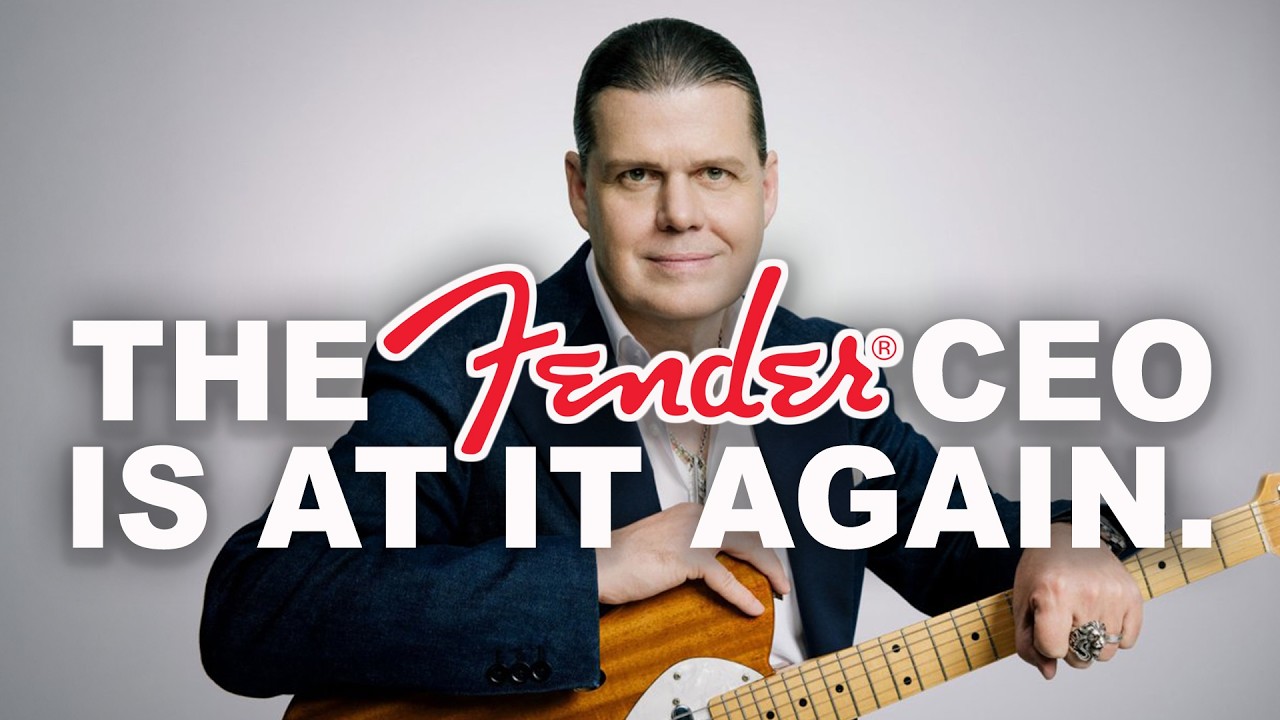
Fender CEO Edward “Bud” Cole has clarified his controversial comments that likened cover music to “analogue AI”, insisting that his intent was was to talk about how new technologies could support the development of musicians.
Cole had been the subject of an online backlash after comments made last month to T3, in which he likened the reaction to AI within the music community to the polarised response the Fender Telecaster received upon its launch in 1951.
“There were people that loved it and adapted, and some people that thought it looked like a rope from a rowboat, or it looked like a plank,” said Cole.
The first mass-produced electric guitar was certainly a radical technology but the objections to it were founded upon a very different rationale. The Telecaster cannot quote/unquote create music out of nothing, train itself on other artists’ creations, then replicate it at scale.
Still, Cole went further and argued that, “AI has existed in music as long as there’s been recorded music”, and that guitar players could develop their skills and arrangements by incorporating it into their creative process.
“I actually believe cover music has been sort of analogue AI for a long time,” he said.
Those comments received a lot of pushback online. Understandably. Covering a song, learning the changes and the nuances in another player’s style, then adding our own, this is all a fundamental part of our musical development.

Cole spoke of “freeing” musicians up from the same old cover songs, when it is the cover song that often liberates musicians by broadening their musical vocabulary and repertoire. This is why the quite excellent Fender Play app is populated by songs from Green Day, Nirvana, and the Stones etc.
Not to mention that some of the greatest works of recorded music have been covers, or that a cover song, great, perfunctory or otherwise, is in effect a dialogue between two artists – two humans.
Speaking to Fast Company, Cole did not address the cover song controversy directly but he did clarify his position on AI and its place in the 21st-century musician’s toolkit.
“My intent was to talk about how technology can help artists and players learn and grow,” he said. “Music is an inherently human experience, and great songs are born out of people’s lives, their creative energy and the countless hours spent learning their instruments – something no machine can ever replicate.”
And yet the machines keep trying, and people keep on developing technologies that let them try harder. That threatens artists in a very direct way – their copyright, deepfakes, AI-generated stock music, etc – but also in indirect ways, too, with the incoming tide of AI-generated content poisoning the well, a growing suspicion about what we hear and see online. Is it fake, generated by AI, or is there a real human behind it?
See the D’Addario string demo controversy for an example of how that all plays out.
Cole says he acknowledges those concerns and argues that artists and their work need to be protected, but also that “conversations need to happen about how to advance AI”. The question is whether those two instincts, to protect the artist and to advance AI, are fundamentally at odds with each other.
We already do use AI whether we like it or not. AI technologies often underpin digital amp modelling. Companies such as Positive Grid and Mooer Audio have introduced tone-by-prompt AI features for dialling in tones. We are already being used by AI whether we like it or not, and that's part of the problem, too.
Cole still believes AI can play a supporting role in helping musicians develop their creativity, but, he tells Fast Company, “Music starts and ends with people. It always will.”
