
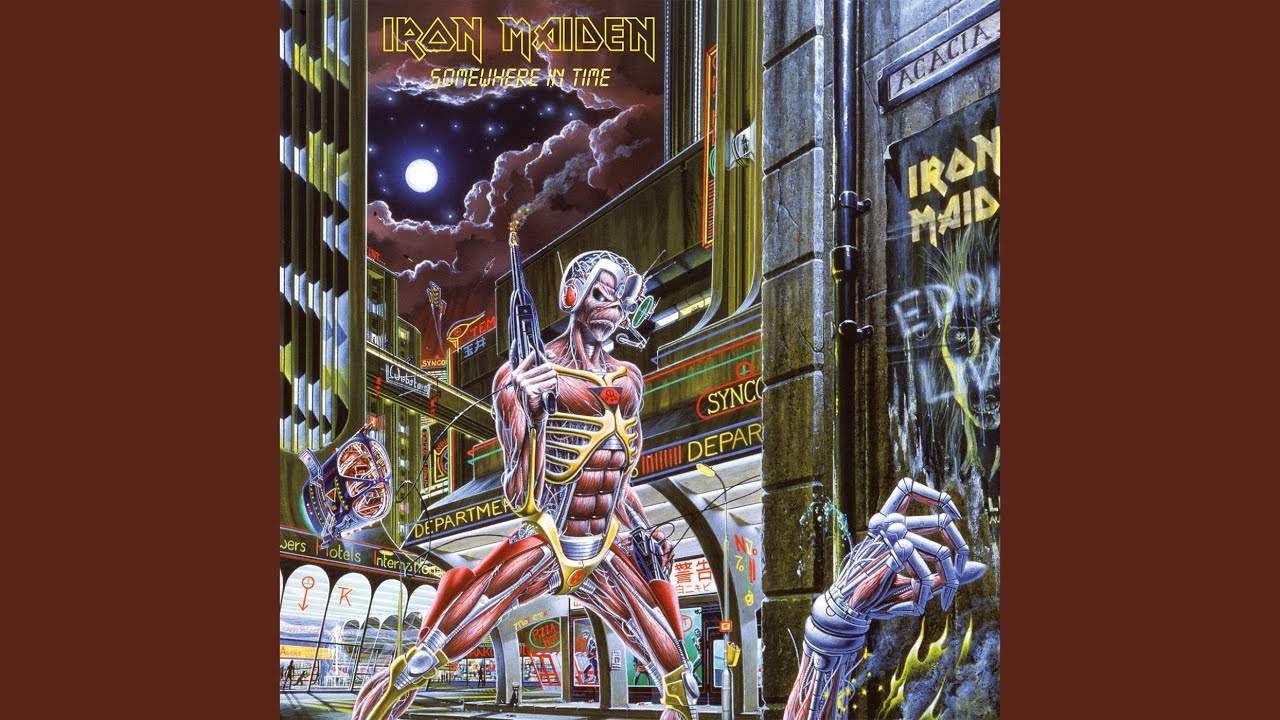
When Iron Maiden’s sixth studio album Somewhere In Time was released in 1986, singer Bruce Dickinson had a funny way of describing the frequently violent content of the band’s lyrics: “We always manage to get in a few massacres and carnage along the way,” Dickinson laughed.
During the making of Somewhere In Time, Dickinson had been suffering from mental and physical exhaustion following the band’s marathon World Slavery tour, in which 189 shows were performed in 331 days. As a result, the singer played no part in the songwriting for that album.
Instead, guitarist Adrian Smith wrote three songs – Sea Of Madness, Wasted Years and Stranger In A Strange Land, the latter pair issued as singles. The band’s other guitarist Dave Murray co-wrote one track, Deja-Vu. The remainder of the album was composed by the band’s bassist and leader Steve Harris.
In October 1986, a few days after Somewhere In Time was released, Bruce Dickinson and Steve Harris spoke to Sounds magazine and discussed the lyrics that Harris had written for the album’s two longest tracks – Heaven Can Wait and Alexander The Great.
While Adrian Smith’s songs were chosen as the two singles, Heaven Can Wait is an anthem with a powerful chorus and a storyline based on real life-or-death dramas.
Harris told Sounds: “People have had experiences when someone dies and for a couple of minutes on the operating table they transcend themselves – they leave their body and see themselves on the bed. People have said they've seen a tunnel with lights at the end, with people holding hands and beckoning them in.”
This was the inspiration for Heaven Can Wait.
“It’s basically a story about a bloke who does that,” Harris explained. “He sort of comes out of himself, sees himself on the bed and says, ‘Fuck it – I’m not going, it’s not my time.’
“And when he goes back down in he’s not sure whether he's died and been reborn, or whether he’s just been dreaming. It’s kind of like a bad hangover!”
The album’s closing track, Alexander The Great, is a historical epic detailing the life and empire-building conquests of the Greek king who reigned from 356–323 BC and was never defeated on the battlefield.
Dickinson told Sounds about the story in this song and his approach to singing it.
“Alexander The Great is like a lot of Steve’s songs,” he said. “It’s trying to dramatise a series of historical events so that people, if they use their imaginations, can visualise it.
“It also has that sense of futility at the end. The last line is: ‘He died of fever in Babylon.’ After all that!”
Dickinson admitted that the dense, wordy lyrics in Alexander The Great made it a difficult song to sing.
“In general, if Steve comes up with a tongue-twister then we go with it,” he said. “The only time I’d say something is if it got a bit Spinal Tap. It’s a fine line.”
Dickinson went on to name two classic Maiden songs in which Harris was at his best as a lyricist.
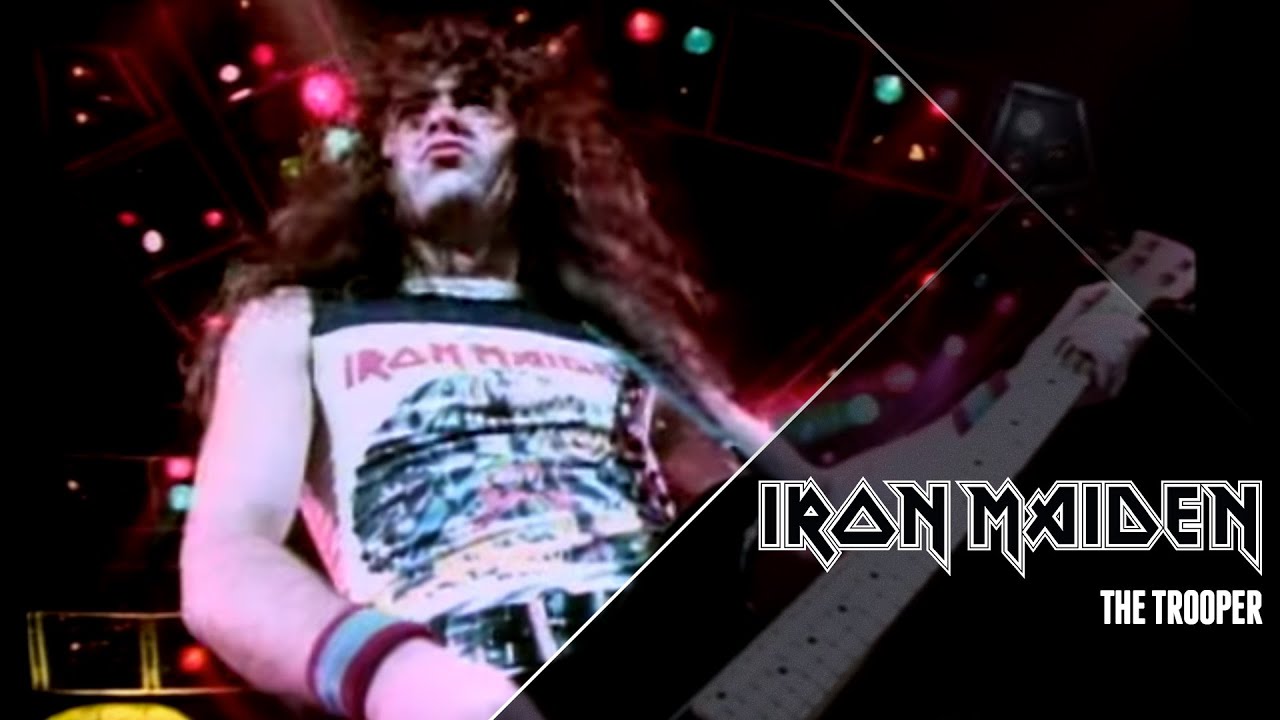
First was The Trooper, from 1983 album Piece Of Mind. The song told the story of the Charge of the Light Brigade, a disastrous military action undertaken by British forces during the Crimean War. Dickinson admired how Harris portrayed “a totally senseless waste of human life”.
Dickinson also appreciated how Harris adapted the famous Coleridge poem Rime Of The Ancient Mariner for the epic Maiden song of the same name, featured on the band’s 1984 album Powerslave.
“When he did Rime Of The Ancient Mariner the whole song was like the poem,” Dickinson said. “It was metaphorical – Man against Nature, where God fits into it and all that. It came across in the song very well, I think.”
