
An acoustic lament that has pervaded popular culture for nearly 20 years via prodigious appearances in the soundtracks of popular TV shows and movies, I Will Follow You into the Dark is indisputably Death Cab for Cutie's most well-known song.
Sitting atop the band’s streaming rankings, it’s fascinating to learn that the song, a fragile, stripped-back requiem for a departed lover, was written in an incredible 15 minutes. Its final studio recording was put down even quicker.
Its sole writer and performer was the four-piece band’s then-28 year-old lead singer and songwriter, Ben Gibbard. He’d penned it as a potential idea for Death Cab's in-progress follow-up to elegant fourth LP Transatlanticism, the Washington indie quartet's critically acclaimed pop cultural breakthrough.
Along with his bandmates, Nick Harmer, Chris Walla and Jason McGerr, Death Cab intended to further build on the preceding record’s critical and cultural clout, but this time with the headwinds of major label backing in their sails, courtesy of Atlantic Records.
This more commercially-angled move stoked the ire of some indie purists, convinced that their signing was evidence that the once-cult favorites were set on 2005 being the year they became a mainstream concern.

While Transatlanticism thematically dwelled on the fraught tension and heartache of a long-distance relationship - and the notion of separation in general - the band's new album, Plans, was fixated with mortality.
The surprisingly rapid genesis of I Will Follow You into the Dark happened during the initial songwriting stage. Gibbard sought to treat the songwriting process for Plans with a more 'grown-up' methodology than the occasionally back-of-the-tourbus, notebook-scribbled approach that spawned earlier Death Cab cuts.
To that end, he rented out an apartment in Seattle specifically for songwriting, and subsequently decked it out with instruments.
"I'd treat it like a job and just go to my office,” Ben told Rolling Stone.
On one such ‘office day’, Gibbard entered the apartment as normal, preparing for another solitary day at the grindstone with a guitar and piano. It was a plan that was soon derailed…
“One day, I went to work, had my lunch all packed, because I bring my own lunch, and I sat down to attempt to write a song,” Ben told VH1’s Storytellers. “I wrote this next song in about 15 minutes and I kinda took my lunch and put it back in my bag and went home because I realized there was no point in working the rest of the day.”

With a capo on the fifth fret of his Stella Harmony H159 acoustic guitar, Gibbard cycled through a fairly straightforward, resolute-sounding, I-VI-IV-I-V chord sequence (C-Am-F-C-G).
Its slightly amended chorus (which doubled as the song’s intro) halved the time that each chord sounded in the bar. This section incorporated more minors, and pulled at the brightness of the F major key, returning with inevitability to its home, and signing off each chorus with the titular proclamation, ‘I will follow you into the dark’.
Ben opted to approach these chords via a hybrid strumming/picking pattern which added a sense of rhythm to each chord revolution. His thumb hit the bass notes, while his fingernails strummed the other strings, while subtle arpeggiation brought out the higher notes. Atop it, Gibbard weaved a gorgeous, romantic topline.
Conjuring an instantly sentimental vibe, Gibbard decided to go all-out with his most emotive lyric to date.
It wasn’t just a formative break-up Ben was contemplating here, or the angst of a long-distance relationship. This was a wise, love-beyond-life ode of dedication. It was as gothic as it was sweet.
“Death is an ever-present fear. If not a fear, then an impending reality in our lives,” Ben would later reflect in an interview with NME’s Song Stories. “We like to think that when people leave this life, we will see them again some day. Writing a love song that deals specifically with the inevitable death of one’s partner and that you will follow that person into whatever the afterlife is or is not, that’s something that people can relate to.”
Love of mine, someday you will die
But I'll be close behind
I'll follow you into the dark
No blinding light or tunnels to gates of white
Just our hands clasped so tight
Waiting for the hint of a spark
Although the song's intimation of the specter of death haunting our happiest moments would have huge resonance, it was actually pointedly personal for Gibbard. In fact, it was written with his then-girlfriend in mind.
“[It’s] a love song I wrote for my lady, really sweet and romantic,” Gibbard told Rolling Stone back in 2005. “It’s about someone dying, and the person they love saying, ‘I’m close behind, I’ll follow you into the dark.’ But then I played it for her and she was like, ‘This song is [really] sad!’ Best to run with what comes naturally. I tried.”
Months later, and with quite a few solid songs under his belt at this stage, Gibbard and the band decamped for Plans' lengthy rehearsal and recording sessions at the Long View Farm Studios in North Brookfield, Massachusetts.
Initially conceived as an acoustic sketch, the idea was that I Will Follow You… would potentially be worked-up into a full-band arrangement.
It would be yet another plan that would go awry, and its final form would actually be tracked super-quickly, following an unforeseen technical issue which led Gibbard to impatiently start playing his favorite new song.
“We were going to track the vocal for another song and there was something screwy happening with the headphone mix,” Producer and guitarist Chris Walla recalled in an interview with Mix Online. “We were having problems, so I said, ‘Ben, this is gonna be a few minutes. Take a break.’”
“Ben's version of taking a break while we addressed the headphone problem was to pick up this Stella [Harmony] guitar that he loves and start playing this song we were planning on recording some time later during the sessions,” Walla continued.
“He was still coming through the vocal mic as he was playing this, and it was sounding really cool to me, so I went up and said, 'Let's track this real quick,' and we did and that's what's on the record. It was a mono recording with no effects. Nothing. I added a little compression and de-essed it a bit. It's really weird. It's totally there and it's happening.”
The choice to keep things stark was an inspired choice from Walla, capturing the purity of Ben’s vocal and the Stella Harmony H159 acoustic guitar through just one AKG 414. The resulting intimacy of the recording emphasised the introspective lyrical theme.
It was a more effective approach than gilding the lily by adding a bombastic string arrangement or impassioned guitar solo. It was a song that was ready-to-go.

Sequenced on the resulting 11-track album as its fifth song, I Will Follow You into the Dark served as the mortality and time-concerned record’s crux: A central rumination on the profound power of love to persist beyond this mortal plane.
It was framed on Plans by further death-haunted cuts, including hospital bed vigil What Sarah Said, further existential pledge Soul Meets Body and the more dispiriting relationship-epitaph that is Brothers on a Hotel Bed.
When not pondering death specifically, Plans was dominated by the notion of endings and resolutions. Listening to the record, there was a sense of inevitable pages being turned in the book of life's journey - with many of those titular plans left unachieved.
“One of my favorite kind of dark jokes is, ‘How do you make God laugh? You make a plan,’” Gibbard told Mix Online. “Nobody ever makes a plan that they’re gonna go out and get hit by a car. A plan almost always has a happy ending. Essentially, every plan is a tiny prayer to Father Time.”
Released as the record’s third and final single in July 2006, the song initially, and very surprisingly, failed to make any significant commercial inroads. In fact, what would ultimately end up being the band’s most-streamed song ever didn’t chart at all on the US Billboard Top 100, and only rose to a paltry 66 in the UK.
But that was by no means the end of the story. I Will Follow You into the Dark would gradually become more widely known following its use in a series of high-profile television shows, cementing a reputation established by the band's prior ubiquity on such dramas as the OC.
It appeared on US teen-angled drama 90210 and (particularly touchingly) in the hugely popular sitcom Scrubs, during a memorable episode early in its eighth season.
The song would also find its way onto numerous film soundtracks. Music supervisors clearly found its bittersweet sentiment an irresistible choice for their various projects.
Another factor in its gradual rise in cultural prominence was its fitting music video.
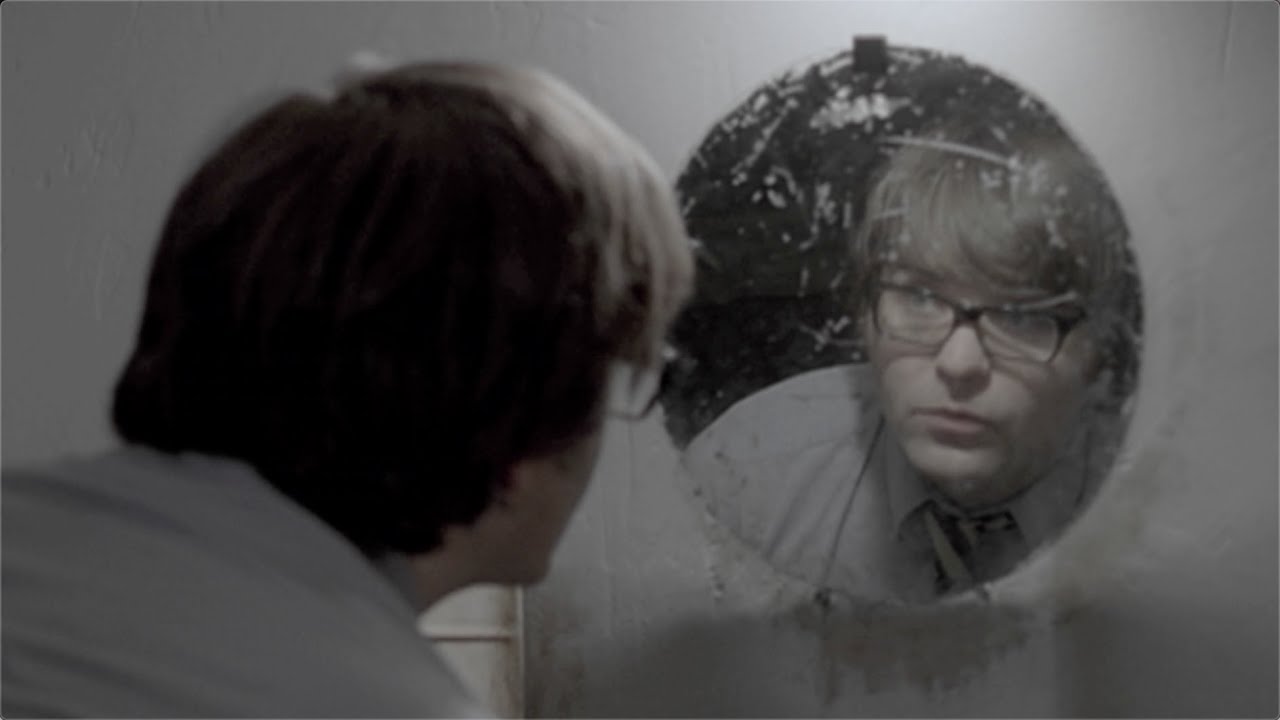
Directed by Jamie Travers (and slightly reminiscent of the tone of Kafka's Metamorphosis) it depicted a lone Ben Gibbard living a solitary life within a colourless, grey apartment - occasionally playing the song on a single bed with his acoustic guitar. A small black hole which initially appears on an exposed floorboard is soon accidentally widened when Gibbard puts his foot through it.
As the video proceeds, the hole gets increasingly larger. Eventually becoming a yawning chasm that threatens to consume the whole room, Gibbard falls out of his tiny single bed and descends downward into the void. Landing on solid ground within the black space below, Gibbard seemingly makes a choice to gradually proceed downward.
It doesn’t take much chin-rubbing to surmise that the hole here serves an apt visual metaphor for death, increasing in size as a presence in life as time passes.

“There is a period of your life in which it feels like you’re going to weddings every weekend and there’s a period in your life when it feels like you’re going to funerals every weekend,” Ben told NME. “I think it’s very important in our relative age group that we recognise that we’re living in a very special time in our lives where we’re going to far more weddings than funerals.”
But it was across the then-insurgent social media platforms (MySpace and Facebook especially) where the song really found currency. It percolated across the web in a range of different forms.
Its death-pondering lyrics drew in those who were more accustomed to the gloomier-end of the listening pool, while its sweet, gentle arrangement meant it was still pleasant enough to grow into a popular iTunes and radio staple.
Here in 2025, I Will Follow You into the Dark has long settled into place as one of Death Cab for Cutie's most cherished songs, and a veritable modern hymn. A quick scan of its video's YouTube comments testifies to the song's ongoing power to stir deep emotions.
Trying to make sense of that 15-minute gestation period in a 2015 interview with Cue Point, Gibbard mused on the idea that the song was in some way channelled from the great beyond.
“What I do find interesting is a point that a friend of mine once stated, which was, ‘You know, being a writer of any kind of discipline is kind of like being a magician. You’re defying the laws of physics.’ There’s nothing there. And then there’s something there. That defies the first law of physics. So, in that sense, maybe there is something spiritual about the process of writing.”
Gibbard continues,“When I wrote [I Will Follow You into the Dark], it seemingly came out of nowhere. It did feel that there was some sort of spiritual transcendence happening [with] the song being beamed down to me. But, at the end of the day, I wrote [that] song.”
