
Everywhere you looked there was bad news, tumult and tragedy. It was late summer, 1983, and the world thrummed with anxiety.
Rush had decamped to a lodge in the Horseshoe Valley, an easy 90-minute drive north from Toronto, where the peace and quiet of an off-season ski resort would give them some time and space to put some songs together. The outside world arrived by post.
Drummer and lyricist Neil Peart would pore over the newspapers, digesting the day’s events for inspiration. If the artistic mission behind the Canadian prog trio’s follow-up to Signals was their search for a more perfect union between synthesizer and Alex Lifeson’s electric guitar – and wherever Rush’s fathomless musical curiosity would take them – front-page events helped establish its emotional cadence.
Lifeson and bassist and frontman Geddy Lee would study Peart’s lyrics and let them guide their melodic choices. The question was how was all this going to sound? How was it to come together?
Rush had made the difficult decision to part ways with producer Terry Brown, who had handled all their albums from 1974’s Fly By Night to 1982’s Signals. Sitting in a suite in The Connaught, one of the more salubrious locations in London’s Mayfair, Lee explains why it was time for a change.
“We decided to move away from Terry for that album because we had gotten to the point on Signals that when Terry said something we all kind of knew what he was gonna say,” he says. “We were too able to read his reactions. And that told me that we were not learning anything from him any longer. What he would normally say was already part of our process, let’s put it like that. So we needed new input.”

Things were going well for Rush. Signals had gone platinum. The New World Tour of America sold out, with than one million tickets sold. London’s Wembley Arena was sold out for four nights straight, New York City’s Radio City for five.
But there was change in the air. The bands Rush were listening to were trafficking in intoxicating new sounds. The synthesizer was disrupting the rock idiom and Rush were already halfway down the rabbit hole. They wanted to see how deep it would go.
And, as Lee admits, they were still ambitious. Rush believed they could get better, and they wanted someone who would push them.
“We needed new opinions. We wanted new influences. We wanted to challenge our brains,” says Lee. “We wanted to write better songs. We needed to learn how to write better songs. We didn’t think we could do that in the same setup. So we wanted to bring somebody in that was fresh, challenging.”

They drew up a list of candidates. On the strength of Signals, Rush were hot property. Chris Squire of Yes was in the frame, as was Trevor Horn. Famously, they found their man but he bailed on them. He blew them out in favour of Glasgow’s hottest band.
“We had made an agreement with Steve Lillywhite to produce that record. Unfortunately, he pulled out at the last minute, and then sent us into a bit of a panic,” says Lee. “He went on to do Simple Minds. I just think he wanted to work with Simple Minds and that came up, and he said, ‘Oh, fuck. I already committed to these Canadians but…’”
With the studio deadline advancing, Rush cast the net wider and hired Peter Henderson as a co-producer. Henderson had worked with Jeff Beck and Paul McCartney, and helmed the previous three Supertramp albums.
By the time they arrived in Le Studio, up in Morin-Heights, Quebec, to record, winter was closing in and the world was in no better shape. The Soviets had shot down Korean Air Lines Flight 007 and pulled out of the Intermediate-Range Nuclear Forces (INF) talks, and tit-for-tat ballistic missile deployments upped the ante as the Cold War simmered.
Everyone, everywhere was tense.
On Signals, we felt that the keyboards got a little dense, and the guitar got a little small, and Alex was a bit hungry to have the guitar size back
Geddy Lee
How else could Grace Under Pressure open other than the restless, fitful energy of Distant Early Warning; it’s a vibe. We have Lifeson’s zero-gravity chord stabs, hanging suspended in the air, cold and frigid, slightly alien with the echo and reverb. Lee’s bass guitar is warmer, conversational, more human.
Lee can’t remember if this was a conscious decision but they had very clear ideas about what they wanted from the guitars on Grace Under Pressure.
“I’m not sure, and not in the way that you describe it so beautifully. I can’t take credit for approaching it that way,” says Lee. “But we definitely wanted to equal the role of keyboards and guitar. On Signals, we felt that the keyboards got a little dense, and the guitar got a little small, and Alex was a bit hungry to have the size, the guitar size back, and I thought, ‘Well, why not? Why can’t we trade off? Let’s have everything. [Laughs] More of everything, please!’”

There was more gear to be acquainted with. There was the PPG wavetable synth. You can hear that all over the place (like on the volume wells on Afterimage). This was the first time they would really layer the keys, hunting out different textures to complement Lifeson’s guitar.
That, too, was undertaking an evolution of sorts. Grace Under Pressure would be all electric; Lifeson’s acoustic guitars stayed in their cases. He had discovered the Roland Jazz Chorus guitar amp during the making of Farewell To Kings and ever since chorus had become the bedrock to his sound.
For Grace Under Pressure, he used the chorusing function on a pair of Loft Digital Delay rack-mounted units, running one with 25 per cent wet, with the rate at noon, the depth just over half-way. The other would be more lush, running 50 per cent wet, depth maxed out, rate the same.

An MXR distortion pedal would be a pinch-hitter in the studio. He’d use his trio of his modded Sportscasters – the red, black and white S-styles – going into his trusty Marshall 4140 combo amps, or on occasion his Carvins. As ever, there would be echo. For the first time on record, Lifeson would use a Fender Telecaster, often using it to double a part already recorded on this Hentor Sportscaster S-styles or his Gibson ES-355.
Lee says he wanted “more of everything” but physics dictates that there are only so many frequencies to work with. The engineers had their work cut out.
If Lifeson was streamlining his guitar sound, taking a more judicious approach to multi-tracking and not being afraid for the sounds to a little leaner and rangy, then the evolution of Geddy Lee’s bass offered ballast.
“My bass had a lot of twang in the early days,” he says. “Moving to the Steinberger was, as you suggested, moved it to a slightly different register to allow the guitar and some of the keyboard parts to poke through, and so all those things are dependent on the other.

“But, yeah, Distant Early Warning is a Steinberger. I’m playing Steinberger on that. I don’t think I played on every song. There were other experiments going on, obviously, and it was all about we have only so many frequencies you have to share, and if everybody wants attention you better have a good engineer to push those frequencies away in the right way – and that also went into the decision to change producers; we were becoming more adventurous, sonically.”
No adventure comes without risk. Grace Under Pressure was notoriously difficult to make.
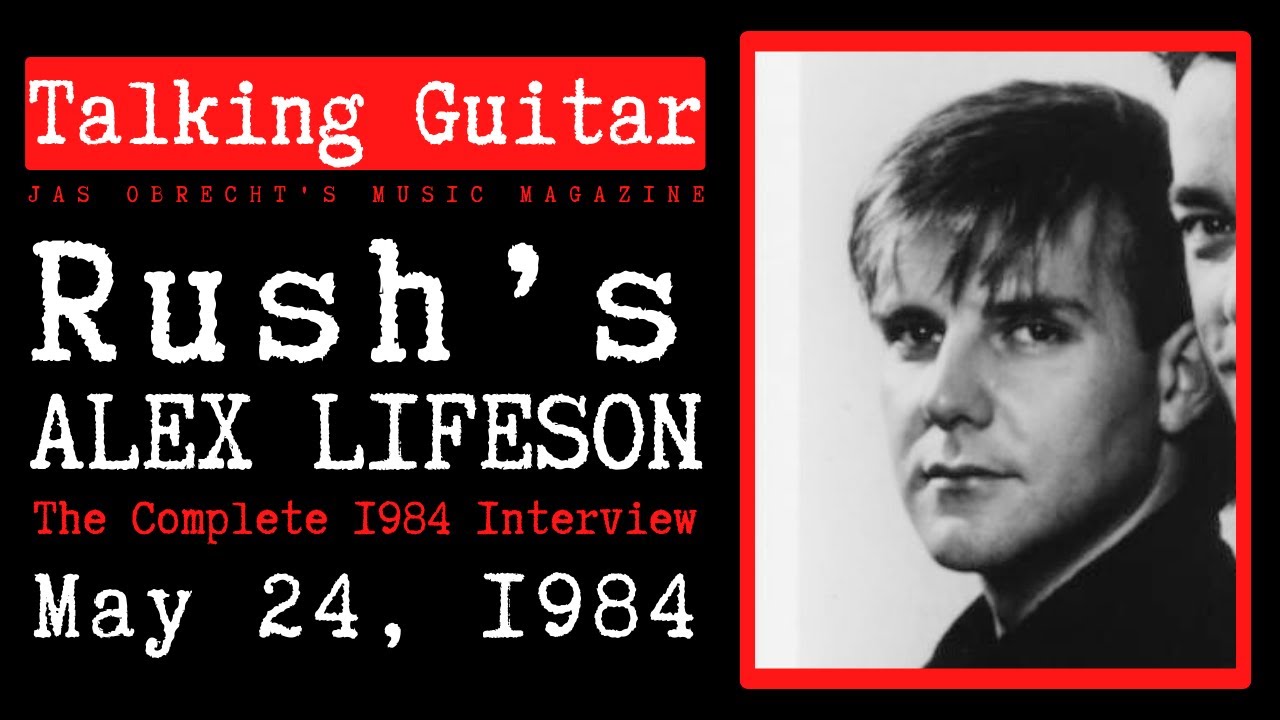
Speaking to Jas Obrecht in 1984, a conversation you can listen to on Obrecht’s superlative YouTube channel, Talking Guitar , Lifeson said he nearly gave himself a “nervous breakdown” when tracking the solo to Kid Gloves. That was one that came together in the studio.
“The solo section starts with that one held note, and I kept thinking, you know, what the hell am I gonna do? I spent a long time on that, and I was really on the verge of a nervous breakdown,” said Lifeson. “Again, it was one of those situations where I just go crazy, just do something, and one thing led to the next. Each one of those sections of the solo led into each other.”
After a couple of days back and forth he had a solo. His leads on Body Electric were a similar story, with Lifeson driving himself to distraction before the dam broke and it all came together. Forty minutes later, it’s on tape.
The search for a producer, the practicalities of getting new sounds down, the damned weather, Grace Under Pressure was uphill all the way. “I did feel the record was very difficult to make, for all those reasons and more,” says Lee. “We were holed up in Morin-Heights, Quebec, in the dead of a very cold winter. Fuck, it was hard to make that record.”
The struggle was real. But they were reaping the rewards when they listened back to it in the control room. Lifeson had some weird kit with him, and some uncanny sounds coming through the speaker. He used the octave-up feature on his Delta Lab DL-5 HarmoniComputer to give the Distant Early Warning solo its unnatural quality.

The Enemy Within is another case study in how Lifeson has always been master of disguise when it comes to tone.
“That was kind of unusual. I split the guitar in half, and played a lower line and a higher harmony line,” he told Obrecht. “And we tried to get, a balalaika-type effect to it.”
Why should a guitar always sound like a guitar? Sometimes player can engineer a sound so weird it fools the ear and forces the audience to lean into the recording. This has always been Lifeson’s MO. Speaking to MusicRadar in March 2025, Lifeson said it is a sensibility he has to this day.
“I’ve always moved outside of what typically the job of the guitar is,” he said. “I have always looked at trying to manipulate the sound; it’s obviously played on the guitar but it doesn’t sound anything like one, so I am already set up for that sort of thing.”

Lee remembers Grace Under Pressure as another chance for Rush to prove themselves as songwriters, to take another stab at sonic expansionism with experiments conducted upon the Jupiter-8, Oberheim and PPG synths.
Pitched somewhere between nightmare and hope, inspired by Lee’s mother’s experiences as a Holocaust survivor, Red Sector A finds Lee dispensing with bass altogether in favour of propulsive yet haunting synth.
Here, again, Lifeson’s DL-5 throws his guitar sound off its axis, just as Rush throw us off ours, reminding us that barbarism runs deep just beneath the thin skin of civilisation.
We were listening in bands like Ultravox, like the Police, like Propaganda. There were so many bands that were happening around that time
Geddy Lee
One of the leitmotifs of Grace Under Pressure is how Rush play with the new sounds and rhythms that were augmenting popular music at the time. The Enemy Within moves to a ska beat, punctuated by the polished steel splash of Lifeson’s guitars.
“We were listening in bands like Ultravox, like the Police, like Propaganda,” says Lee. “There were so many bands that were happening around that time. And the English music scene, especially, was really vibrant. The studio scene was really vibrant, and Trevor Horn and all these great producers were breaking down barriers. Now, at the same time, recording budgets were getting huge.”
This truly was a golden age for studio experimentation. The record companies would bankroll it, then the artists would do as artists do and make the most of it. “People were spending a year making art of noise,” says Lee, a note of awe, maybe nostalgia, too in his voice, citing Tears For Fears as a reference. They, too, were making it up as they went along. Everyone was.

These technologies – samplers, drum machines, the evolution of synthesized sounds – had never really been used like this before.
Being sponges, we knew if we had the right guy we could soak up a lot of new techniques and have a different perspective on writing a song.
Geddy Lee
“It just seemed to me to be a really fascinating time in production,” says Lee. “Record production had taken another attitude; electronic gear was expanding, the Fairlight was being used all over the place. There were devices being invented that could affect the sound of the snare by using that gated noise.
“All those things were going on and we felt we wanted some of that. We want to learn about that shit and see what’s appropriate to our music, and what’s not. And being sponges, we knew if we had the right guy we could soak up a lot of new techniques and have a different perspective on writing a song.”
And that’s what they were looking for from Henderson. As it turned out, he was more hands-off. Speaking to Guitar World, Lifeson said the band got more involved with the engineering of the sounds than they might have liked.
“Peter had a good track record, but while he was qualified, he just didn’t seem to be focused,” he said. “That left it up to the three of us to really focus on production. We like to work with a producer that’s sort of like the fourth wheel, where we do what we do and they add just a little bit of direction and deal with some of the stuff we don’t want to deal with. That way we can focus directly on the music. But that wasn’t quite the case.”
Still, Lifeson was happy with how the album turned out. And Lee agrees. Henderson did the business. Rush left a dedication to Terry Brown in the liner notes to Grace Under Pressure. But if there were any hard feelings on Brown’s part, they didn’t last. Brown volunteered a remix for its 2026 super-deluxe reissue.
“I didn’t think it needed remixing,” says Lee. “But I said, ‘Sure. Have at it, you know? Nothing to lose, everything to gain.’ It’s not gonna change that version that fans love. But it’s another take, and I think it sounds great. He did a great job because he is a good producer, and because Peter Henderson did a terrific job recording that record. So it’s a win win.”
Even if it isn’t a concept record per se, with no over-arching narrative from start to finish, Grace Under Pressure could be treated as such.
There is an emotional consistency that ties it together, contemporary anxieties, past traumas and grief (Afterimage was written as an upbeat tribute to Le Studio’s tape operator Robbie Whelan who had died the previous year).

The title, borrowed from Hemingway, speaks to all of that. Furthermore, it speaks to what was happening inside that studio as the snow fell outside and the weeks went by, and three guys from Canada nursing what could be diagnosed as some kind of cabin fever.
Grace Under Pressure does not refer to the music, it refers to the situation we were in, and it’s very much about our emotional state
Geddy Lee
“I mean, Grace Under Pressure does not refer to the music, it refers to the situation we were in, and it’s very much about our emotional state,” says Lee. “That title was borne out of our emotional state, and the difficulties making that record. And the songs were quite varied, but there’s a sense of unity on that record, from one song to the other, because of the fact it was written in isolation, and performed in isolation with those same people. And it’s a time capsule of that moment.”
So, then, another difficult Rush album. Plus ça change! But just between us – entre nous, if you like – they weren’t all like that.
“You said a lot of our records were painful to make – not all of them!” Lee protests. “You know, Hemispheres was a bitch. Urgh! [Laughs] Grace Under Pressure. But Permanent Waves, one of our best records, was a joy. Easy peasy! I don’t know why. Farewell To Kings was a joy. Moving Pictures was fun to make.”
- Rush's Grace Under Pressure Super Deluxe box set is out now via Mercury
- Rush's Fifty Something Tour visits the UK, Europe and South America in 2027. See AEG Presents for UK ticket details. Head to Superfan Rush VIP and Superfan Rush Travel for VIP and deluxe travel packages
