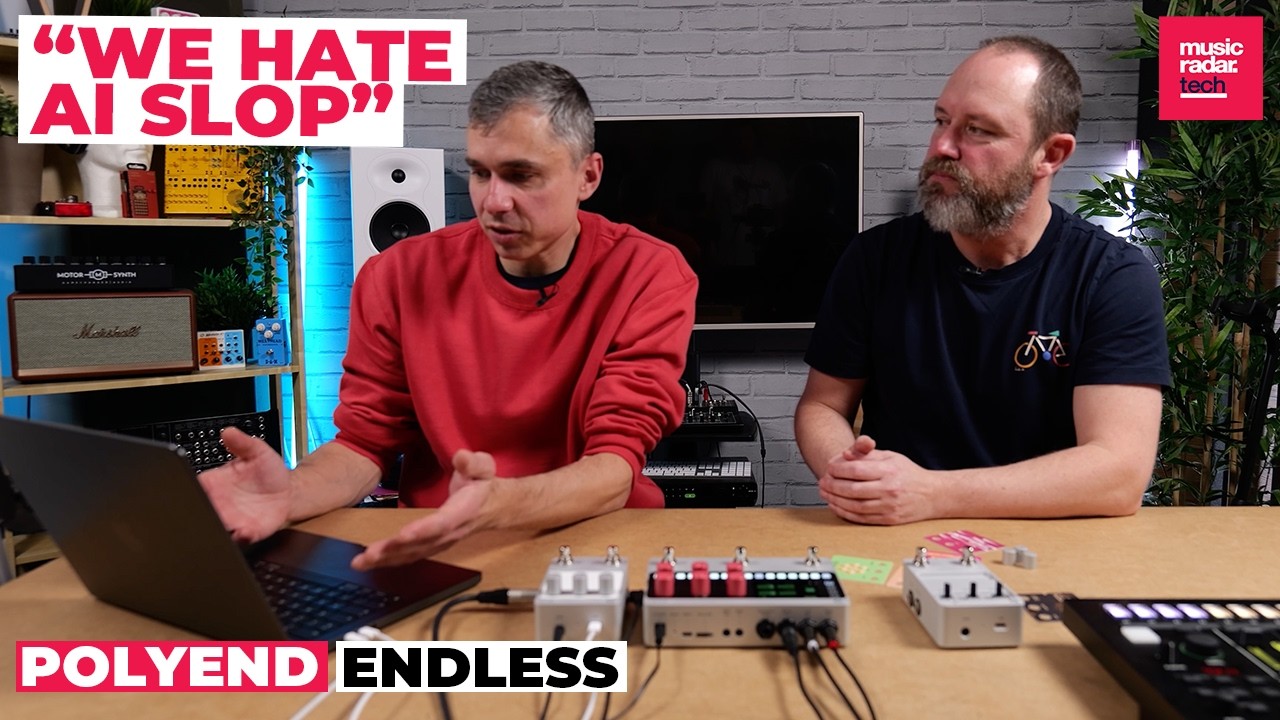
Polyend’s latest hardware release, Endless, was one of the most eye-catching announcements at this year’s NAMM show.
Endless is a digital stompbox effect that can be loaded with different processing algorithms in order to produce a near-limitless variety of sounds. What makes it so attention-worthy, however, is the accompanying Playground system, which can turn a user’s text prompts into a completely bespoke DSP effect ready to load into the pedal.
It doesn’t take a deep understanding of technology to figure out that this sort of text-to-code system is likely powered, at least in part, by AI. Interestingly though, its creators are reluctant to use that term. Where other technology companies seem to be competing over who can demonstrate the flashiest, most advanced application of LLMs or machine learning, Polyend’s website includes barely a single mention of AI, a term it describes as ‘radioactive’.

“We hate AI slop,” Polyend founder Piotr Raczyński tells us. “We don't want the fun to be taken out of music making. I think there is a distinct boundary where AI should be involved in creating the tools that inspire you, but it doesn’t take any of the fun from you.”
It’s true that, while the AI-assisted aspect of Endless is its most eye-catching feature, it’s only one aspect of how the system works, and users can make full use of the pedal without interacting with The Playground at all, should they wish.
There are, in fact, three ways to access new effect algorithms. The first and simplest to use is Plates, which is Polyend’s community-focused library of effects. This hosts all of Polyend’s own effects, as well as those created and shared via users (although community submissions will be tested by Polyend before being added to the library).
This ever-growing library is free and fully accessible for all Endless owners, and already features a broad range of creative tools, including reverbs, distortions, loops, granular effects and more.
Those with coding skills of their own can create effects using C++ and Polyend’s open-source SDK.
However, if you have your heart set on a specific bespoke sound and need some help bringing it to life, that’s where The Playground comes in.
“If you don't know how to code but have some idea for an effect, that’s when you can use The Playground,” Raczyński says. “You describe your effect in your own words and kind of talk to the system.”
This kind of ‘vibe coding’ – using a large language model (LLM) to create code based on text prompts – isn’t hugely unusual. As Raczyński explains though, what’s going on behind the scenes of The Playground is a little more complicated than simply outsourcing the work to something like Chat GPT.

The Playground makes use of various AI agents that are doing multiple things simultaneously, deciphering the text inputs, searching through the existing database of effects and running testing so that the end result is something at least reasonably functional.
From a user point of view, based on the initial text input Playground will offer up three potential effect options, each with a description and some suggestions for adjustable parameters to be assigned to the hardware’s knobs and switches. The user can choose one of these to pursue, as well as suggest any changes or updates, at which point the system will begin the process of generating and testing the code.
As Raczyński explains, Playground doesn’t automatically jump straight to creating code from scratch. Initially it will search through the library of algorithms to see if it can piece an effect together from existing code.
“The system goes through the whole vast database of DSP algorithms that we’ve created, over the years producing Tracker and Synth, and the Endless DSP effects,” he tells us. “There is a huge, ever evolving library of effects that we prioritise in the first place.
“The system uses that, but if there is not an effect that it finds in the database it can connect a couple of them together. So if you want, say, an overdrive that goes into reverb then goes into delay, it will try to find those in our system and then stitch them together using LLM models.
“If it is out of the scope of our system, it will generate the DSP code itself from scratch. This is where magic can happen.”
Soft Play
When Raczyński visited us in our studio, we put this system to the test by using The Playground to create a glitchy looper effect (you can see and hear the results in the video above.)
The technology is undeniably impressive, but not without limitations. It’s easy to get a little over ambitious with your prompts, and the Playground system can struggle to keep up.
“You have to be very deliberate about what you actually need,” Raczyński says, “or you can wait for a happy accident to happen.”
Problems can sometimes arise from the limitations of language itself. It can be tempting to try and feed The Playground a lot of adjectives – glitchy, crunchy, warped, ambient – but these are somewhat ill defined concepts, and it’s usually more effective to tell the system exactly what you want it to be doing.

“Imagine you are generating a picture,” Raczyński says. “Sometimes you get what you intended, sometimes it’s bad and you have to reiterate [what you wanted].”
That being said, Endless is also capable of more than you might initially think. As Raczyński demonstrates in our video, the pedal can also be used to generate sounds itself. In our demo, you can hear it being used as a physical modelling synth generating randomised Euclidean sequences.
“What we've discovered is that prompt quality has the biggest influence on the quality,” Raczyński explains. “The idea that we are working on now is that there will be some kind of agent we call a prompt engineer that will convert these simple ideas into proper engineering words, because that helps a lot with the quality.”
By Polyend’s own admission, The Playground – which is still currently in Beta – is an ongoing work in progress, which will only improve as time goes on.
“This is the worst version of The Playground you'll ever see,” Raczyński explains. “LLMs are getting better because there is this huge competition between the big companies, but also we are getting better in understanding what we need to feed it.
“Say we want it to be able to specialise in building loopers, we could build more libraries regarding loopers – and that's what we will do. It will be easier for the LLMs to create the DSP process. It can just take the looper infrastructure and add, say, whatever glitchy stuff you want. It will be nice and quick. As of now, we don't have a looper DSP built in, so it will be done by DSP 100%. Thus we can expect weird things to happen.”
Use of The Playground isn’t free, relying on a system of tokens that users need to pay for. We were pleasantly surprised to see how far a few tokens will get you, however.
“With the device, you are getting 2000 tokens for free, and this should give you about 10 to 15 ready patches,” Raczyński tells us. “All the community patches and our patches are free and will be for free forever.
“If you run out of tokens, you just go to the Playground, hit ‘get tokens’, and the pack of 2000 costs about 20 bucks.
“We are not making any money on the tokens,” Raczyński says. “We are using some external APIs and language models that are coding for this system. And that costs. We are adding just a little bit of markup to have the infrastructure covered as well, because there is a huge infrastructure.”
Polyend also tells us that they hope the token system will become cheaper over time, with the aim that eventually it won’t be needed at all.
The future is Endless
Polyend has some lofty ambitions for the future of Endless and The Playground – ones not limited to the pedal itself.
“My idea wasn't to just ride the wave of AI hype,” Raczyński says. “I kind of see a vision of where we could open up everything we do, and then allow users to use our Playground to generate bits and pieces in a way that’s open ended.
“Imagine a synthesizer, let's say [Polyend] Synth. Just imagine you've got a filter section or oscillator section, and you can say, ‘hey, I want my oscillator to be based on something with a square wave, but FMing’. You know, the sky is the limit.”
"I was trying to create a looper like Thom Yorke uses on Bloom. As I was doing that, Johnny Greenwood sent me a message to say he was into the idea of Endless"
The first step in that vision is bringing Endless’s bespoke effects to Polyend’s multi-effect pedal Mess, with a new free firmware update that adds an Endless Player module. This allows users to upload effect algorithms created for Endless (a few small DSP limitations aside) to Mess, to use alongside the pedal’s sequencers and inbuilt effect modules.
Mess owners will have access to the community library of effects, although – for the time being at least – access to Playground will be limited to Endless owners.
It will be interesting to see how quickly Endless and The Playground are adopted by music makers, and what sort of tools the community develops. Even from the initial announcement, the system has seemingly generated a lot of interest, including from some high profile names.
“Two days ago I was trying to create a looper like [Radiohead’s] Thom Yorke uses on Bloom,” Raczyński says. “He plays piano and puts it through the modular system. He plays something, loops it, and it slowly evolves into, like, broken cassettes.
“Funnily enough, during production of that, [Radiohead guitarist] Johnny Greenwood wrote me a message to say that he's into the idea [of Endless]. It’s crazy that it happened at exactly the same time.”
Mess is out now priced at $599. Endless is available to preorder priced at $299. Head to the Polyend site for more information.
