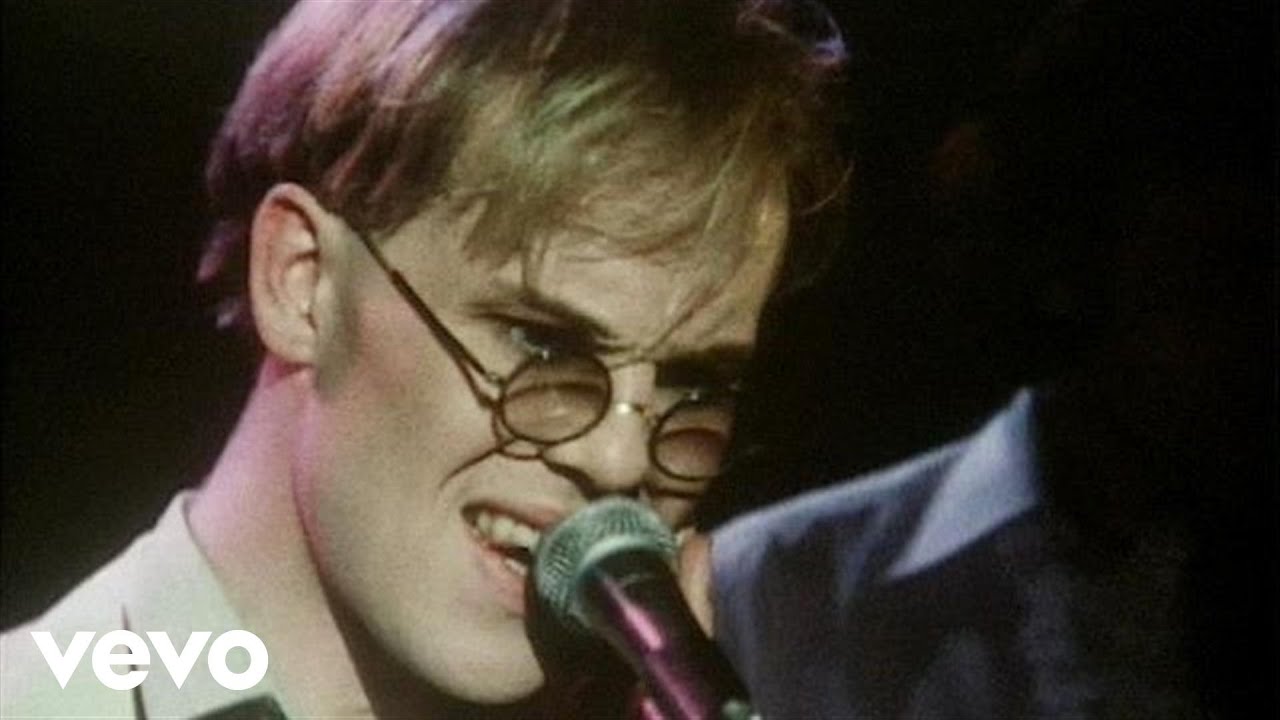
RECORDING WEEK 2026: For a variety of reasons, the 1980s often get a bad rap. Unfettered capitalism shifted the western axis from good to greed, and pop music began to mirror this newfound faith in consumerism - and our collective fixation with the life-enhancing benefits of modern technology.
Old certainties were being supplanted by a vision of just what tomorrow might look like - with science and innovation leading the way towards a glorious tomorrow for households throughout the western world.
Someone who’d long been dreaming of a techno-utopian future however, was Thomas Dolby. A man who came to a epitomise the synthesist-pop artist of the early 80s, Dolby spent his formative years listening to bands like Tangerine Dream and Kraftwerk - but the prohibitive cost of synthesizers meant that he was forced to head to the West End of London in order to play expensive synths in shops, often getting booted out a closing time!
Growing up in South West London he could often be found hanging around the Electronic Music Studios - also known as EMS - who produced legendary synthesizers such as the VCS3.
By chance, he found a discarded circuit board for a synth in a skip at the back of their studio, and, being inquisitive and fairly industrious, took the circuit board home. Before long, Dolby had built his own synth.
And so, the perception of Dolby as something of a synth-scientist started to become more like art imitating life. He worked as a programmer and keyboard player for the band Foreigner (the intro of Waiting for a Girl Like You, specifically) and supplied keyboards for an early 7-piece lineup of the Thompson Twins, before they became a trio.
Monetising his passion allowed him to afford the creation of his first album, and what a debut it was!
The Golden Age of Wireless is regarded as a classic, despite the fact that at the time, Dolby was a relative unknown, and the album didn't do terribly well. The skeptical record company told him that they needed a hit, or his prospects were looking bleak…
Dolby had become increasingly away however, of the increasing importance of music video. In his head, he imagined the visuals for a prospective short film. Albeit one that needed a particularly compelling track to soundtrack it…
“I was very keen to try out my talent as a music video director. I was always a big fan of silent movies: Chaplin and Keaton and Lloyd and so on. And I saw music videos as really a silent movie with a soundtrack,” Dolby told Songfacts.
“I managed to persuade my record company to let me take a shot at writing and directing [a video]”
His label were intrigued, however they wanted to hear the song that the video was actually for… “I said, ‘Oh, well, I'll bring it on Monday morning.’ Then I went home and wrote the song,” Dolby told Forbes. “So it was definitely spurred by the enticing idea of writing and directing my own video.”
Created over the space of this single weekend, She Blinded Me With Science was born. Dolby harnessed his carefully assembled instrumental rig to maintain the sound-set from the first album. Given EMI's retrospective desire to integrate the single, that was clearly a good move.
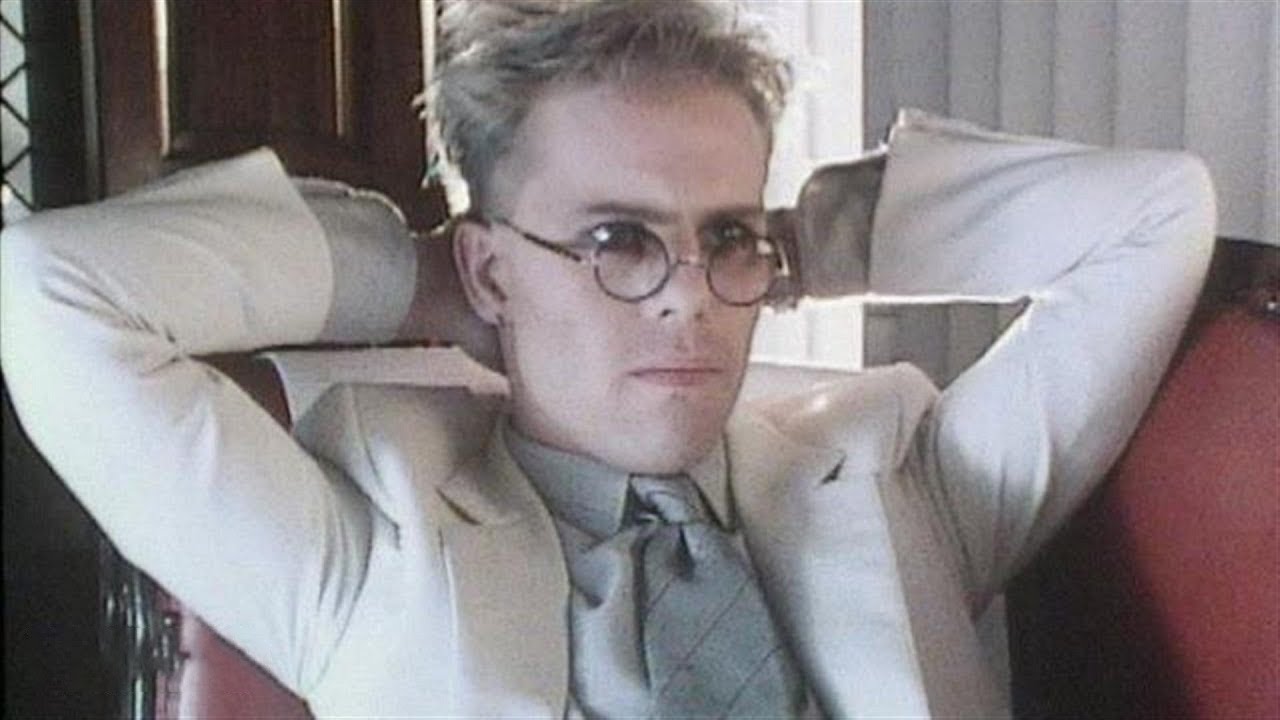
Dolby was a huge advocate for the PPG Wave and associated computer. Offering wavetable synthesis, the Wave also provided basic sequencing and sampling, which proved invaluable for the song. He even nicknamed the wave computer ‘Henry’.
The drum track was generated from both the PPG and a Simmons drum module. The iconic offbeat cowbell was played by the PPG, which was also used to sample the snare sound, which was detuned before being incorporated into the track. The other drum sounds, particularly the highly distinctive toms, were supplied by the Simmons module.
Regrettably, the Wave Computer that had done so much of the heavy lifting on the first album had a terrible accident. It ended up falling down a lift shaft, and with that, Henry regrettably met a less than auspicious end.
Consequently, Dolby nicknamed his newly acquired Fairlight CMI Henry the 2nd! Of course!
He was only able to afford said Fairlight thanks to an advance from his record company, with which he also bought a flat. According to Dolby, the Fairlight was more expensive than the flat.
Long-time friend and bass player Matthew Seligman (also previously with The Thompson Twins) played the bass part on Science using Dolby’s Moog Source synthesizer. Rather than simply DI’ing the signal, it was played through a bass amp in the studio which was mic’d.
The magic created between the metronomically sequenced drum parts, and the organically played bass part is just perfect. There are subtle moments of improvisation in the bass, while it sits just behind the timing of the drums.

The iconic lead lines and jazz-influenced synth chords were all played by Dolby on his Roland Jupiter-4. He would later own a Jupiter-8, but the identifiable saw brass perfectly shores up the verse and chorus sections in both an accompanying and lead sense.
Drawing upon his experience of playing with bands, both live and in the studio, Thomas Dolby never seems to overplay on his songs. Everything has a place, with space being an important element, often letting musical moments of interest peep through, from a vocal to a synth sound.
What's quite surprising about this song is that it doesn't have a vocal heavy chorus. In many respects, this is the genius of the song - because it just continually references the song’s name. One element which really hammers this home is the continual interjection of the word “Science!”
Back in the early 80s, a scientist called Dr. Magnus Pyke, was quite a celebrity. He could often be seen in the role of an eccentric scientist on many television programmes. Hence, he was quite a household name in the UK.
Thomas Dolby discovered that it was possible to hire the good doctor by the hour, so he bravely booked him to come to his studio and deliver a few choice lines, as well as earmarking him to appear in the soon-to-be iconic music video.
Apart from the word “Science!” , in various stylised proclamations, he also delivered the line “Good heavens, Miss Sakamoto, you're beautiful!”
Of course, by today's standards, this feels slightly inappropriate, but it came from a position of love and respect, and cheeky a nod to the wife of legendary artist and composer Ryuichi Sakamoto, who was a good friend of Dolby's.
One particularly interesting moment of the production stems from the interjecting vocal line in each verse, which feels quite ‘eastern’ in musical style and delivery. This was supplied by session vocalist Miriam Stockley - apart from being a superb singer, her versatility was fairly renowned in the industry, making her an ideal person to sing the line which is also doubled by violinist Simon House.

But as fantastic as the song was, its real purpose was to back Dolby's vivid video vision. Based around the concept of Dolby being a patient on the psychiatrist's couch, the video depicts him being questioned by Dr. Magnus Pyke in the extraordinary setting of Holme House - an enormous Georgian mansion located near Regent’s Park, in London.
All of this played into a narrative that became quite successful for Thomas Dolby. The notion of him being something of a whacky professor or inventor, surrounded by synthesizers and wire-trailing studio equipment, became the overriding perception of him during this part of his early career.
As a single, She Blinded Me With Science sadly failed to trouble the UK charts, topping out at number 56.
However, in America, it went all the way to number #5, due largely to the widespread rotation of the video, which was a mainstay on the freshly-launched music channel MTV.
“If you had a video that was a little bit original, then it definitely causes some waves,” Dolby reflected in an interview with The Electricity Club. “And I think in my case, they were talking in the States about the new ‘British Invasion’ and synthpop so everyone was casting around looking for what this thing was. There was a guy with a catchy song and a very specific image and it was the antithesis of the mullet rock ‘n’ roll of the late 70s. So I think that’s why it really caught on. It was perceived as being very English and quirky. Whereas in the UK, there’s quirky Englishness around you all the time… Magnus Pyke was always on TV so there was nothing so extraordinary about seeing or hearing him!”

With a hit to his name finally, Dolby’s record company EMI re-released the album, frustratingly losing the superb track The Wreck of the Fairchild in favour of the new Science single, along with its accompanying B-side, One of Our Submarines. Great as this was for invigorating sales, it seemed to unbalance the conceptually-structured album.
But, Dolby would go on to prove his artistic breadth across albums such as The Flat Earth and Aliens Ate My Buick. His command of studio technology, coupled with an exceptionally sound musical background, meant that while he was possibly denied the exceptional success that he deserved, his albums were critically acclaimed.
“Obviously I was very pleased with Science,” Dolby told Billboard in 1984. “But, something about it also turned me off. I thought it was my most frivolous song, that it wasn't me. I'm more serious, more intense than that.”
With his finger ever on the technological pulse, Thomas even went on to supply the software that was used in early Nokia mobile phones that allowed them to play polyphonic ringtones.
For Dolby, science and innovation continue to excite, and open new creative doors…
"I think over the years, starting with electronic music but then going on to MTV videos, to production, to working with computers and the internet, web, ringtones, filmmaking, writing novels, teaching at university… Each new field I've gone into I’m really out of control and that's what sparks me,” Thomas told us last year.
"I sort of go into atrophy if I find myself working in an area where I do have control and I know what I'm doing. I get bored and uninspired quite quickly.