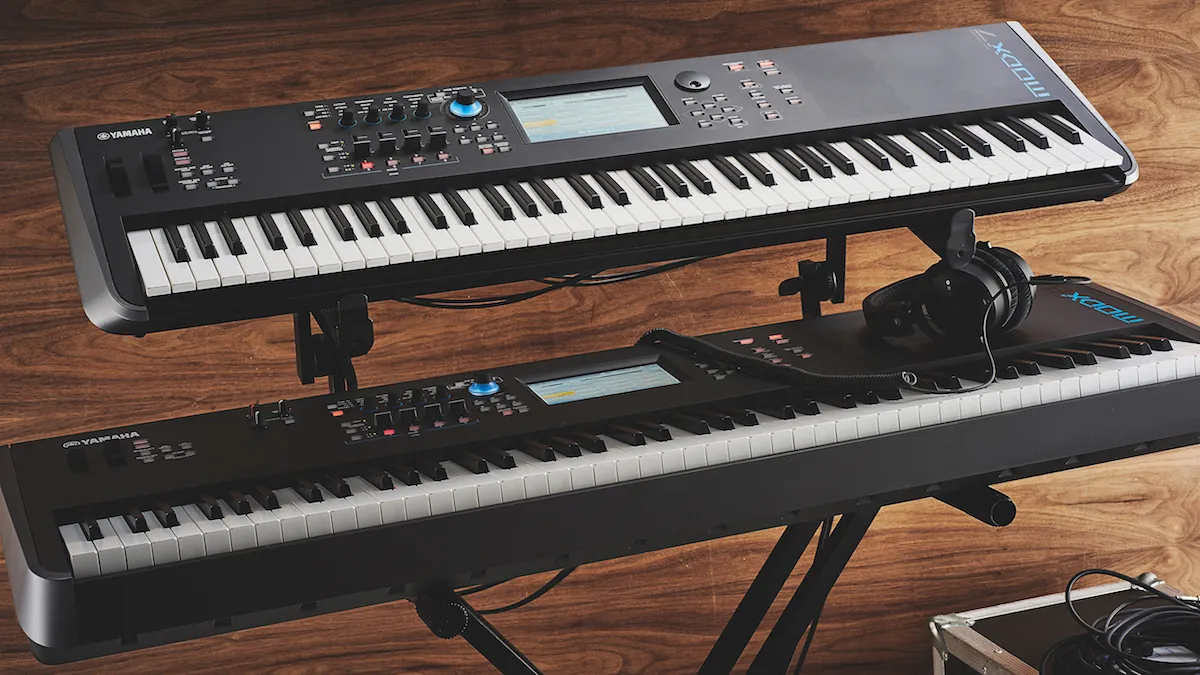
Like most support acts, the humble keyboard stand is often overshadowed by the more handsome heavyweights of the stage and studio, your prized keys and synths. But ignore it at your peril, the best keyboard stands are an essential bit of kit if you want your performances to go without a wobble.
Whether you’re a flamboyant, Wakeman-style stage performer with multiple ‘boards, a sedentary stage piano-pounder or a beginner with just a single home keyboard to accommodate, there’ll be something in this guide for you. After all, in every keyboard player’s life, there comes a time when you must take a stand.
If you just want to check out our choices, keep scrolling. If you’re looking for more guidance, we have included an in-depth how-to choose section, the answers to commonly asked questions, and even a glossary to help you decode the jargon around keyboard stands.

Best overall

The K&M 18860 comes up time and again when researching the best keyboard stands, so it must be doing something right. Although not the cheapest, it seems like there’s nothing K&M haven’t thought of to make their stand the best in this category for professional players.
Capable of housing two instruments, with the upper arms tilted at a 15-degree angle to the horizontal, the Spider Pro can be fitted with an optional extra pair of arms for a third keyboard, and also has a threaded connection on the top to attach a microphone boom arm. The lower part of the column sports two clips for cable management.
The reverse angle of the central column is set perfectly to allow full access to the lower keyboard, and you can even attach an optional laptop stand if required. The raised feet leave more than enough room for pedals, and you can even get it in a choice of silver, black or eye-catching red finishes.
Best double stand

The Hercules KS210B Double Tier X Keyboard Stand is a versatile, rugged stand built from durable steel, and in my opinion, it’s seriously road-ready. Its defining feature is the EZ-LOK system, which ensures the stand remains firmly locked in your adjusted position, eliminating mid-performance wobbles.
This quality, double-tier design offers plenty of performance options by accommodating two keyboards. The second tier is engineered for optimal playing setups, featuring independent height- and tilt-adjustability, allowing you to perfectly position your second instrument for seamless access during a set.
With four height adjustment options for the main tier, and adjustable rubber feet providing extra stability on uneven floors, the KS210B is ideal for gigging musicians. Best of all, this dependable stand folds up nicely and compactly, making it a perfect, space-saving solution for the tour van.
Best on a budget

If all you need is just a simple, inexpensive single-tier stand to hold an equally inexpensive keyboard, the Millenium KS-1010 is definitely worth a look.
Although often billed as a ‘heavy-duty’ piano stand, with a load capacity of only 25 kg, it’s best suited to lightweight electronic keyboards, so you should probably look elsewhere for something to house a digital piano.
This unit is really easy to put together, it’s height adjustable from 52 cm to 92 cm, and its double-braced design means it should be more than sturdy enough - as long as you stick to the weight limit!
Best table-style

The 18810 is a premium design specially suited for stage pianos and other large, heavy instruments. Its rigid steel tubing construction, open, table-style design and large round floor protectors offer more than enough onstage stability, with plenty of room underneath for your knees and any pedals you might want to attach.
Speaking of attachments, there’s a huge range of optional accessories that can be bolted on to this stand, including microphone booms, extra tiers, laptop supports, tablet holders and music stands. The 18810 has four Velcro tapes for cable management and is engraved with a height scale.
Available in black, white or red finishes, there’s plenty of height and width adjustment, and it can be folded flat for storage, although its form factor makes it a little more awkward to transport than an X-style stand.
Best triple stand

Jaspers is a small, family-owned, German business with a big reputation for A-frame stands and racks. Ask any group of synth ticklers for a keyboard stand recommendation and the name ‘Jaspers’ is bound to get a mention, inevitably followed by the phrase ‘they’re expensive’.
Sure, the 3D-105B is a bit pricier than a basic X-frame but look at the benefits. It’s made from sturdy but light aluminium tubing that’s either powder coated or anodised, depending on the part. Three tiers are included but there’s room for more if you need it. The lower tier, which is reinforced by a second tube, can support up to 40kg, while the top tiers can handle 15kg each (more with optional strengthening bars). The tube clamps all feature handwheels for easy adjustment, and the whole thing, with a bit of effort admittedly, can be folded up for transport.
Out of the box, the 3D-105B is insanely good for positioning a quiver of synths and a drum machine or two on the top tiers, together with a big kick-ass controller on the lower tier. But why stop there? Jaspers stands are modular, so you can add more holders, strengthening bars and accessories as your collection of instruments grows. Need to build in a laptop stand, an iPad stand, a music stand or some speaker stands? No worries, they’re available as bolt-on optional extras. Oh, and there’s no need to dismantle the entire stand to do so either, saving you from an afternoon of DIY hell…
Best heavy-duty

Built with the quality you’d expect from a big name like Roland, the KS-11Z is robust enough to handle everything from a lightweight home keyboard to the heaviest 88-key stage piano. It’s a good-looking contraption that will set off any brand of keyboard nicely, not just Roland’s own instruments.
Seven levels of height adjustment facilitated by spring-loaded levers, combined with eight levels of width adjustment via sturdy metal crossbars, make this a versatile and high-performance stand.
The support arms are foam-padded to give your keyboard a luxurious place to sit, and everything folds down neatly for transport. All in all, the KS-11Z represents a high degree of flexible support from a name you can trust.
Best A-frame

Ideal for those with a multi-keyboard setup, the Roadworx 4120B features folding A-shaped tubular aluminium side frames, connected by sturdy cross members onto which three pairs of adjustable support arms are bolted.
The 120 cm internal width is wide enough to accommodate a 76-key keyboard, and the support arms can hold up to 10 kg payload each and be positioned anywhere along the cross members to comfortably house smaller instruments.
Four keyboards stacked up always look impressive, and the 4120B doesn’t disappoint in the looks department, setting any collection of boards off nicely, whether displayed permanently in a studio or set up on stage. For the latter scenario, the frame folds up easily for storage and transportation.
Best Z-stand

Do you have recurring nightmares that your keyboard stand is going to give way mid-performance? Leaving you sitting with nothing but a bruised ego and crushed knees? Well, the Hercules Stands KS410B is for you. It can handle a whopping 130kg (286lb) of load without breaking into a sweat.
The heaviest stage piano I can find is the Kawai MP11 SE, which is built like a tank (it looks a bit tank-like too) but weighs only 34kg. Plenty to keep your Chiropractor in business but not nearly enough to trouble the KS410B. Same story with Yamaha’s new Montage M8x piano/super-synth/workstation thingy. It may be a heavyweight in the synth world, but it comes in at a paltry 28kg. You could perch both these keyboards plus a medium-sized vocalist on this stand without it flinching.
Why the over-engineering? We suspect it’s because Hercules wants you to enjoy a rock-solid platform for your keys, so it’s built a stand that can easily survive the rigours of touring. It’s made to last.
Load capacity aside, it’s a clean-looking two-tier Z-style stand, with adjustable rubber feet to ensure your playing remains on the level. Its Autolock system and locking pins, which have a reassuringly solid action, make setup and tear-down both easy and secure.
How to choose

What types of keyboard stand are there?
The best keyboard stands come in a variety of styles, literally from A to Z, but which one is right for you? The ones on our list fall into five main categories:
X-Style keyboard stand
Probably the most common type of keyboard stand, X-style stands are popular due to them being sturdy, lightweight, foldable, versatile and affordable. They can be assembled rapidly by swinging the two crossmembers out into an X shape and locking the stand into place at the required height with a spring-loaded pin at the centre of the X. The result is a durable solution with broad appeal, although legroom can sometimes be an issue for taller, sedentary players.
Z-Style keyboard stand
Taking the form of twin Z-shaped side struts linked together by central horizontal supports, the Z-style stand is another high-performance, sturdy design that’s especially suited to a more permanent setup as it usually takes a little longer to assemble than the X-style variant.
Table style keyboard stand
These rock-solid designs are best for playing whilst seated, so are great for holding up stage pianos or organs. While maybe not the most attractive design aesthetically, they can easily handle the weight of a hammer-action 88-keyer without wobbling around and have a wide open design at the base, meaning there’s plenty of room for your pedals – and legs!
A-Style keyboard stand
A-frame stands work great for housing multiple instruments, good for storage or display purposes - we found stands in this style capable of holding six synths at a time. So if you have a lot of vintage synths in a project studio, for example, and don’t necessarily need to play them all that often, A-frames are a good way to go.
Central arm keyboard stand
These types of cantilevered stands have a large central column that extends backwards at an angle from the base, from which the keyboard support arms extend at roughly 45-degree angles to hold your instruments. They have an appeal for looking good on stage, and also tend to ‘disappear’ behind your keyboards, making them good for displaying your gorgeous synths without drawing too much attention themselves.
Besides overall type of stand, other things to bear in mind when buying a keyboard stand include:
How heavy and what size is your keyboard?
MusicRadar's got your back Our team of expert musicians and producers spends hours testing products to help you choose the best music-making gear for you. Find out more about how we test.
What keyboards will you be using with the stand? The number of keyboards you have determines the number of tiers you’ll need, and if you have small, 25-note keyboards be sure to check that the minimum width is small enough. This is particularly true with X-style stands, as the width and height are relative – the narrower the width, the greater the height of the main tier.
There’s also the weight to consider – you don’t want your expensive and delicate instruments plummeting to the ground, so be sure the stand you go for is strong enough to accommodate the total load capacity.
How much legroom do you need?
If you play sitting down, you may want to consider a table or Z-style stand over an X configuration, as X-style stands, particularly double-braced versions, can inhibit knee room when playing seated, especially if you’re of basketball-player proportions.
What are you using your keyboard stand for?
For regular gigging, it’s important to consider overall portability, plus how long it takes to set up and break down a stand before and after the show. If you need a stand for home or studio use though, it’s more likely to be a semi-permanent setup, making this less of an issue.
When assembling this guide, we ruled out stands made as accessories for individual models of keyboard, like ones intended for use with a specific piano from big manufacturers like Yamaha and Kawai. Instead, we focused on general, multi-purpose stands designed to support any common-or-garden keyboard or synth from project studio to stage.
Outstanding advice
In summary, before you commit any cash to the first model you see, work out what you need from a stand and narrow down your choice from there. From A-Frame stands to Z-Style stands, you’ll discover plenty of options to support your keys, but one is bound to prove better than the rest for you and your kit. We’ve touched on this already, but if you’re tall beware some X-Style stands, because you’ll forever be brushing your legs against theirs (and not in a flirtatious way).
Consider the weight of your kit, plus the load capacity of each stand, and build in some headroom to be on the safe side. If you gig a lot, how easy will it be to set-up and tear-down night after night? Look for a stand that’s secure, robust and can be returned to precisely the same playing height with ease. Trust us, faffing around with flailing arms and legs (the stand’s, not yours) pre-gig is no fun. Similarly, trying to fold up a stand post-gig that still wants to stay up and party is tiresome to say the least. So, make sure it’s well-behaved and folds up quickly and neatly.
Finally, A-Frame stands that display all of your synths from floor to ceiling look amazing loaded with the right kit, LEDs flashing in unison. However, don’t expect to be able to play the ‘boards stacked four inches from the floor, or six inches from the ceiling - it’s not going to happen (more than once, anyway). Instead treat these as storage/display stands or rig up a controller to play them remotely from a comfier stand elsewhere in your studio.
Keyboard Stand Glossary
- Adjustable: Lets you change the height or width for comfort.
- Bracing: Extra bars that make the stand sturdier and less wobbly.
- Double-Braced: Stand with two bars on each side for strong support.
- Folding: Can be collapsed for easy storage or transport.
- Grip Pads: Rubber pads that keep your keyboard from sliding around.
- Locking Mechanism: The part that keeps your stand set at the right height.
- Pedal Shelf: A spot on the stand for your sustain or expression pedal.
- Portable: Easy to carry from gig to gig or around the house.
- Tier: An extra level on your stand for a second keyboard.
- X-Stand: A stand shaped like an X, super common and easy to use.
FAQs

Are all keyboard stands compatible with any keyboard?
Not quite! Keyboards come in all shapes and sizes, and stands do too. Some stands are universal and can adjust to fit most keyboards, but others are made for specific models or sizes. Always check the specs of both your keyboard and the stand. Pay attention to the width and weight limits. If you have a really big or heavy keyboard, make sure the stand can handle it. If you’re unsure, look up your keyboard model and see what others are using, or ask the store for recommendations.
How do I know if a stand is sturdy enough?
Sturdiness is key; nobody wants their keyboard taking a tumble mid-song! A good way to check is by looking at the stand’s materials (metal is usually better than plastic for heavy keyboards) and its weight limit. Reviews can also be super helpful for spotting any wobble issues. When you set it up, give it a gentle shake to see how stable it feels. Double-braced legs and locking mechanisms are a good sign. And if you play with a lot of energy or have pets or kids around, it’s worth investing in something a little extra solid.
Can I use a keyboard stand for other equipment?
Sometimes! Many keyboard stands work great for things like DJ controllers, mixers, or even laptops. Just make sure whatever you’re putting on there fits the stand properly and doesn’t exceed its weight limit. Some stands are more versatile than others, and a few are made to handle multiple types of gear. Adjustable-width stands are especially good for this. But if you need a stand for something very heavy or oddly shaped, it’s better to find one designed specifically for that purpose.
How do I set up and adjust my keyboard stand?
Most stands are pretty straightforward to set up. Start by unfolding or assembling the frame, then adjust the width and height to fit your keyboard and your playing style. Make sure all the locking mechanisms are secure before you put your keyboard on top. If your stand has rubber grips or straps, use them; they’ll help keep your keyboard in place. Take your time with the first setup and get comfortable with how the adjustments work. And always double-check stability before you start playing. It’s worth spending a minute or two to make sure your gear stays safe and steady!
How we choose the best keyboard stands

Here at MusicRadar, we are experts in our field, with many years of playing, creating and product testing between us. We live and breathe everything music gear related, and we draw on this knowledge and experience of using products in live, recording and rehearsal scenarios when selecting the products for our guides.
When choosing what we believe to be the best keyboard stands available right now, we combine our hands-on experience, user reviews and testimonies and engage in lengthy discussions with our editorial colleagues to reach a consensus about the top products in any given category.
First and foremost, we are musicians, and we want other players to find the right product for them. So we take into careful consideration everything from budget to feature set, ease of use and durability to come up with a list of what we can safely say are the best keyboard stands on the market right now.
Find out more about how we test music gear and services at MusicRadar.
Meet the experts

☑️ Established 2007
☑️ 2.9 million monthly users globally
☑️ 9,500+ reviews on-site
With more than 17 years of experience, MusicRadar is the premier music-making website in the world. Run by musicians for musicians, we offer expertly written gear round-ups and high-quality, authoritative reviews by an extensive team of highly experienced industry professionals.
Below you'll find more information on the expert authors of this guide.

Dave is an expert in all things keys, from beginner keyboards, to digital pianos, synths and beyond, and has been a music technology writer and product tester since 2007, contributing to the likes of Computer Music, iCreate, MusicRadar and Attack Magazine. Dave has also programmed and played keys on recordings by a range of world-renowned artists including George Michael, Kylie and Gary Barlow.

Daryl is a Senior Deals Writer at MusicRadar, and is responsible for writing and maintaining buyer's guides on the site as well as testing out products for reviews. Before writing for MusicRadar, Daryl worked for many years in music retail, helping musicians of all ages find the best gear for them. Whether it was a beginner's first keyboard or a top-of-the-range digital piano for the pros, Daryl was there to help steer players in the right direction.
Related buyer's guides
- Best keyboards for beginners: Start playing today
- Best digital pianos for beginners: start playing in style
- Best electronic keyboards: top keyboard options for every budget
- Best online piano lessons: recommended apps, software and websites
- Don't forget about these other essential piano accessories
- Explore our pick of the best Casio keyboards