





MusicRadar Verdict
Even as an update to a previous software instrument, Cherry Audio has managed to take a great synth to far greater heights. It looks, sounds and feels like a Moog, for a fraction of the price, and with no technical issues. Hooray!
Reasons to buy
- +
From the very first note, it sounds stunningly Moog
- +
Equipped with dual layering and 16-note polyphony, even in layering mode
- +
New ‘Modern’ filter feature reinstates low-end drop when using Emphasis (resonance)
- +
Now includes polyphonic aftertouch and MPE support
- +
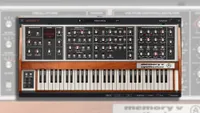
Blow it up to full-size on screen, and it’s like having a Memorymoog in the room with you!
Reasons to avoid
- -
Erm, it’s not a hardware original for $69?
MusicRadar's got your back Our team of expert musicians and producers spends hours testing products to help you choose the best music-making gear for you. Find out more about how we test.
What is it?
As we all know, Moog is more than just a company. Since the late '60s, it has continued to produce one of the most iconic synthesizers of all time; the Minimoog. The power of this humble monophonic machine, continues to be revered and much in demand, even for the most contemporary of applications.
However, Moog has also had its fair share of trials and tribulations. Never has this been more apparent than with its turbulent track record for creating polyphonic machines.
Described by Moog as an intended ‘polyphonic Minimoog’, the Memorymoog originally started production in 1980. As a 6-voice unit, each voice offered the same architecture as the Mini, but at a time when Japanese companies were stealing a march on the polyphonic domain. Moog really struggled to make a machine that worked reliably, despite sounding amazing (which it did), with many users giving up on the machine, in favour of the competition.
Fast forward to 2021 and Cherry Audio brought us its recreation of this much revered classic, in a software form. Five years on, Cherry is revisiting this concept, bringing us the Memorymode 2. Not only does it look sharper, but it sounds even more detailed, thanks to the implementation of improved modelling techniques that Cherry has explored over the last few years.

Performance
According to Cherry, this update began with the intention of adding a few more layers of sheen to what was already a fantastic-sounding model of the Memorymoog. Of course, as they started stripping away the layers, they quickly realised that they could go far further, which explains why it feels like there is a significant uptick in the outputted sound.
We all know that the default patches are designed to show off a synth in its best light, but even with our very own experiences in this domain, you cannot help but be impressed. The instrument installs with over 800 presets, all beautifully arranged and aligned, so you can find exactly what you are looking. One tiny criticism is that the graphics in the Preset browser seem to whizz by very quickly when controlling with our mouse or trackpad. Even so, you will want to explore everything that the synth has to offer, complete with Cherry’s usual array of stunningly good FX.
Graphical
One of the most obvious areas that has been improved, relates to the graphics. Like all of the more recent Cherry designs, the interface seems incredibly three-dimensional. We thoroughly enjoyed blowing up the interface to the full size of our screen, as a standalone version, and just playing like a proper hardware synthesizer, which is of course what it is/was.
Stripping back to a new patch level, the oscillators sound rich and warm. With three VCOs per voice, you can treat this like a Mini in Poly-clothing. Saw, Triangle and Pulse waves are available, with the latter being open to pulse width control. Each oscillator has its own level/volume control, and you can add noise to the equation too, if so desired.
With a drift control located nearby, it’s possible to exaggerate VCO detuning, in that analogue way! This element works very effectively; however, we did find ourselves dialling it back quite a bit, such is the level of its effectiveness.

Filter quirks
As any adopter of the Moog ladder filter will attest, cranking resonance (emphasis) does tend to engineer a drop in low-end signal. Traditionally, we would always employ saturation or overdrive in an attempt to reinstate the bottom end.
Apart from the beautiful modelling of the filter, we didn't find the drop here too overbearing, but by way of heading off any problems at the pass, Cherry have now included a ‘Modern’ feature, which reinvigorates the low end, but without distortion across the whole patch. We were very impressed with this; upon engaging while playing a note, there was a noticeable low-end thump, but despite this, the employment of the modern feature sounds very musical. It is not in any way overzealous, and seems to merely add more character.
The filter section also plays host to its own 4-stage envelope, along with a control for velocity. This mirrors the amplitude envelope, although in typical Moog style, there is a dedicated button to activate the Release phase.
There is now full implementation of polyphonic aftertouch, as well as full MPE support, with patching which is designed to show this off beautifully, provided you use a suitable controller keyboard.
More extras
The lower portion of the interface allows Cherry to offer its usual trick; switching between keyboard, sequencer (motion) and FX.
The FX section needs little introduction, offering five dedicated slots for its excellent parade of modelled effects. Everything is here from Juno-esque chorusing to Galactic Space Echos, and with the ability to apply globally, or across the upper or lower levels.
Talking of which, the Memorymode 2 is fully stackable in two layers, with no loss of polyphony. We have to warn you, things can get pretty wild and huge when you do, which may entice you to explore the split mode instead. You can decide where you want your layering to begin and end, but we did find that things were often huge enough, without extended use of layering on a regular basis. That’s what happens when you have three VCOs per voice!
The Sequencer mode also reveals an enormous layer of fun, being fully programmable and triggerable from the keyboard. However, we are always suckers for a good arpeggiator, and we weren't disappointed here either. With various available patterns and some nice timing enhancement settings, we could find ourselves lost for many minutes at a time. Of course, things only improve when you clock the arpeggiator together with clockable onboard delays.
Verdict
Despite the numerous enhancements, not least the vast array of 52 modulation destinations, the one thing we haven't mentioned in detail yet is the overall sound. We've been experienced Moog users for many years, in various keyboard capacities. The Memorymode 2 unequivocally sounds like a superbly serviced vintage Moog synth, and is clear from the very first note that you play.
Cherry has been exceptionally faithful, including the original 100 presets from the hardware. You can also transfer original patches from hardware to the software, should you be lucky enough to have an original… and it still works!
But, as is so often the Cherry way, the craft and exploration that has gone into creating a vast set of included patches takes the concept to a new level of contemporariness, which really shows off the product in its best light. It simply sounds amazing, so if you have a hankering for the old hardware but don't have a bank balance to match, this is an excellent place to go. You will get all of the original sounds, but with so much capacity to go further.
Hands-on demos
Cherry Audio

Alternatives
Specifications
Price |
$69 ($39 upgrade from v.1) |
Key features |
Two VCOs per voice Sixteen note polyphony Two 4-stage envelopes Classic 12dB/24dB ladder filter with ‘modern’ mode Layering capability - Dual and Split On-board sequencer and arpeggiator Full suite of FX also on-board Full MPE support and polyphonic aftertouch |
System requirements |
MacOSX and WindowsPC: AU, VST/3, AAX & Standalone formats |
Contact |
