





MusicRadar Verdict
The Prodigy from Martinic is a beautifully modelled example of a much-revered classic. It hosts many useful additions to the original, while maintaining that authentic Moog sound.
Reasons to buy
- +
It’s got that unquestionable Prodigy sound and grunt
- +
You can keep it true and authentic or switch to Advanced mode for additional parameters
- +
6-voice Unison or 8-voice polyphony available
- +
Plenty of usable presets included
Reasons to avoid
- -
At its heart, it’s still quite a basic synth, but it’s got character
- -
Only basic spring reverb and overdrive effects onboard
- -
No standalone version
MusicRadar's got your back Our team of expert musicians and producers spends hours testing products to help you choose the best music-making gear for you. Find out more about how we test.
What is it?
Back in 1979, the synthesizer landscape was markedly different to the market we face today. Monosynths ruled the stages, with many being heavy and expensive, but with competition from Japanese brands gathering pace, Moog was under pressure to package its Minimoog into something far more affordable.
Enter the Moog Prodigy, a synth bookended in wood but offering a dual-oscillator design, along with Moog’s 24dB ladder filter. Its original price was a mere £295, which in the late '70s made it a total bargain (although in 1979, that was still a heck of a lot of money!).
Limiting circuits
Back then, most people who could afford any synthesizer on the cheap would have been exceptionally happy with the attributes of the Prodigy, although it did have considerable limitations when compared to other synths, particularly the Minimoog.
The dual oscillators only provided three waves apiece – saw, triangle and square; although VCO 1 offered the reedier sound of a pulse, at a fixed width, instead of a square wave. You could at least sync the oscillators or change the pitch of VCO 2 to create basic chords, up to the outer limit of a fifth each side of VCO 1. The LFO only offered triangle or square waves, although it could be applied to pitch or filter.
There were two three-stage envelopes, adopting the classic Moog ADS contour, with a switch to activate a release phase. To keep the cost down, the pots were not as robust as those found on other Moog products. The panel switches were not the highest quality either and were prone to failure.

Performance
Given the sonic limitations, you would wonder why anyone would entertain resurrecting the Prodigy in software? The straightest answer to this question is that it’s a superb-sounding synthesiser at any cost. It’s also interesting to note that, while sample libraries of the Prodigy have existed for a while, this is the first example of a Prodigy (at least, that we are aware of) that takes the form of modelled software.
Martinic could still be regarded as a relatively new brand in this sector, but it has vast experience, having previously produced instruments for other companies. The Prodigy could be its most defining product yet, being a more obvious contender in its product line if compared to some of the more left-field instruments that the brand has created, good as they are!
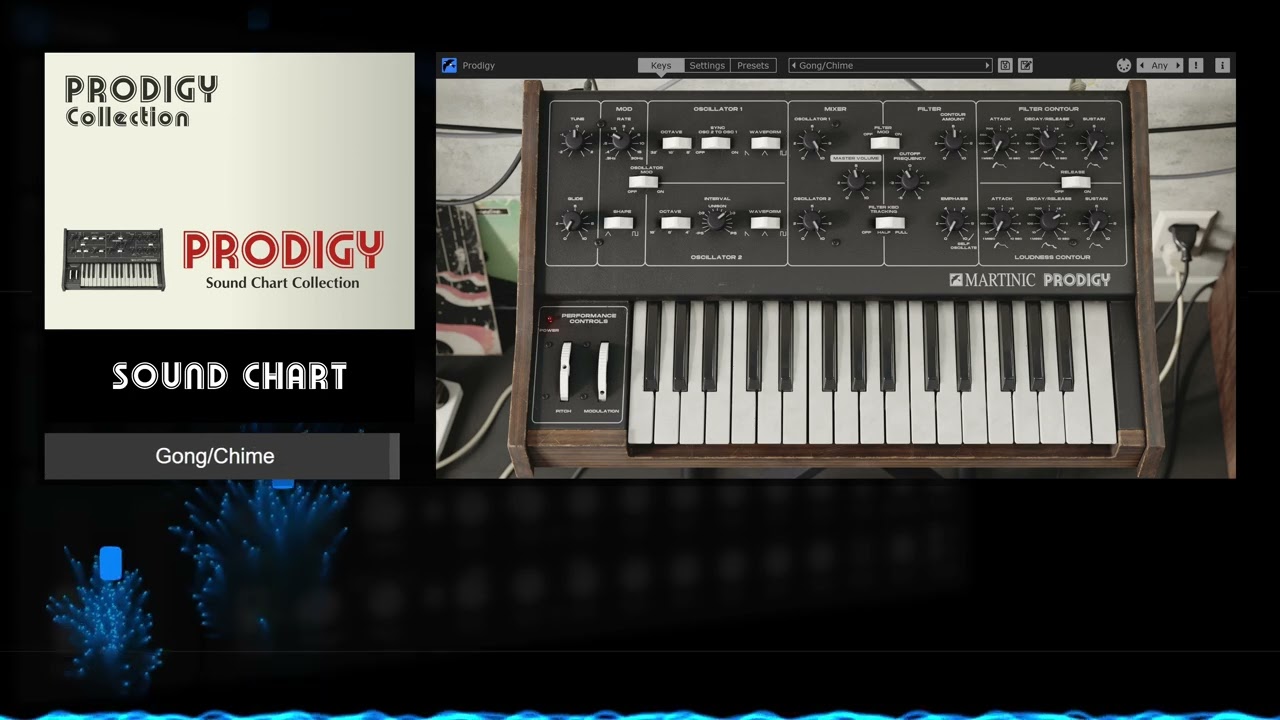
Loading Prodigy from within a DAW, you can't help but immediately smile when the main screen splashes into view. The clever graphics place the original keyboard interface front and centre, with various associated elements of cabling resident in the out-of-focus background. It's beautifully done!
The panel itself looks entirely familiar, complete with a few minor scratches to the panel and woodwork, much like a second-hand example we fear! Loading in its default state, the initial saw wave is bright but weighty, particularly if you then add the second VCO to immediately thicken the texture.
Down the ladder
Reaching for the filter cutoff control, the pot is very swift to react, completely filtering out the oscillator audio fairly early in the virtual pot’s turn. We can't remember the behaviour of the original, but we would imagine that Martinic has paid great attention to this element. Application of resonance, described here as ‘Emphasis’, does exhibit the usual ladder filter trait of a loss of low end, although the emphasis can be pushed to self-oscillation should you wish to turn down the oscillators and just work with the emitted sine. Either way, the filter sounds exceptionally reminiscent and very fine too!
This obvious facet makes it a good time to explore the fact that, while Martinic’s overarching attention is on authenticity, there’s far more to explore. With a quick meander through the excellent presets, it’s clear that there is a bit more to this monosynth than the original architecture. By clicking on the Settings page, at the top of the plugin, you reveal a host of additional functionality, which runs alongside the original, described as Advanced mode. This includes a boost mode to reinstate the loss of low end generated by a high-resonance (emphasis) setting. However, there is a lot more available in this mode.
The oscillator wave count shifts up to four waves. Residing alongside the two main oscillators, there is a basic sub oscillator, accompanied by either pink or white noise. There is also an overdrive pot, which is useful on several levels, which includes extending the power of the Prodigy’s bass prowess.
The two envelopes appear in a four-stage format, and the LFO is extended to five waveforms, with a multitude of applicable modulation destinations. However, one of the most exciting elements has to be the sequencer, which is located at the bottom of this page. This can be used as a 16-step sequencer or split into two lanes of eight steps, with a similarly impressive array of modulation destination options, and syncable… of course!

Verdict
There's an awful lot to really love and enjoy about this plugin. At first glance, it is an excellently modelled recreation of the original Prodigy, with a stunningly beautiful display which is a joy to use. However, it does have its limitations, because of Martinic’s attempts to keep that authenticity alive, while allowing the user to decide their preference for functionality over graphics. While the Settings page might feel a little dull graphically, it offers an awful lot more, on the level of programmability and sheer sonic joy.
We do miss the lack of a standalone version, but Martinic makes up for this by also offering the plugin in the CLAP format. This may also explain why the Prodigy only ships with relatively basic effects, namely overdrive and an excellently modelled spring reverb, but it's always nice to have these elements on call from within.
Notwithstanding, the overall power of the synth for bass and leads, and its new flexibility in polyphonic mode, means that this plugin is impressive and authentic in equal measure. It’s quite literally the Prodigy’s return!
Hands-on demos
Martinic
Alternatives

Specifications
Price |
£58 (full licence) or £20 (1-year licence) |
Key features |
Dual-oscillator architecture with Sub (in Advanced mode) Up to 4 oscillator waveforms available Classic Moog 24dB Ladder filter Syncable LFO modulation 6-note Unison mode or 8-note polyphonic mode MPE pitch bend support Onboard Spring Reverb |
System requirements |
MacOSX and WindowsPC : AU, VST2/3, AAX and CLAP plugin formats |
Contact |
