




MusicRadar Verdict
Zebra 3 is an extraordinarily good synthesizer, which boasts over 1,200 presets as a starting point. Sound creation is an important part of the product’s manifesto, but you will need to put in the legwork to understand how it all works and interacts together. You’ll need to earn your Zebra stripes!
Reasons to buy
- +
Extraordinarily good sounding plugin synthesizer
- +
It goes so deep sonically, the rabbit hole metaphorically hits Australia!
- +
It is packed full of exceptionally good presets, which are categorised
- +
The clean UI is a pleasure to use, although complex
- +
Comprehensive number of synthesis options available
Reasons to avoid
- -
There is a fairly steep learning curve, even for experienced synth users
- -
A standalone version would be nice, from a programming stance. Sometimes you don't want a DAW in the background!
MusicRadar's got your back Our team of expert musicians and producers spends hours testing products to help you choose the best music-making gear for you. Find out more about how we test.
What is it?
To say that the release of u-he’s Zebra 3 has been enormously anticipated is possibly the understatement of the century! It had almost become a running mantra that every time you met someone from u-he, you would ask the same question and be presented with the same answer. Q: When will Zebra 3 be released? A: Soon!
The full update finally dropped in April 2026, after an extensive period of public beta testing, which, according to u-he, was specifically designed to iron out any possible software issues before full release. Let's face it, there was no point in rushing this, as the first line of code for Zebra 3 was written 11 years earlier! That's quite a period of development. Hey, it's worked for GTA VI!
However, the burning question is, was it worth the wait? We can cut to the chase immediately on that front, with a resounding ‘yes!’ But there is clearly a lot more to it than that!
Zebras young and old!
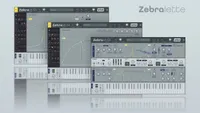
The Zebra product line has been around since late 2003. Version 1 was a relatively simplistic affair, the bare bones of which infiltrated a number of other products in the Zebra lineup. We have to give thanks and kudos to ZebraCM, which is an exceptionally powerful 2-oscillator product, and still available as a freebie, as is Zebralette 3, which is a stripped-down version of the full-blown Zebra package.
With the shift to Zebra v.2, so came a radical redesign of the interface, which made the product substantially more modular in make-up. This remains the foundation for Zebra 3, but it has been vastly overhauled to make access to modules even easier and clearer to use, at the programming level. You might think that this means that it’s been simplified – bottom line, it hasn't! It's now more complex than ever, but predominantly because the forms of synthesis on offer are extensive and can be used in multiple combinations to create incredibly complex patches and signal chains.
So what exactly do you get in this package? Forms of synthesis and tone generation include the more regular subtractive waveforms, accompanied by wavetable and additive synthesis engines. Yamaha-style FM synthesis is available (aka phase distortion synthesis) as well as modal resonators and comb filters, coupled with noise and exciter modules, allowing for the creation of complex physical modelling.
The oscillator sections are complemented by 20 oscillator effects which include spectral decay, oscillator sync, phase remapping and more.
Modulation is an enormous component of Zebra 3, and alongside the more usual LFO generation, the Multi-Stage Envelope Generators (MSEGs) allow complex shapes to be created for modulation, triggering and looping. It’s a bit like having a product like Shaperbox (by Cableguys) built into the heart of your virtual synthesizer.
There are ring modulators, distortions, wave folders, and an incredibly large number of effects, which sound impressive in their own right. Zebra 3 also supports MPE and microtuning systems, and even supports the new CLAP plugin format and Linux operating system.
Phew! That’s quite a lot in a single soft synth!

Performance
As is so often the case, a great starting point to get a feel for a product is with the auditioning of some of the included preset sounds. All of the presets are categorised, which is just as well, because there are currently over 1,200 presets supplied. Many of u-he’s favourites have been collated into a favourites folder, labelled Showcase; otherwise the categories are self-explanatory. You get everything from Atmospheres to Drum Loops, and it doesn't take long for you to work out that there is an amazing complexity to the available palette, and that translates into some amazing sounds across all genres.
Euro-style pads and chordal sounds reside alongside engaging basses and leads, and modelled interpretations of acoustic instruments. It’s all very playable, engaging and inspirational, particularly when trying to get off the blocks creatively.
We would suggest that part of the reason for the quality of the supplied presets is that the patch programming team have had quite a run-up to the full product release. This is the sort of synth that you need to take time to learn, and there are undoubted levels of exploration throughout the preset catalogue.
One slightly disappointing note is that programmed sounds from Zebra 2 cannot be imported into Zebra 3. This is a bit of a shame, but it reflects the complete change in product architecture.

Programming
It's always interesting to try and reverse-engineer presets, particularly ones that are more complex.
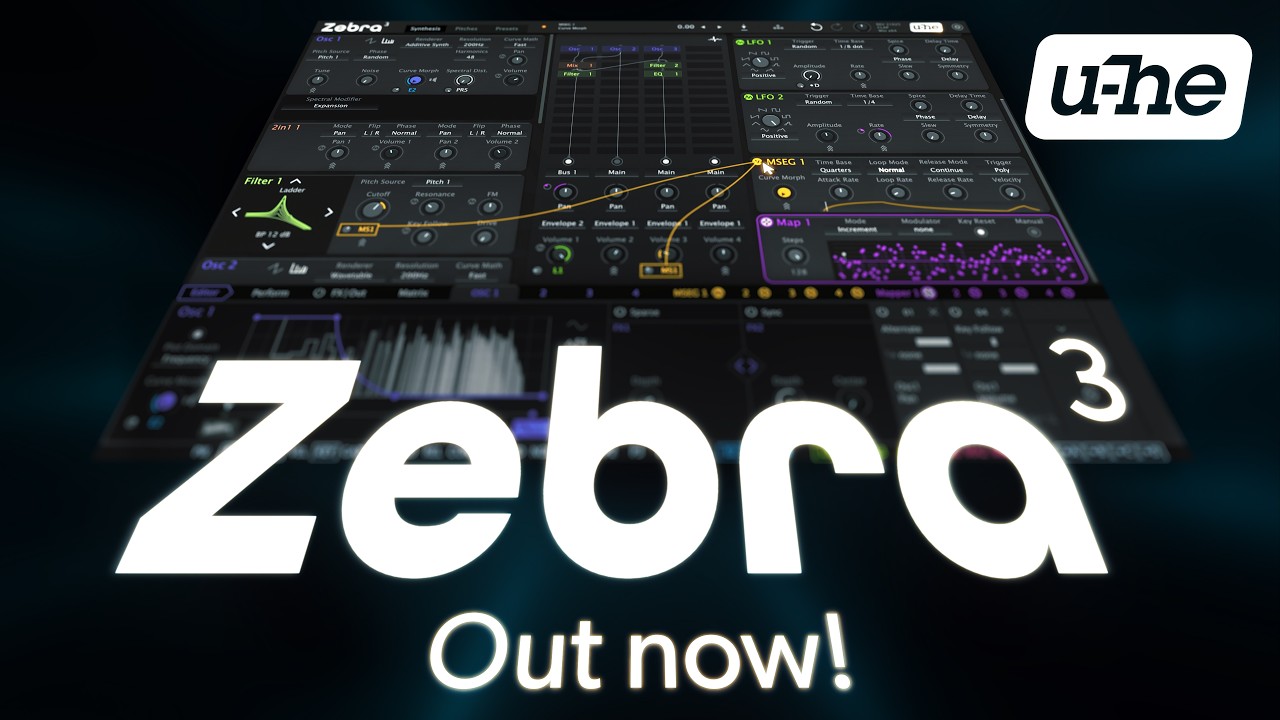
The starting point for this is the main Synthesis landing page, which broadly provides four working areas. In the centre, the main grid displays a visual interpretation of the signal flow. There are four columns, which can be treated individually or interact with each other. It’s also a convenient place to visit for solo sections, allowing the auditioning of individual sonic components.
If you were to head back to absolute basics, the starting point would be here, with the creation of an oscillator, followed by a filter. Of course, the moment you leave the comfort of subtractive synthesis, you can quickly go off-piste with modal and FM synthesis, which requires a little bit more experimentation. The bottom line is, many of the simplistic tones (at least tones that seem simplistic on the face of it) are generated from some of these more extensive synthesis forms. The resulting output is a clean and engaging level of sonic creation, at least until you add further elements to dirty the signal up.
One point that did emerge in our own explorations is how complicated the basic oscillators are. u-he even suggests that you might revert to its free Zebralette 3 synth plugin, as the vastly simplified signal path allows the user to get to grips with the basics before adding all of the complexities of the full-blown version of Zebra.
Coming back to the signal path itself, the signal generators appear on the left of the plugin window, and the modulators appear on the right. The lower 25% of the plugin allows quick access to more detail, relating to oscillators, modulators and more.
When starting from scratch, you can certainly keep things basic, although there is nothing basic about an oscillator. Embracing wavetable, you can quickly create movement at the very front of your sound, even with a simple LFO. You can also keep things simple on the envelope front, through the adoption of the included 4-stage envelopes, but the MSEGs do present extraordinary capacity for creativity over time. As part of our reverse-engineering technique, we were impressed by the MSEGs' versatility; everything from basic loop-style modulation to literal triggering of drum pitches.
The good news is, if you follow your signal flow from the main grid, clicking on a particular module immediately takes you to that element, allowing you to tweak easily as you go, and establish exactly what's doing what.
Filters
Another area which benefits from a considerable makeover is the filter section. There are now 13 models of filter, all available in various states. This extends from low, high and band-pass modes to 6/12/18/24dB slopes. It adds up to a bewildering number of filter options.
The filters simply and quickly allow the taming of some of the purer oscillator elements, but can also result in fantastic depth and detail, if you just want to construct something like a bass patch.
Once you have selected the filter module itself, a quick double-click reveals a selection grid, making it very easy to see exactly what you have available and try different filter models with total immediacy.

Verdict
So is there value in upgrading to Zebra 3, or jumping on board for the first time? In both cases, there is a colossal amount on offer, whether starting afresh or upgrading from Zebra 2.
As an upgrade proposition, you will notice that even the most basic elements, such as the introduction of different colour schemes, really aid workflow, but be prepared to have to put in a little bit of graft. OK, you can certainly use Zebra 3 as a preset synth, and if programming is not your thing, we are very sure that third-party companies, such as The Unfinished (Matt Bowdler), will be on hand to make some extraordinary new sound sets, so you don't have to! (You will be in good company, as Matt has worked with the likes of Hans Zimmer and Lorne Balfe, on everything from TV shows up to Hollywood features.)
If you have a good understanding of synthesis, particularly a nodding appreciation of modular, you can think of Zebra 3 as a virtual Eurorack, where the signal path is the key to everything, as is understanding how individual modules interact, and that is the element that will undoubtedly take up your time.
As a synth, Zebra 3 is a firm cut above many of the other products on the market. There is quality in the overall construct which is undeniable from the very first listen. Little surprise that Zebra 2 became such an industry standard, and we would wager that Zebra 3 will simply continue the legacy.
Hands-on demos
u-he
Alternatives
Specifications
Price |
€249 |
Key features |
Unique interface which adapts as you work. Over 1,200 onboard presets. Wavetable, additive, FM and modal synthesis options. 20 oscillator effects. 13 filters, available in various states and responses. Enormous modulation routing possibilities. Comprehensive backend effects section. |
System requirements |
Mac or PC : MacOSX, WindowsPC and Linux : CLAP, AUv2, VST3 & AAX plugin formats |
Contact |
