
MusicRadar Verdict
If you’re after an affordable and flexible U87-inspired mic, then look no further. The WA-87jr is well made and really does deliver that U87 style sound for a fraction of the cost.
Pros
- +
U87 style frequency response.
- +
Choice of nickel and black finishes.
- +
3 polar pickup patterns.
- +
Onboard high-pass filter and level pad.
- +
5-year warranty.
Cons
- -
No flight case.
MusicRadar's got your back Our team of expert musicians and producers spends hours testing products to help you choose the best music-making gear for you. Find out more about how we test.
What is it?
A decent large capsule condenser microphone is one of the most useful recording tools you can buy. Choose wisely and with minimal maintenance it should last you a lifetime. Neumann’s U87 is the most well-known large capsule condenser, so it’s no surprise you can pick up all manner of designs based on it, and the models from Warm Audio are a case in point.
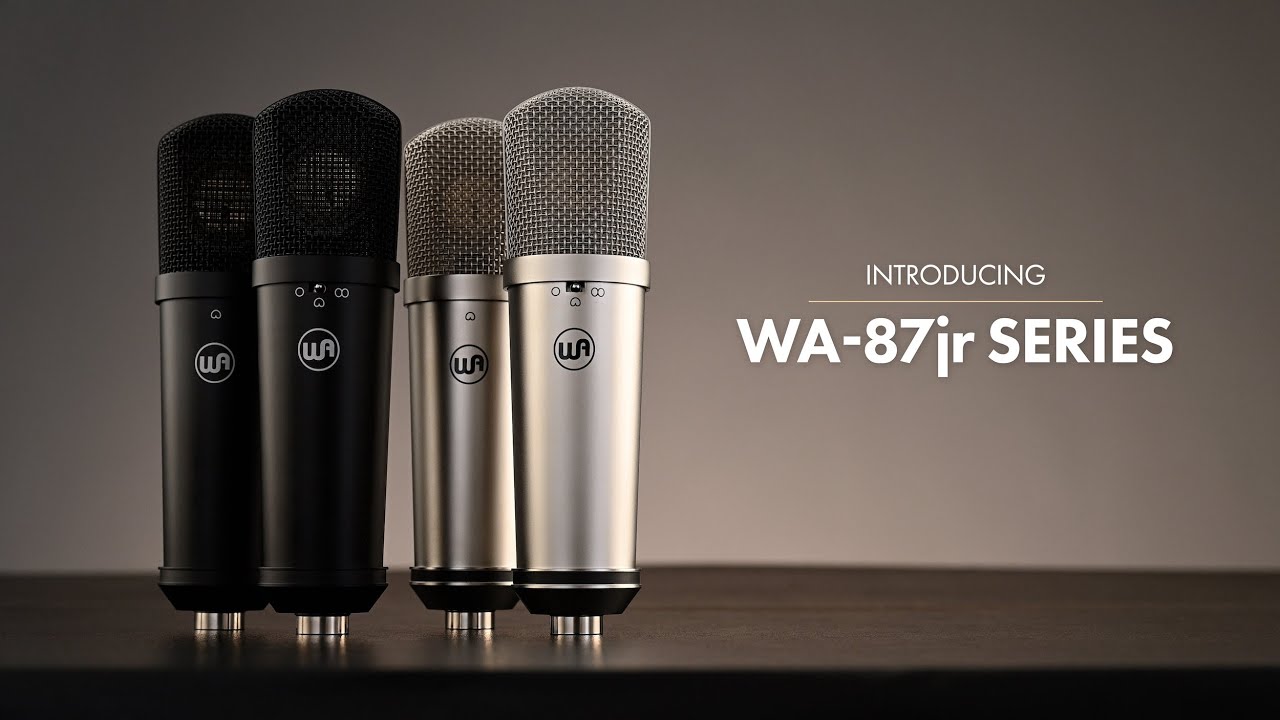
The WA-87jr is one of three similarly tuned U87-inspired mics from Warm Audio and at $299 is their middle-priced offering. It is a multipattern dual-diaphragm phantom-powered mic that’s available in either black or nickel finish. The package includes the mic, a storage pouch, and both a screw-on hard clip and suspension cradle. They’ve even included a replacement pair of cradle elastic bands, which is handy. The only downside is there’s no flight case, although the foam-lined cardboard box ably accommodates all the bits.
The dual backplate capsule is a custom K-87 style design with gold-sputtered, centred tapped diaphragms. It’s the same capsule used in their flagship and considerably more expensive WA-87 R2. This delivers three polar patterns – cardioid, figure 8 and omnidirectional. Beyond this, the electronics use a fully discrete surface-mount FET-based transformerless circuit utilising Wima film capacitors and Toshiba FETs. This is more affordable than the transformer-based circuit found in the WA-87 R2.
Further features include a switchable -10dB pad and a switchable 70Hz high-pass filter. Finally, although assembled in China, the mics are hand-tested at Warm Audio’s facility in Austin, Texas, and carry a reassuring five-year warranty.


Performance
The WA-87jr feels very well-made with a high-quality finish. The on-body switches have a solid feel and the cradle and clip are well-milled and easy to tighten. The headstock design maybe isn’t quite as stylish as an original U87, but it’s good to see a dual-layer grille, and this feels strong enough to see off bumps and knocks or even a wayward drum stick.
The mic is tuned to have a mid to high-frequency lift. Much like the U87Ai, this is slightly different depending on the polar pattern. But in cardioid mode, which is the mode you’ll want for vocal recording, this peaks at around 9kHz. The lift is 2dB at most and just enough to add some articulation and air. For lower frequencies, the cardioid mode also has a proximity effect that becomes pretty obvious from about 20cm and closer. In cardioid mode, unless you have excellent control of plosives, you’ll find a pop shield essential for close miking vocals. Meanwhile, in terms of isolation, the suspension cradle does an excellent job of reducing stand bump noises.
Warm Audio doesn’t provide detailed frequency charts for each polar pattern. As expected, in cardioid mode, we found the fully off-axis position noticeably rejects the mid-range, but high and low-frequency rejection is more irregular. Importantly, the on-axis response is quite broad, so you can move around quite a bit without the response changing drastically. The quoted self noise figure is 9dBA alongside a sensitivity of 10mV/Pa. This means you’ll need a bit more gain than the best-in-class large capsule condensers. However, the noise figure is excellent, and not far off some of the quietest condensers.
The WA-87jr achieves its figure-8 and omnidirectional modes by combining its two back-to-back diaphragms. Although typical for a large capsule design, this can be less precise than single capsule or ribbon designs. Even so, the figure-8 sounds pretty consistent on both sides. The omni, meanwhile, does have some subtle high-frequency variations in the pattern, and this is to be expected. That said, the omni mode is still very handy for capturing room ambience, particularly given its low self-noise.


Verdict
Overall, we really like the WA-87jr. It captures the essence of the U87 design and importantly, features multiple polar patterns and on-body pad and filter options, making it ideal for a multitude of recording tasks.
Hands-on demos
Warm Audio
Alternatives
Specifications
Price |
$299 / £299 |
Type |
Large capsule capacitor |
Polar Patterns |
Cardioid, Figure-8, Omnidirectional |
Frequency Range |
20Hz to 20kHz |
Output Impedance |
100 Ohms |
Power |
48V phantom |
Self Noise |
9dBA |
Sensitivity |
10mV/Pa |
Dynamic Range |
116dBA |
Maximum SPL |
125dB, 135dB with pad |
Accessories
|
Hard mount, suspension cradle, pouch |
Contact |
