
MusicRadar Verdict
If this is the future of guitar, then sign me up. Doing away with design for tradition's sake, the Strandberg Boden Original N2.6T is a guitar that pushes the boundaries with the sole aim of providing a better playing experience, and it succeeds on pretty much every front. With sounds versatile enough to cover a vast array of styles and an incredibly comfortable playing platform, once you’re willing to get over the strange looks, you’ll find one of the most satisfying instruments you’ve ever played.
Pros
- +
Unrivalled ergonomics make it super comfortable to play.
- +
Small body size and light enough to take anywhere.
- +
Excellent variety of voices available from dual humbuckers with two voices and split coil modes.
Cons
- -
Won’t lean against an amp or sit in a regular guitar stand.
- -
The looks may still be a barrier to the traditionalist.
MusicRadar's got your back Our team of expert musicians and producers spends hours testing products to help you choose the best music-making gear for you. Find out more about how we test.
What is it?
Unlike much of the tech in wider society, guitarists haven’t changed their habits much since the 50s and 60s, when classic designs like the Strat and Les Paul first emerged. While gear like guitar amps and pedals have gotten smaller and more powerful, the guitar itself hasn’t diversified much from those 70ish-year-old designs that brought it into the mainstream.
When I first brought the Strandberg Boden Original N2.6T to some of my rehearsals and practice sessions, the reactions were pretty varied, and definitely much more intense than those I get bringing a more regular-looking guitar. From comments like ‘it makes me uneasy’ to ‘that is the coolest thing I’ve ever seen’, it’s understandable that these headless guitars polarise people because they are just so different from the norm.
It’s like when the internet relentlessly mocked the look of AirPods when they were first announced. Or how people dubbed the first commercial steamboat ‘Fulton’s Folly’ back in the early 1800s because they never thought it would replace traditional sailboats. It makes me wonder if this type of guitar will be the norm 70 years from now, or whether we guitarists will still be clutching our S-types, T-types, or our LPs and SGs.

The Boden Original N2.6T still has many of the features you’d expect from a regular guitar. It’s a chambered swamp ash body with a flame maple veneer. The roasted maple neck features a roasted birdseye maple, multiscale fretboard with 24 stainless steel frets. It’s got dual Strandberg POWR:D by Fishman USA humbuckers with active and passive modes for tonal variety, engaged via a push-pull tone knob. So nothing too untoward here.
That’s where the similarities to your average electric guitar end, though, as the headless, multiscale fretboard helps set it apart, along with that eye-catching body shape. The EndurNeck profile features here, with its alien, asymmetrical carve looking different from pretty much anything else on the market.
It’s also got a totally redesigned Arc Tilt tremolo bridge, with Strandberg EGS 'barrel' tuners, bridge saddles that sit exactly in the correct intonation positions for a set of 10-46 electric guitar strings, and a radiused base plate that aligns with the radius of the fretboard. It’s got a wider range of movement compared to the original Strandberg tremolo systems, and features an improved whammy bar design with no deadzone or wobble.
Specs

- Launch price: $2,599 | £2,499 | €2,899
- Made: Indonesia
- Type: Six-string, multiscale, headless electric guitar
- Body: Swamp ash
- Neck: Roasted maple with titanium reinforcement, EndurNeck
- Fingerboard: Roasted birdseye maple
- Scale length: 25-25.5"
- Nut/width: Neutral stainless steel fret, 42mm
- Frets: 24 frets, stainless steel
- Hardware: Arc TILT 6-string multiscale tremolo bridge
- String spacing at bridge: 52.5mm
- Electrics: 2x Strandberg POWR:D by Fishman USA humbuckers, master volume, master tone with push pull, 5-way pickup selector
- Weight: 5.73 lbs / 2.6 kg
- Left-handed options: No
- Finishes: Black Denim Burst (as reviewed), Sunset Coral Burst
- Cases: Strandberg Standard gig bag
- Contact: Strandberg
Build quality

Build quality rating: ★★★★½
Unboxing the Boden Original N2.6T, it ships in a Strandberg Standard gig bag, which looks comically small next to my other guitar cases. It’s a grey colour with the Strandberg logo in bright green, a small Swedish flag near the zipper, and a reflective patch on the top to make you easier to spot in the dark, I presume.
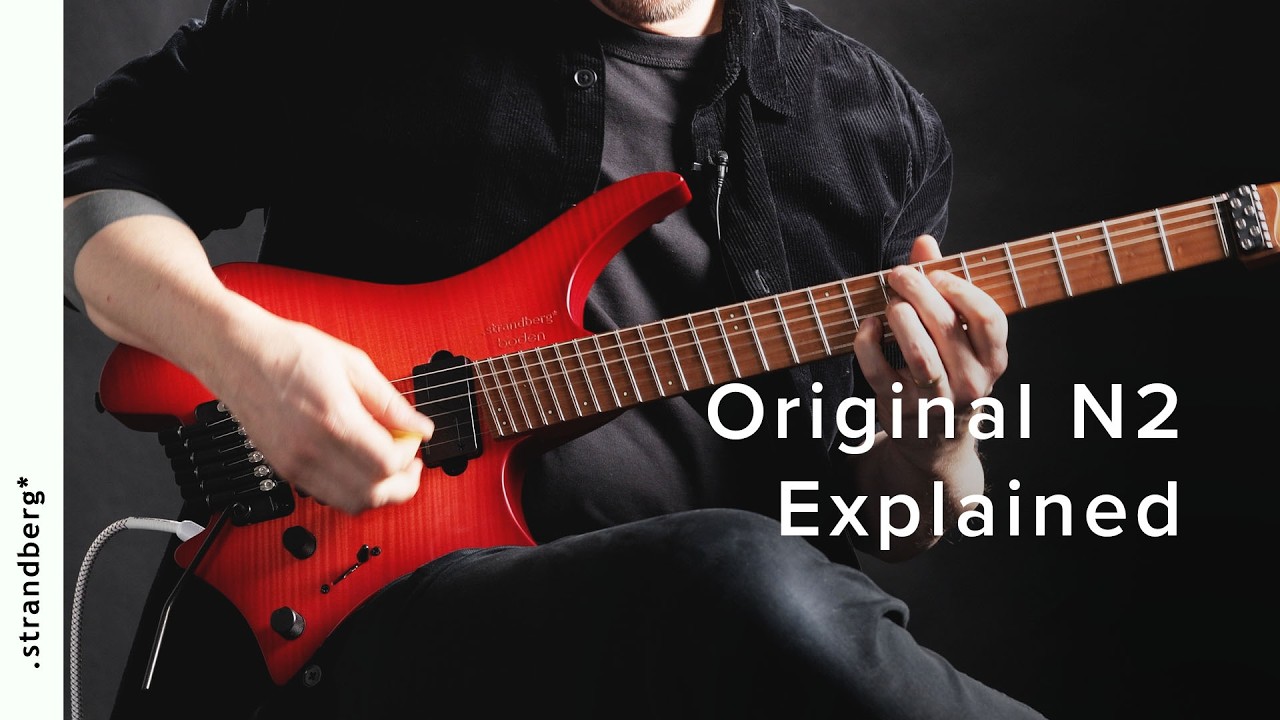
Opening up the case and pulling out the guitar, there’s an immediate difference in weight versus many of the other guitars I’ve tested out over the past few years, with the N2.6T weighing in at 2.6 kg on my scales. The body’s alien design isn’t just aesthetic either, with the carve to allow for playing in different seated positions, such as over the right leg, over the left leg, and classical positions over either leg.
Looking at the back of the body first, the swamp ash features a light, 3D grain with a very slight belly cut. There’s no plate on the rear side of the tremolo for easy access, and the neck joint features another light carve that gets thinner the closer it gets to the neck itself. The output jack is also visible from the rear of the guitar, which is unusual, and has been redesigned from previous models, joining the thin, metal electronics plate.

On the front of the body, there’s another slight carve on the upper bout, with the lower bout staying flat. The words ‘Strandberg Boden’ are embossed subtly above the fretboard. The flame maple veneer is subtle, and looking at the edge of the guitar body, there’s a smooth line where the solid maple top has been applied.
The neck is a fairly deep roasted maple with some dark knots on it, and there’s a visible difference between the birdseye variant, which sits on the fretboard when you look at it side on. The fretwork is ultra-smooth, with the edges feeling like they’ve been rounded off.
The Luminlay fretboard markers sit on the bass side up until the 12th fret, before moving to the treble end for notes higher in pitch. Interestingly, the side dots seem slightly skewiff due to the multi-scale, but we’ll get onto that in the playability section.
Playability

Playability rating: ★★★★★
Sitting down to play it sans guitar amp, I try my hand at the classical, or ninja pose, as it’s better known in the internet age. It feels weird, to be totally honest. Near the nut, the multiscale isn’t so noticeable, but as I get into lead work, I find myself occasionally hitting the wrong notes as they’re not quite where I expect them to be. The side dots above the 12th fret also feel misleading, as they’re in line vertically with the treble side of the neck, which makes them look off-centre versus the bass side of the neck.
I feel like I’m playing faster and smoother than I would on a regular-scale instrument
Despite these initial complaints, I find myself continuing to play, emboldened by the asymmetric neck profile, which feels peculiar for the first five minutes, but then seems to disappear in my hand completely. I stop feeling the trapezoidal shape of it, because my thumb naturally wants to rest on the flat part of the neck.
Moving the body to a regular position, the guitar balances perfectly on my right knee, even when I take both hands off it. Diving into some prog metal acrobatics courtesy of Between the Buried and Me, now that I’m up to speed, the neck is lightning quick for extended scale runs, sweep-picked licks with tapping, and some twisty technical riffing. All previous qualms about the multiscale are gone, and especially with lead work, I feel like I’m playing faster and smoother than I would on a regular-scale instrument.

The lack of a headstock has a few other benefits too. For example, while I’m sat at my desk, it feels less cumbersome moving around to tweak various components of my home studio, whether it’s the amp I’m recording, an audio interface on my desktop, or leaning over to tweak settings in my DAW on my laptop. Similarly, when I sit down to play on the sofa, there’s less guitar to get in the way, making it a surprisingly comfortable instrument to play with a guitar headphone amp.
When I took it to a rehearsal and put it on a strap, the headstock-less design meant it pulled less on my left shoulder, which is a very unfamiliar feeling for me, and I imagine most other guitar players. Once I’d run through half of the set, that feeling disappeared, and the Boden Original was less a weight on my shoulder and more like an extension of my body.
Utilising the new tremolo design, I find it very responsive to even the slightest touch, which is really nice, as with a lot of cheaper trem designs I find you get a little bit of dead zone. It’s not quite Floyd Rose territory in terms of room to maneuver, but there’s a good bit of movement either way, and it can handle some pretty extreme dives. I find that heavy use does take the guitar out of tune by a few cents, which is easily remedied by raising the bridge up sharply to knock it back into perfect tuning.
Sounds

Sounds rating: ★★★★½
The active Fishman pickups, exclusively designed for this particular Strandberg model, are supposed to give players the best of both worlds with a ‘dynamic voice’ for a medium output, more responsive tone and a ‘precision voice’ that’s higher output, and better for high gain playing. These are accessed with the tone knob with the down position giving the ‘dynamic’ mode and the opposite giving the precision voice.
Starting with the ‘dynamic voice’ through a reissue Fender Princeton, I’m surprised at how organic the tone feels. With some spring reverb and a touch of vibrato from the amp, the tones I’m able to get feel far removed from any other active pickup I’ve tried. There’s a lot less compression than I expect, with it responding really nicely to softer playing, allowing me to really eke some bite out of it when I dig in.
Moving through the split coil modes, the pups deliver a very satisfying single coil tone, with plenty of trebly bite. They’re not overly spanky to my ear, lacking a little sweetness versus a true single coil guitar, but through the Fender amp, it’s close enough that I can trick my brain into thinking I’m playing a passive pickup rather than an active one.

It’s not like going from a PAF to an EMG
Pulling the knob up for the ‘precision voice’ and switching to the high gain channel of a Mesa/Boogie MKVII combo, the difference between the two modes is less than I initially expected. There’s a boost in the low end and more midrange emphasis that makes it much more satisfying to chug power chords and play palm-muted riffs, with less harsh high-end than I find doing the same thing with the ‘dynamic voice' engaged.
The jump between the two isn’t huge though; it’s not like going from a PAF to an EMG, but something nestled in the middle of those two extremes of sound. There’s plenty of sustain on lead work, and adding on some octave pedal tones with some reverb and delay makes it great for long, drawn-out bends. Drawing back on the delays and letting rip with alternate picked runs and the occasional sweep delivers a very shreddy tone that will please those looking to play fast.
It's overall an interesting palette to play with, and the Boden Original N2.6T is capable of a lot more versatility than you'd think based on the looks alone. I don't think it will please those looking for a true single-coil sound, but for those who prefer humbuckers and occasionally want to stray into that territory, it does the job.
Verdict

Playing the Strandberg Boden Original N2.6T is quite unlike any other guitar. The lightweight and ergonomic design makes it a really great option for those playing at home and regularly gigging guitar players, taking up less room and being easier to carry around than a guitar with a headstock.
It’s not just a gimmick either
It’s not just a gimmick either; the body shape is genuinely well-balanced, and the neck profile is incredibly comfortable, despite feeling slightly unnerving when you first grasp it. I found the playing experience to be super comfortable once that initial adjustment period was quickly out of the way, and I found I kept reaching for the Strandberg whenever the urge came for me to play guitar.
These ergonomics do have a downside though, and one is that it’s basically impossible to lean the guitar like you would with a regular body shape. Its asymmetry means that having it in a regular stand doesn’t work, nor can you lean it up against a desk or a guitar amp. I also appreciate that for some, the look will be too extreme, and it certainly divided opinions when I took it to rehearsal and for a recording session.
MusicRadar verdict: If this is the future of guitar, then sign me up. Doing away with design for tradition's sake, the Strandberg Boden Original N2.6T is a guitar that pushes the boundaries with the sole aim of providing a better playing experience, and it succeeds on pretty much every front. With sounds versatile enough to cover a vast array of styles and an incredibly comfortable playing platform, once you’re willing to get over the strange looks, you’ll find one of the most satisfying instruments you’ve ever played.
Test |
Results |
Score |
|---|---|---|
Build quality |
Spotless build, but the design makes it awkward to place. |
★★★★½ |
Playability |
One of the most comfortable necks I’ve ever played. |
★★★★★ |
Sounds |
Great selection of tones, not for those who like true single coils though. |
★★★★½ |
Overall |
An incredibly well-designed guitar that’s playable and versatile. |
★★★★½ |
Also try
Hands-on videos
Strandberg
- *****Add related review or guide link here*******
