


Unless you’ve been taking a mental health break from screens, you’re likely aware of the hacking revolution happening in music production. Whether hardware or software, coders are whipping up new firmwares for existing instruments and expanding the features of products like the M-Vave FM-1 and Akai MPC. This hackathon isn’t limited to just synthesizers and grooveboxes, though.
Another cadre of hackers is turning its attention to handheld video game consoles and porting new – and very sophisticated – life into outmoded devices, with unheard of functionality like granular sampling and even full-on plugin compatibility now very real possibilities.
Portable consoles and music production have, of course, crossed over before. Korg made its Gadget DAW available for the Nintendo Switch, and even created a version of the classic MS-10 synthesizer for the Nintendo DS back in 2008 (called, naturally, DS-10).
On the homebrew side, it doesn’t get much more classic than LSDJ, a chiptune tracker for the Game Boy.
These were one-offs though, novel outliers. Thanks to a confluence of often AI-assisted coding, a dearth of cheap but powerful obsolete consoles, and a generation of gamers grown into developer adults, we’re now seeing a sort of mass side-quest happening, with both amateur and professional developers reaching for PSPs and Nintendos alongside Macs and PCs.
Here are three worth looking into…
1. Light Reft DZA.grain
Tokyo-based LightReft is best known for its two Brutalist-inspired hardware devices, the Monolit MIDI controller and the Concrete multi-effects unit. Yet its current project is very different. Called DZA.grain, it’s a freeware granular sampler that runs not as a plugin in your DAW but on a Nintendo 3DS or Sony PSP. The instrument uses the controls of the devices just like a game would, but instead of playing a game you’re processing samples. You can even sample live via the onboard microphones.
“I hope granular synthesis becomes the new Doom, something people try to run on all kinds of musical devices,” enthuses Sasha DZA, co-founder of LightReft. Sasha, who cut his teeth at synthesizer company Black Corporation before starting LightReft, says the inspiration for DZA.grain came while considering what to make next.
“My first thought was to make something for (open source music device) monome norns,” he says. “But an old PSP was sitting on my desk, and I wondered whether I could make something for that console instead.”
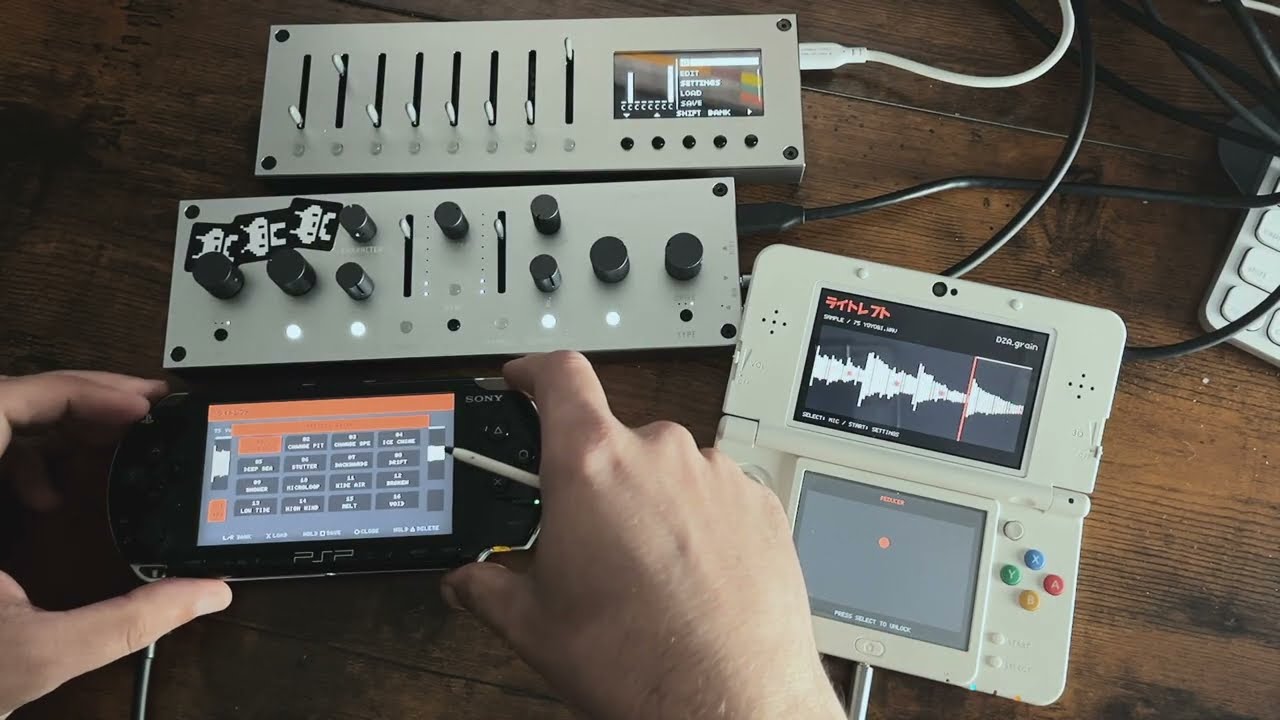
Early-2000s consoles are particularly ripe for this kind of experimentation, being cheap, plentiful, and relatively powerful. There’s also the nostalgia factor. “Both consoles are connected to my 20’s,” explains Sasha when asked why these two particular platforms, “and the PSP still appeals to me as a piece of hardware. I wanted to see whether I could make an instrument for it that people would enjoy using today.”
There is an aesthetic reason as well. “The PSP and 3DS came from a time when industrial design felt bolder and more distinctive,” he says. “I enjoy holding them and interacting with them as physical objects. A new musical purpose is a reason to take an old console out of a drawer, carry it around again, and enjoy using it.”
E-waste is also on Sasha’s mind. Video game handhelds are cheap and plentiful, but must be bought new every few years. Because of this, there are literally millions of them in existence that no longer have any purpose other than to clog up landfills. By bringing them back to life and providing them with a new purpose, Sasha (and other developers like him) are pushing back against this unfortunate aspect of modern society.
“I do not like the idea that you should buy a new device instead of an old one that is still useful,” Sasha says. “That cycle encourages us to produce and buy more electronics than we need. It does not feel sustainable to me. I want to give these consoles another life, at least as musical instruments, and perhaps inspire other people to make homebrew applications for them.”

Sasha is currently working on expanding how people can use DZA.grain by developing a VST plugin, a standalone desktop application, and a version for iOS tablets. These won’t be ports but native versions, he stresses, each with its own specialised interface.
“The console versions are important to me,” he says. “The physical buttons and the character of the PSP and 3DS affect how the instrument feels to play. But the idea behind DZA.grain is not limited to consoles. A computer, a DAW, and a tablet each offer different ways for a musician to interact with sound.”
DZA.grain is currently available for the Sony PSP and Nintendo 3DS. You can download the software free of charge by signing up for the LightReft newsletter at its website You can also purchase it as part of a bundle with an album on Bandcamp.
2. Melted Electronics Glitch Boy
DZA.grain lets you put an original instrument inside an existing console. Glitch Boy from Melted Electronics, however, allows you to do the opposite: install a console, in this case a Nintendo Entertainment System, inside a custom housing and play it via MIDI.
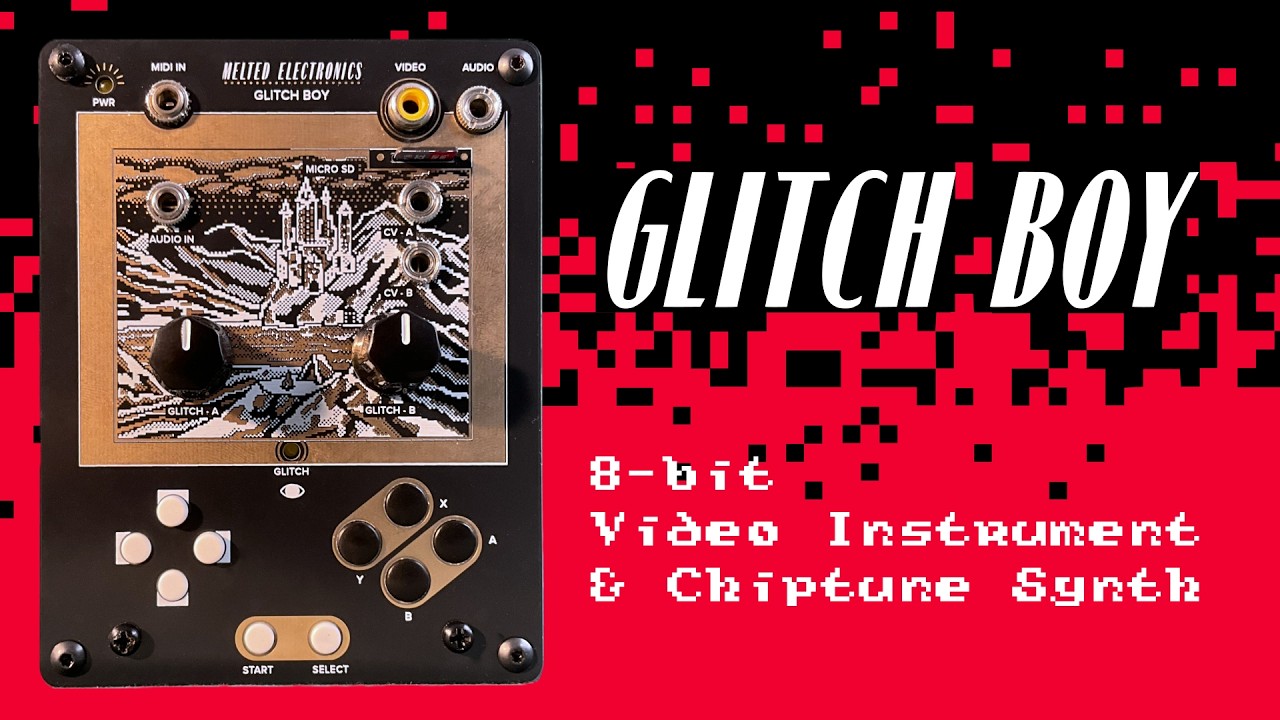
Further blurring the lines between gaming and music production, Glitch Boy comes bundled with an emulation of the classic Nintendo NES gaming system.
Load a game in via microSD card and play it wth the onboard Game Boy-like controls. That’s just the game part, however. Where the music production half comes in is the 8-bit chiptune synthesizer. With four voices, one each for the two pulse channels, triangle and noise, you can control them with a MIDI controller. It also allows you to affect changes to parameters such as pulse duty, volume, envelope, and length with MIDI CC.

As the name Glitch Boy suggests, though, there’s more to this console in disguise than just chiptune. It’s also a video synthesizer. “Built by intentionally breaking a NES emulator, it's a tool for video artists and creatives, perfect for creating authentic 8-bit glitch aesthetics for visuals, music videos, and video art,” says the Kickstarter page (which racked up nearly €40,000 of pledges for a €4000 goal).
You can freak out the visuals either with the built-in controls or over MIDI. Glitching extends to the chiptune synthesizer too, which comes from the emulator’s APU console soundcard, “letting you corrupt your own MIDI sequences at will.”
Glitch Boy is available standalone or in Eurorack format. The firmware is open source and on GitHub if you fancy glitching it out even further.

3. Sndstation: Plugins on a retro hardware console
You’ve probably seen them for sale online, cheap Chinese handheld gaming devices with names like Anberic RG 35 and Game Console My Mini that run classic console emulators. Shockingly cheap, but also shockingly powerful.
Many of these have a Rockchip RK3326 chipset inside, a Linux-based system on a chip that is now being commandeered to run original music production software – including professional plugins you already have in your DAW. This is the work of sndstation, a collective developing a Linux distro operating system to take over modern cheap handhelds.
Sndstation was conceived of by David Viens of Plogue, a software development house that has spent decades turning classic video game chips into soft synths. Now, along with Audio Damage, Baconpaul of Surge Synth Team, and others, David is preparing to unleash the new open-source music-making platform, one that will not only work on these cheap game systems but is optimised especially for it.
“Sndstation's main goal is to allow you to run CLAP plugins without modifications on a portable and self-contained device, but in unique ways,” explains David.
The idea is to not only put plugins on a console, but to turn the console into an instrument itself, with the buttons and controls as the interface. “Yes, you can just plug a MIDI keyboard in it, but the novelty is how you can express yourself with the 17 buttons and two analog sticks. What new forms of gestures will be imagined is what is most exciting to me here.”
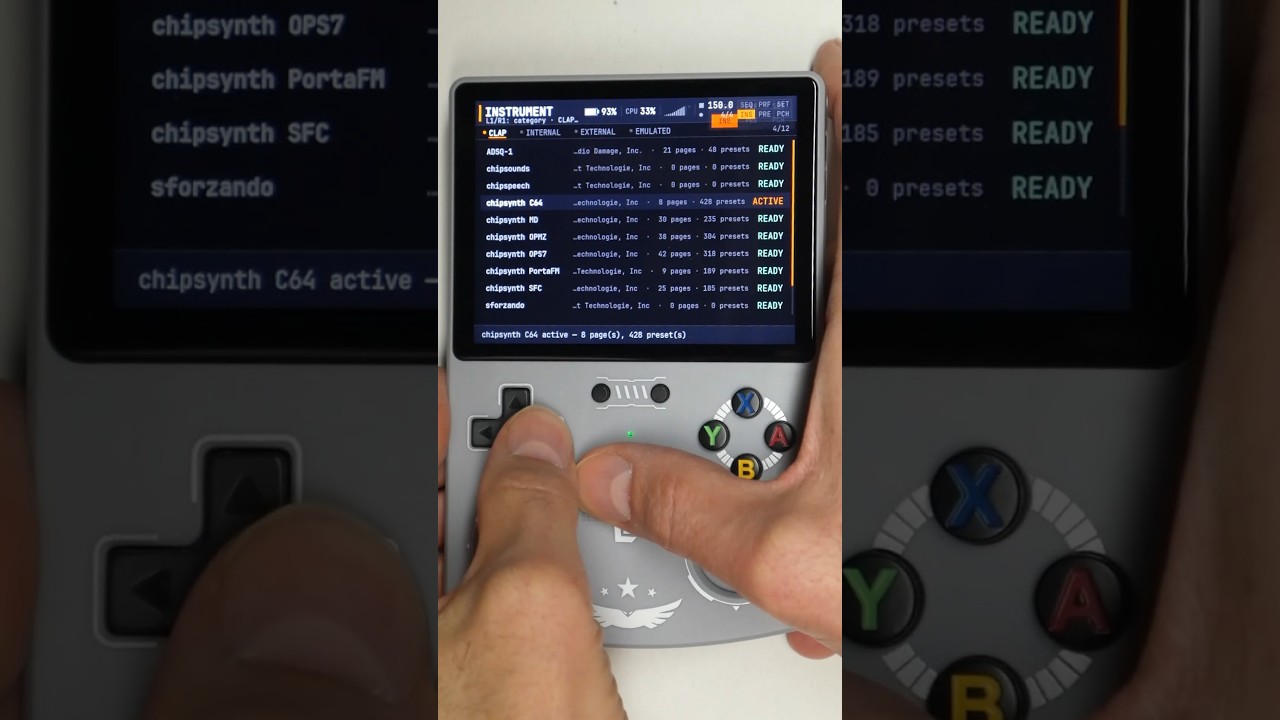
The birth of sndstation was not dissimilar to how Sasha ended up developing DZA.grain: by having a few devices laying around and thinking, 'What if…?'
Porting Plogue plugins to Linux led David down a few rabbit holes, and he eventually ended up with a lot of cheap Linux-based devices on his workbench. Then, while researching arm64 chipsets, namely the Rockchip RK3326 used on cheap handhelds, lights suddenly went on.
“I always dreamed (Plogue) would try its hands on its own synth hardware (and I've done quite a few prototypes), but never wanted to risk the company's future on manufacturing, investments, liabilities etc,” David explains. “On top of this, putting potentially more e-waste out there is against my 'recycle/repair/repurpose' modus operandi, so the idea of reusing cheap mass-produced devices packing such power and so many great features was a no-brainer. The form factor was also unique and, of course, resonated even more with us, as our main specialty is video game audio hardware emulation.”
David, who stresses that his answers represent only himself and not the sndstation team itself, sums it up like this: “In short, we were in fact doing ‘firmware hacking’ much before FM-1 but behind closed doors for a while now. But we are all busy surviving the ‘slop-pocalypse’ so it took longer to materialise.”
As for that FM-1, would it be possible to port sndstation to M-Vave’s mini synthesizer? “It’s probably more realistic to do it the other way around,” he says. “The FM-1 is very fun, but it’s not powerful enough to play off the shelf 64-bit CLAP plugins unless they are rewritten due to its lower power dual-core chipset. However the FM-1 firmwares are more easily portable to sndstation. I've done a proto or two of that. In any case, one has more knobs and a keyboard while the other has two analog sticks and a USB MIDI input. It would need adaptation on either end anyway.”
Along with the CLAP plugins you already have on your hard drive, there will be original software for sndstation. Baconpaul has already revealed a beta of his BaconBeats, a fully-featured sequenced instrument designer.

Sndstation isn’t quite ready yet, but it’s coming very soon, and will be free and open source when released. “We didn't think of any other monetisation than making this as a fun alternative way for our customers to use the desktop plugins they they've already bought from us, and (hopefully) bring some of the 'hardware only' musicians to try our synths as well,” says David.
Find out more about sndstation on the team’s Bluesky account.
