
Three years on from its viral breakout moment, Nopia is finally here… almost. The creators of this much-hyped chord-generating synth have launched a Kickstarter campaign to fund the first production batch of Nopia MK1, and pre-orders are now open with shipping scheduled for early 2027.
Barely 24 hours after its campaign launched, Nopia has already smashed its $50,000 target to reach well beyond $1,000,000 in funding. At the time of writing, the campaign has received more than $1.4m in pledges from over 2000 backers, and there are still 28 days to go.
Considering the overwhelmingly enthusiastic response Nopia received when its prototype was unveiled in 2023, it’s no surprise that support for the instrument has remained strong, but its creators have been blown away by the success of the campaign.
Sharing a statement through Kickstarter yesterday, the Nopia team thanked their backers: “No ad agencies, no massive marketing campaigns, just a community connected through videos, emails, and a deep love for making music,” they said. “To see over 1,800 of you show up for the Nopia MK1 in these first hours is something we will never forget.”
“We honestly didn’t know what to expect today, but that first wave felt like something out of a dream, surreal. You have officially given us the green light to bring the Nopia MK1 to life, and we are going to pour every ounce of our hearts into it. Thank you for trusting us, for opening our emails, and for being here right at zero. This is just the beginning.”
Nopia’s Super Early Bird and Early Bird tiers have both sold out, and there are currently only a handful of units left to purchase in the Standard tier, which are priced at $699. If you’re interested in picking one up, you better move quickly.)
Designed to produce complex chord progressions without an in-depth understanding of music theory or even any keyboard skills, Nopia is described by its creators as a “semi-modular harmony generator” that taps into our intuitive understanding of the language of harmony.
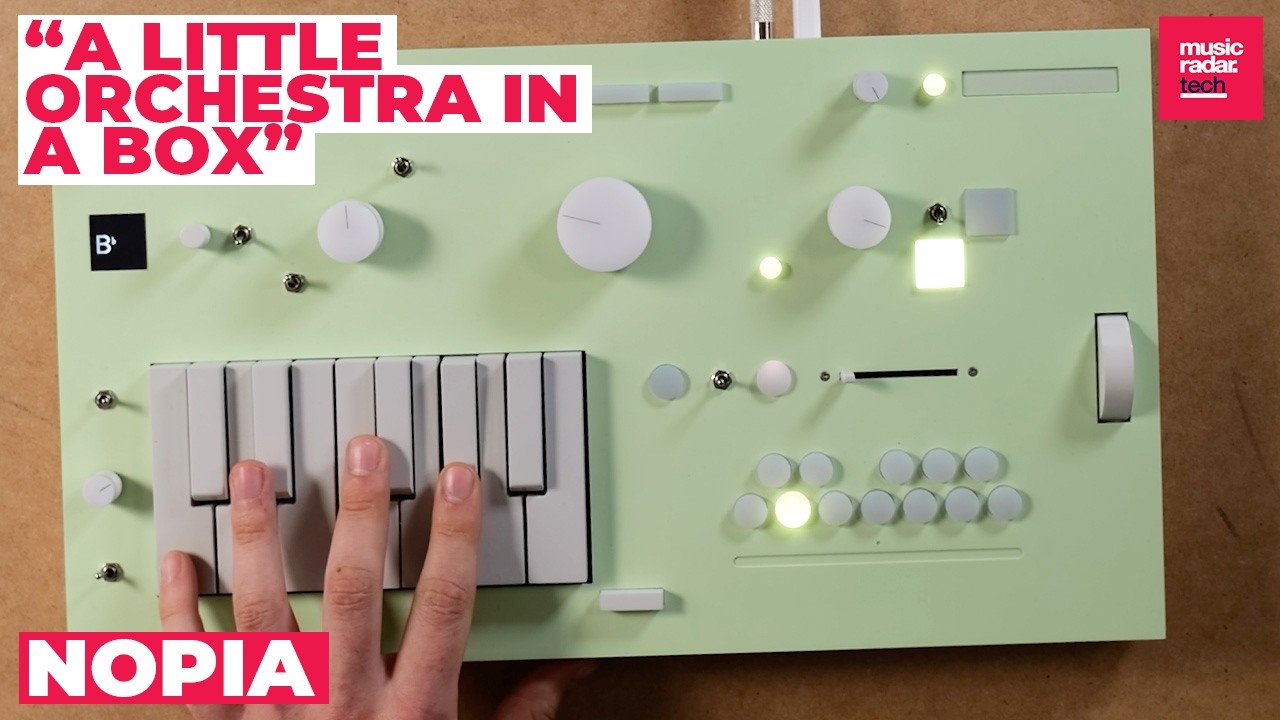
The instrument’s chord-generating workflow is built around two core controls: the Chord Builder, a one-octave keyboard on the left-hand side, and the Tonal Selector, 12 buttons arranged keyboard-style on the right. The Tonal Selector (along with a major/minor switch) determines the home key and the Chord Builder plays whole chords with each key press, but Nopia has two distinct modes that determine what those chords are.
Real Mode builds each chord around the actual note played on the keyboard: choose C major on the Tonal Selector and a D played on the Chord Builder will play a D minor chord. Play a chromatic note, however, and Nopia will treat it as a major third of a chord, functionally harmonizing it to produce a secondary dominant chord that can then resolve to another chord in your home key: play a G# in C major and you'll get E major, the V of A minor.
If that all sounds like Greek to you, fear not: Nopia’s Static Mode is designed to be more intuitive for those that aren’t familiar with theory or the keyboard. Each key on the Chord Builder represents a degree in the scale chosen with the Tonal Selector, rather than a chord that’s based on the actual note played.
Choose C major on the Tonal Selector, and Nopia's Eb key will play a C major (the I chord) and the Bb key will play an G major (the V chord). If you switch over to E major on the Tonal Selector, though, Eb will play E major and Bb will play B major, the same scale degrees but in a different key. This means that non-keyboard players will only need to remember one layout to play all the chords in any key – a bit like a guitarist with a capo.
It’s a brilliantly innovative concept, and it’s not hard to see why Nopia has resonated with so many music-makers
Nopia offers players a variety of ways to add flavour and variation to the chords it creates. There’s an Extensions Knob, which can be used to add harmonic colour with 9ths and 11ths, a Shift button that introduces suspensions and 6th chords, and a fader that adjusts the voicing and octave register. A touchplate under the Tonal Selector can pitch-bend chords, while another in the top-right corner can pluck or strum through their individual notes.
All of this combines to produce a complex polyphonic output that feeds into the instrument’s multitimbral sound engine, which draws on a combination of virtual analogue synthesis and samples across four independent modules: Keys, Bass, Arp and Pad. (Each module gets its own MIDI output and can be routed out to external instruments, or out to your DAW over USB-C.) Samples can be loaded into Nopia’s internal memory via USB-C and synth patches can be tinkered with using a browser-based editor.
That's not all: there's a decent selection of effects onboard, including filter, delay, reverb, saturation and tape emulation, along with a Beat Repeat-style glitch effect. You also get a three-slot looper with parameter automation and overdubbing for building layered performances.
Overall, it's a brilliantly innovative concept, and it’s not hard to see why Nopia has resonated with so many music-makers. Workflow aside, its preset library is stacked with a diverse array of sounds, from sampled pianos, Rhodes-style keys and strings through to virtual analogue pads, plucks and basses, all sharing a subtly organic and textural character.
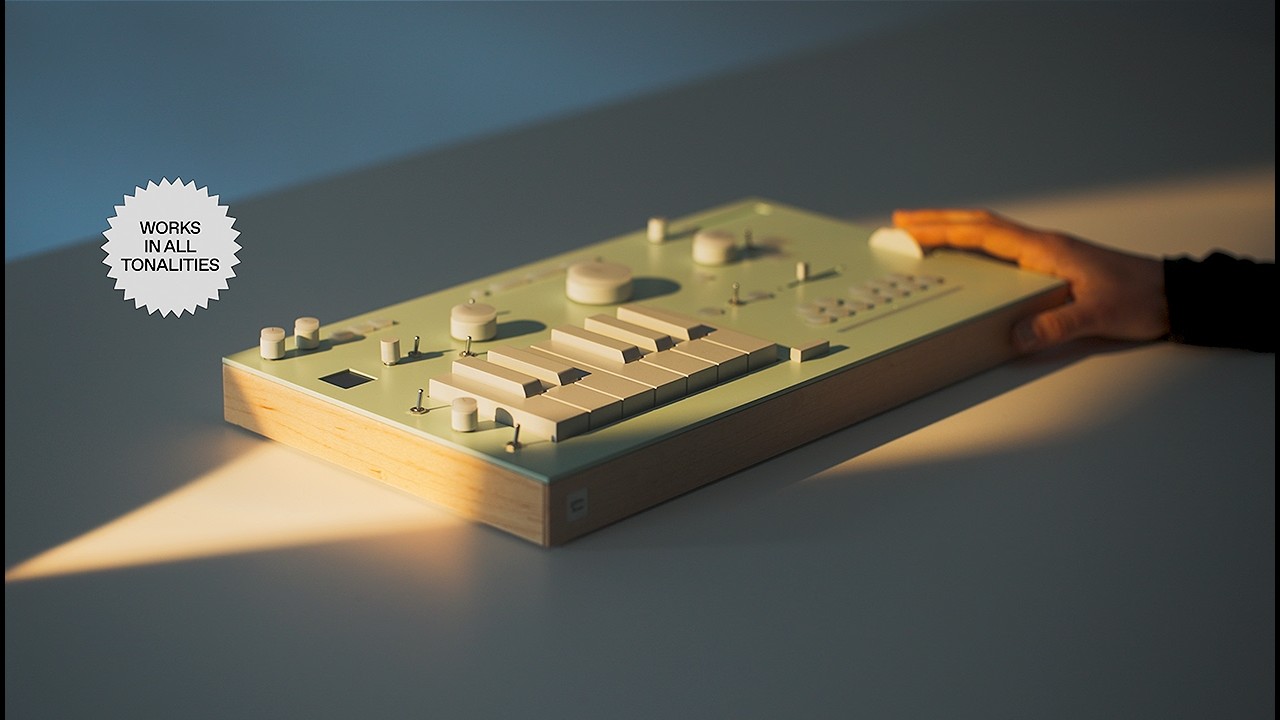
Nopia's distinctive visual design also helped to catch the attention of viewers in its video debut: crafted from solid wood and anodised aluminium with a minimalist, pastel-green aesthetic, it’s completely free of any labels, with only a small display indicating the chords you’re playing.
Nopia was created by a small and independent team headed up by Argentinian musicians and designers Martin Grieco and Rocío Gal. While its creators were visiting MusicRadar HQ earlier this year, we had the chance to shoot a first-look video demo that shows what Nopia can do.
During their visit, Martin and Rocío told us more about the inspiration behind the instrument, the challenges they faced during its three-year development, and their plans for the future.
Where did the idea behind Nopia come from?
Martin: “The core concept behind Nopia stemmed from something that’s happened to me ever since I was a kid. I would listen to music and recognise the chord progressions, but I didn’t even know what a chord was – I learned that many years later. But I would hear them and say to a friend, ‘dude, this song is the same as this one!’ It was maybe in another key with a different tempo or different instruments, but I would recognise the progressions. And at some point, I realised that not many people were paying attention to this specifically in music.
“When I studied music, I managed to put a name to those feelings, but I was always very intrigued by the fact that there was no machine that took advantage of all the theory that explains harmony. There’s so much theory around harmony, but in essence, it’s a very simple thing. The idea was to build an interface that takes advantage of that and gives you the possibility of performing with it.
“There’s something physical about the nature of combining notes together, and I always felt like chord machines behaved more like a spreadsheet. ‘Okay, here’s your C major, C minor, C major seventh…’ and whatnot. Our brains and our ears don’t really work like that – Nopia was built from trying to mimic what happens in the ear.”
Can you take us back to the story behind the first prototype?
Martin: “I was doing live sets, and I found that harmony was such a difficult thing, because I needed two hands either playing the guitar or the piano but I didn't have an extra hand to do sound design or synth stuff. So the idea was, ‘Can I build something that would allow me to play complex chord progressions with one hand and to leave another one available for expression?’
“The idea of how to condense chromatic tonal harmony into one octave came to me in a second. The Extensions Knob, the Tonal Selector, it was like... ‘Okay, that’s how it should be!’ I grabbed my guitar and I recorded each chord one by one in Ableton Live: the bass, the arp, the pads.
“I was using it to play live, but I had it mapped to a MIDI controller. It was funny, people would say, ‘Man, I didn’t know you played the piano’, and I said ‘Didn’t you see I was playing one note at a time?!’ It started out as an Ableton Rack, and when I started talking with Ro, the original idea was to make it a VST. But Ro was like, ‘No, this should be a physical thing’.
“I come from a music and production background, but I was doing a postgrad on Expanded Music which had some electronics work, so I was starting to get into that world, and Ro comes from graphic design and industrial design. That’s how we built the first prototype, as a summer project for an instrument design contest.”
When did you decide to create the video that went viral?
Martin: “We would tell our friends about this idea of this instrument and nobody would understand it. I would talk about secondary dominants, modal interchange, the extensions and the tonal centre… but people would just be like, ‘What are you building?!’ What we really wanted with the video was to just show our friends what the idea was.”
Ro: “We were spending all our time inside a cave doing this and making the video, and nobody understood why [laughs]. It was like, ‘Okay, watch the video if you want to know what we’re doing.’”
Martin: “It was insane. We uploaded it, and boom! The next day, we opened the computer and it already had 20,000 views. It got to a million views in three days. It was like, ‘what is going on?!’ More than the views, the interesting thing was what people were saying in the comments. They were saying in words much more precisely than us what we were trying to explain.”
Ro: “We got a lot of messages, we talked with many people, and it was like, ‘Okay, this is beyond just the viral thing’. There are many things that go viral, but people’s words had a lot of meaning. So we said, ‘Okay, we should do something with this.’”
How did things unfold from there?
Ro: “We started to build it together. There’s so many things involved in making an instrument: production, design, electronics, engineering, firmware. We met amazing people, and we’re a bigger team now, and we’re here to keep the instrument alive. Everyone knows a lot about their own subject, and each of us are working on so many things.”
Martin: “At first, everybody said, ‘Don’t design your own knobs, don’t design your own buttons, don’t make your own keybed’. But we tried working with off-the-shelf stuff and it didn’t work. There was something about getting the feel just right, the tactile thing, which took a lot of time to get right.”
Ro: “We didn’t want to change the spirit of it, and that was the hardest thing, because it’s not the main way these things are done.”
Martin: “The industrial designers, they wanted to kill us when we were like ‘No, it has to be real wood!’ [laughs] Charlie and Vicky, shout out to them.”
I imagine you must have felt a lot of pressure after the video blew up?
Ro: “I can’t explain how much expectation and pressure there was. We were making it because we felt it was important and it was something that we wanted to play. But the pressure was also from people thinking that we were just a company launching a product and didn’t want to sell it, or something like that.
“It wasn’t an advertisement, it was more just like: ‘We have this idea, and we want to make it!’ It’s a lot of pressure. We live in a rollercoaster all the time.”
Martin: “I got really confused at first, because I was like, ‘Okay, we’re designing an instrument’. We uploaded a video, a lot of people wanted it, and suddenly everybody was calling it ‘your product’ and ‘your launch video’. I was like, ‘What are you calling a product?’ It’s an instrument, and it wasn’t a launch video – it was just showing an idea of what could be!
“But then, we take things really seriously, and we’re like, ‘Okay, it has to be as robust as possible’. It can’t fail. You need to be playing live and you need to know that this thing is not going to crash. It has to be in real time, it can’t have latency. All of these things that are essential.”
Where did the name Nopia come from?
Martin: “It didn’t have a name for a long time, and then randomly, a friend of my mum said ‘You have to put a big sign on the instrument that says ‘yhis is not a piano’’ – because everybody would call it ‘your little piano’. That idea resonated with me and I started thinking about that. Not a piano… no, piano… Nopia.
“There’s this funny thing in Argentine slang where you can flip the syllables of a word and it will mean the same thing. For example, pizza can become ‘zapi’. So tango players, old-school piano guys, will refer to the piano as a ‘nopia’. So people from Argentina will recognise it immediately. It’s not a piano, but it sort of is!”
Building chords with Nopia obviously works in a different way to a piano, but you’ve still got the one-octave keyboard there that people will recognise…
Martin: “At first, Ro was like, ‘Why are there even piano keys?’
Ro: “The question is, ‘Why is it a piano instead of just buttons in the same arrangement?’ But Martin said humanity has arrived at this layout over four centuries, this layout is important. We don’t have to change everything. [laughs]”
Along with the underlying concept, the aesthetic seems to be something that caught people’s interest early on. Can you tell us more about the visual design?
Ro: “There are so many things... one of the main things is that there’s not a grid of buttons or knobs in the same place. If you close your eyes, you can remember that there are different groups [of controls]. One of the main ideas was to create something very tactile that you can remember. I try to learn to play instruments with my eyes closed – when you’re playing live and it’s really dark, it’s nice to just remember. That’s why it also has a lot of space in between [the controls], which for industrial design is kind of weird.”
“Also there’s this no-label thing. A lot of people have said to us that they really like that it doesn’t have labels.”
"We took it to an event, and the first thing people said was 'please don’t add labels!'"
Martin: “As Ro said, the original idea was that you should be able to play live with the smoke machine and the lights, and know where everything is. That’s why it originally didn’t need labels. I’ve tried one with labels, and I really love them, but nobody else does. We took it to an event, and the first thing people said was ‘Please don’t add labels!’”
Ro: “You have these dynamic labels, so each time you enter anything, you will see it on the display, and you’re not working blind. Maybe you can just make your own label and put it there if you want to remember. Like when people have their own instruments and they add labels and stickers to make it personal… this kind of blank space is its personality.”
How about the pastel colour? It’s an interesting choice.
Martin: “Ro was like ‘Make it white, man!’ [laughs] But I said it has to be that shade of green. It was inspired by a Fender Stratocaster, the green and the wood, but the closest we could find with spray paint was this horrible shade of green. It really was horrible. Then a friend of Ro’s, Matt Miller, told us to go to this paint shop and ask for a catalogue. I was there at the shop, I looked back at Ro and I’d never seen her eyes so big. She was like ‘it’s this one!’”
Designing your first instrument must be quite the learning curve. What was the most challenging stage of the process?
Martin: “Everything, absolutely everything. What thing wasn’t challenging? [laughs]”
Ro: “Everything, because even the tiniest things are a huge process and learning curve. We learned that it’s better to make technical decisions first. We made the layout and the aesthetic decisions first, and then we entered the technical side, and that’s very difficult – but we managed to make it.”
Martin: “Like I said, everyone was telling us, ‘Don’t design your own buttons, don’t design your own knobs’. Three years later, I’d have said the same thing to myself, but I’m glad that we did it. We’ve learned how difficult making a hardware instrument is, because it’s mission-critical. It can’t fail, but also it’s real-time. Everything you’re doing, it has to do so much in milliseconds, microseconds even.”
What does the future look like beyond Nopia MK1? Is a MK2 too far ahead to think about?
Martin: “There’s already a list for MK2. I want to make the MK2 so bad!”
Ro: “When Nopia meets the people that will be playing it, there will be so many things for us to learn and to make better.”
Martin: “That’s going to inform the MK2 much more than my list! But originally Nopia was part of a suite of instruments. With this MIDI controller I was telling you about, I also had a module for drums, for polyrhythms, for sampling. We have some prototypes for the other instruments – I made one for Ro’s birthday. So it’s a mix of a MK2, and hopefully expanding on the family.”
