
2011 was a pivotal year for Sia. Though it’d be a further three years until her global mega-hit, Chandelier established her as a household name, it was the impact of her lead vocal on David Guetta’s monster hit Titanium that first introduced her room-shaking power to the world at large.
After spending the previous decade pursuing her own artist career, the outset of the 2010s found the Adelaide, Australia-hailing Sia Furler tiring of the endless press rounds and relentless touring schedule.
Wanting to retreat from the limelight, Sia decided to re-orient herself. Instead of pursuing musical success as an artist, she would pivot into being more behind-the-scenes figure, and lean into her abilities as a proficient pop songwriter.
“I get to sit at home with the dogs on the sofa, record in a closet in the office, send them off and, if I’m lucky, make a million dollars,” Sia told Billboard. It was an understandably alluring idea.
Meanwhile, French DJ and EDM heavyweight David Guetta had successfully undertaken a transition of his own. The club-focussed deck-spinner had now become the unlikely architect of a number of pop's biggest success stories.
One only needed to look at the Black Eyed Peas’ Guetta-produced behemoth, I Gotta Feeling, then there was those chart-scaling collaborations with Kelly Rowland (When Love Takes Over), Akon (Sexy Chick) and Fergie and LMFAO (Gettin’ Over You) from his 2009 pop breakthrough, One Love.
It seemed that David Guetta had become the man with an industrial supply of the secret sauce that was flowing through late '00s pop's.
Learning that she was now a songwriter for hire, and already a fan of work, Guetta reached out to Sia to help write a track for his next album, 2011’s Nothing but the Beat.
Inspired by the recent indie chart victories scored by the likes of Coldplay and Kings of Leon, Guetta decided that his next record would incorporate a few more guitars and even bigger choruses. It would also be a double album, with its first disc spanning this new salvo of chart-angled fare, with an entirely instrumental second disc.
As with its predecessor, Nothing but the Beat would feature a who’s-who of contemporary pop and hip-hop vocalists, with featured artists ranging from Lil Wayne, Taio Cruz and Nicki Minaj to Ludacris, Snoop Dogg, Afrojack, Flo Rida and many more.

Despite sporting a hefty voice of her own, it was Sia’s abilities as a songwriter that Guetta was after.
“I was totally amazed by Sia,” Guetta told Australia’s The Daily Telegraph. “This has made me more curious to study her music more because I was really impressed. I have the biggest people on the album and she has a different profile, more like an indie kind of artist and it makes [Titanium] even more special, it makes it stand out I think.”
Enthusiastically taking Guetta's commission, Furler was promptly sent 10 instrumental ideas, with the brief being to use one or more of these instrumental bedrocks to build a song that would suit Alicia Keys.
There was one problem - Sia wasn’t a fan of Guetta’s populist flavours.
“Electronic dance music is not my kind of music,” Sia told The New York Times.
However, there was a piece that Sia found herself drawn to. It incongruously began with an Every Breath You Take-recalling, palm-muted guitar motif. “The only track I liked was [Titanium’s] guitar riff,” Sia told the New York Times.
This looping motif, which exploded outward into a four-to-the-floor, vibrant club throbber, sparked Sia to write something fittingly tough. A resolute lyric that served as a rebuttal to those who’d tried to pull her down, or critically maul her in the past.
She turned to Google. “I typed into Google, ‘What is bulletproof?’ . . . I wrote Titanium in 40 minutes.”
I'm criticised, but all your bullets ricochet
Shoot me down, but I get up
I'm bulletproof, nothing to lose
Fire away, fire away
Ricochet, you take your aim
Fire away, fire away
Guetta’s music - co-written with Giorgio Tuinfort and Nick van de Wall and produced by the three alongside a young Afrojack - transitioned seamlessly from its indie-leaning intro to a more club-friendly pulse, which balanced a typical verse/pre-chorus/chorus/verse dynamic journey of a pop song with the synth-heavy, sonic trappings of EDM. A monstrous, sidechain-compressed kick defined its surging drop.
Recording her vocal atop Guetta’s template, Sia played it back to her manager Jonathan Daniel.
Daniel was overawed. But, to him, this was more than just a demo. It was clear that Sia’s distinctive vocals were intrinsic to the song’s potential; “Sia loves straight-up rhythmic pop. She loves Beyoncé,” Daniel told Billboard. “She wrote Titanium for Alicia Keys. But I told her, ‘No one is going to take your voice off of that.'”
Jonathan was right. Sia had landed upon a hit that would grant her the commercial success that had so long been unobtainable as a solo act.
The only problem was that, by this point, she had little ambition to front it.
When Guetta heard the demo, he was similarly besotted with Sia’s guide vocal. With Alicia Keys (mystifyingly) passing on being the track’s feature artist, David tried to persuade the song's reluctant co-writer to allow him to put out the version with her vocal.
It was a hard ‘No’.
With Sia not permitting her vocal's use, Mary J. Blige took a respectable stab at taking the lead. While Blige made a solid pass, it just didn’t compare to Sia's towering original.
Much to David’s dismay, in the wake of Titanium’s success, this early Blige-led take on the song was actually leaked online. “You shouldn't even know about that," Guetta told Australia’s Adelaide Now. "I'd rather not speak about it. That [leak] was annoying. It wasn't supposed to be out there."
Guetta kept pushing Furler.“The first time I heard what Sia did, because she was not in the studio with me, I fell in love with it," Guetta said in a News.com interview. "I didn't even want to give it to anyone else; it was perfect the way it was.”
But Sia wouldn't budge, remaining stubborn in her refusal.
Enter Katy Perry, who had just had a similarly-themed flush of success with the effervescent Firework. Perhaps she would be up for taking on this obvious blinder?
Naturally, Katy loved the song. But, she realised that even she would be up against it when trying to match that Sia vocal.
In Perry’s view, it was just too good as it was.
“I remember specifically listening to Titanium on the plane, I was like, ‘Oh my god, this song is so good. Who is the person on the record?,” Perry remembered during 2020’s Tommorowland conference which she did alongside David Guetta.“‘They [the vocals] should stay on the freakin’ record. This is a hit.’’”

That was the final straw for David, who redoubled his efforts, insisting that Sia take the lead. It would later cause no little amount of consternation.
“He took [Mary J Blige’s] vocal off it, and put my vocal back on, my demo vocal, without asking and released it,” Sia said in a 2014 interview with NPR. “I never even knew it was gonna happen, and I was really upset. Because I had just retired, I was trying to be a pop songwriter, not an artist."
Guetta however, stressed that Sia did indeed actually give final permission to let the song be released with her original vocal. Albeit as the result of a lot of begging.
“I really had to beg her and almost force her," Guetta said in a video interview, clipped on this YouTube Short. "She was like ‘No, I don’t want this.’ So we agreed that, yes she would stay on the record, but she would not do any promo, she would not do any interviews, she would not be in the video - and she wouldn’t have to tour or support the record in any way. All she [wanted] was to stay home, write songs and have a quiet life.”
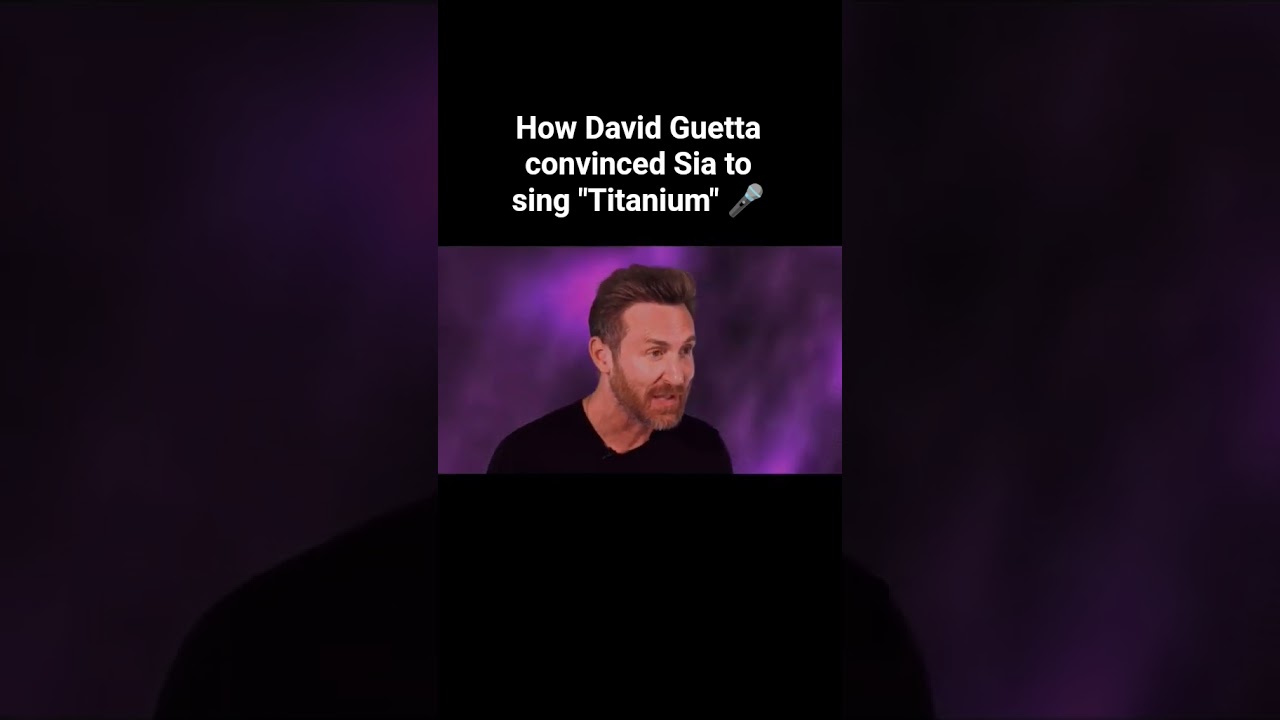
Sia’s attitude toward Titanium changed when the song, sporting her vocal, was released as the album’s fourth single on December 9th 2011.
It transpired that Guetta and his team’s instincts were bang-on. The song went big, quick. In tandem with a video, which depicted a boy struggling with controlling his X-Men-like superhuman powers, it became a global smash hit. It shifted 4 million copies in America alone, hitting number 7 in the Billboard Top 100, and topping the chart in the UK where it continues to be a club perennial.

Beyond opening the floodgates for her solo success with the epic Chandelier a few years on (more on that here), the impact of Titanium brought Sia some not inconsiderable rewards.
“I’d spent such a long time building what I thought was my own credible music career, and I found myself embarrassed by the commercialism of that music,” Sia told The Sunday Times (as referenced in NME here). “But, of course, when it buys you a house, it stops feeling like such a bad thing.”
Titanium was unavoidable not just through 2011, but across the ensuing decade. Enmeshing the communal spirit of dance music with the thrilling dynamics of an infectious pop banger, Titanium perfectly married Guetta’s vibrant club magic with Sia’s powerhouse vocals and her resilient theme.
It resonated with millions the world over. On the back of this phenomenal success, Sia obviously forgave Guetta for his nagging, and would go on to collaborate with the DJ a further 8 times, with the latest being last year’s Beautiful People.
A decade on from Titanium’s release, David Guetta reflected on the enduring majesty of the track, and its role in bringing Sia to the attention of the wider world. “That is probably the song that makes me the proudest in my career,” Guetta told Billboard in 2021.“First, because I think it’s probably the song that really revealed Sia to the world. She was successful, but in a more underground way, a more indie-pop way. She didn’t really cross over so massively before, and it was so incredible for me to discover what I consider probably the biggest talent on the planet.”
