
Despite its overriding ubiquity as the theme in the canon of pop music, writing a genuinely affecting love song which doesn’t clunkily stick a foot in one of the bear-traps of cliché can be a tall order.
By the dawn of punk in the late 1970s, songs about love were given a wide berth by many of music's sneering figureheads. In the era defined by nihilism and disorder, those singing songs about happiness were suspect.
By the early 1980s, these punk-driven attitudes might have receded, but even the most innovative post-punk outfit would turn their noses up at songs which touched on what it means to actually be content. The angst of a bitter breakdown (Joy Division's Love Will Tear Us Apart, for instance) was the more frequently-chosen avenue when addressing relationships.
By 1983, Talking Heads had evolved from the scratchy art-rock angularity of their 1977 debut into the house band of the highbrow.
Capping their exceptional Eno-produced trilogy of albums with the critically-revered Remain in Light, the band's boundless musical exploration was married to an equally diverse thematic canvas.
Fronted by the idiosyncratic David Byrne, Talking Heads’ artistic drives widened the scope of post-punk, with occasional forays into the mainstream via a salvo of odd, but undeniably catchy cuts.
Their most widely-known songs up until that point pertained to the inner-life of a murderer (Psycho Killer), survival in a post-apocalyptic landscape (Life During Wartime) and the submersion of the self under a blanket of consumerism (Once in a Lifetime). It was far from your typical pop - or even post-punk - fare.
The very last thing you’d expect a band of this nature to do next would be to pen a love song. A song that addressed what it actually meant to surrender to the allure of happiness, and imagine a future with someone you actually loved.
But, despite its writer referring to it as such, This Must Be the Place (Naive Melody) bore little resemblance to a typical example of a 'love song'.
“It's a real honest kind of love song. I don't think I've ever done a real love song before,” Byrne said during his bizarre Self-Interview on the DVD of concert film Stop Making Sense.
“Mine always had a sort of reservation, or a twist. I tried to write one that wasn't corny, that didn't sound stupid or lame the way many do. I think I succeeded; I was pretty happy with that.”

Written during the sessions for Talking Heads’ fifth studio album, 1983’s Speaking in Tongues, at Compass Point Studios in the Bahamas, This Must Be the Place would be the LP’s incongruously heartwarming closer.
Although Brian Eno was no longer in the producer’s chair, the four took an Oblique Strategy-esque route in making the song.
The starting point came when the group decided they’d try and build a musical framework that leaned into a feeling of trepidation and naivety. To realise it, the band decided to swap instruments (similar to how Eno and Bowie had encouraged their players to trade places when making the garage rock-sounding Boys Keep Swinging in 1979.)
Tina Weymouth put down her bass and instead picked up a guitar, whilst lead guitarist Jerry Harrison headed over to a Prophet-5 synthesiser to conjure the repetitive bass part.
Meanwhile Byrne flitted between guitar and synth, and it was David himself who concocted the song’s hallmark fidgety flute-synth motif and occasional 'shy'-sounding rises and falls while riding the Prophet-5’s pitch wheel.
However, with nobody else in the band able to play drums, Talking Heads’ drummer Chris Frantz remained sat behind his kit.
“[David] played that little keyboard part: ‘doot doot do-do-do-do do, doot doot’”, Frantz told Songfacts “Tina played guitar and Jerry played keyboard bass. I played drums because I was the only one who knew how to play drums."
The team were also bolstered by session-synth legend (and member of the Compass Point All-Stars) Wally Badarou who provided the song’s synth stabs, and David Van Tieghem who contributed additional percussion.

Unshackled from their instruments, the team landed on a constantly-repeated, cyclical progression, spelled out by Harrison’s synth-bass part. Harrison's bass pulsed up and down through a riff that surged between D, E minor, C and back to E minor, this was augmented by some higher-register, crystalline guitar licks from Weymouth.
Despite the implied musicological trappings of this loop, Byrne’s initial vocal melody idea began with a G note - which suggested the key of G. On paper, this should have created something of a clash with the home-chord avoidant bass notes, but, somehow, the group made it work.
As musicologist and MusicRadar contributor Ethan Hein explored in a fascinating article on his blog, the theoretical oddness of Byrne’s ever-shifting vocal melodies playing off of Talking Heads’ ostinato loop is quite the head-scratcher. However, the vocal’s peculiar discord with the music added much to the song’s intrinsic naivety.
“What the heck key is this in? All the pitches are within the G major scale, and the vocal melody certainly sounds like it’s in G major," Ethan writes. "But the bassline only glances at the note G; it seems to spell out a chord progression of D, Em, C, Em. That implies either D Mixolydian mode, because D is in the strongest metrical position, or E minor, because that’s the chord where the bassline spends the most time.”
Ethan's piece is well worth a read for more in-depth analysis of the song’s peculiar theory.
This unusual arrangement had an unease to it, with the idea of ‘home’ (both in a musical sense, and lyrically) ever so slightly out of reach.
"We called it ‘Naive Melody’ before there were any lyrics put to it," Frantz told Songfacts. "[For Speaking In Tongues], we recorded all the basic tracks instrumentally and then the lyrics were added after.”
Over a period of months, the group corralled their ambiguous sketch into a solid song. The track, now called This Must Be the Place (Naive Melody), would house one of Byrne’s most perceptive lyrics to date.
Balancing its singer's characteristic trepidation against the allure of real stability, Byrne mapped-out a series of - as he described them - non sequiturs.
“[They were] phrases that may have a strong emotional resonance but don't have any narrative qualities,” Byrne reflected in the Self-Interview.
However, when arranged, Byrne’s lyric pointed toward a man on the verge of allowing himself to feel life-altering contentment with his partner
Home is where I want to be
Pick me up and turn me round
I feel numb, born with a weak heart
I guess I must be having fun
The less we say about it the better
Make it up as we go along
Feet on the ground, head in the sky
It's okay, I know nothing's wrong, nothing
Byrne’s blossoming relationship with Adelle Lutz, a costume designer that David had met whilst visiting Japan in 1982, was the likely inspiration for the song’s lyrical theme. A few years later, they would marry and later have a daughter Malu Abeni Valentine Byrne.

Although Byrne had been in a few relationships before (particularly a year-long relationship with choreographer Twyla Tharp) it was the grounding effect of meeting his future wife that was undoubtedly playing on his mind as he penned these bliss-anticipating words.
Perhaps settling into a sort of comfy normalcy was something that would bring the skittish 31-year-old a sort of fulfilment he’d never expected.
But, unsurprisingly for the man who’d only recently bellowed, ‘This is not my beautiful wife!' in his diatribe against the ordinary, Once in a Lifetime, there remains a gnawing sense of suspicion in his lyric.
Something was bound to go wrong, wasn't it?
I'm just an animal looking for a home, and
Share the same space for a minute or two
And you love me 'til my heart stops
Love me 'til I'm dead
Byrne’s more candid, internally-revealing lyric was a deviation from to his then-typical approach of improvising a vocalisation across the backing live and then gradually working out what the words needed to be as the song developed. As he shared in his excellent 2012 book How Music Works, Byrne was conscious of the danger of being too overt with prescribed meaning when songwriting.
“At times words can be a dangerous addition to music - they can pin it down,” Byrne said. “Words imply that the music is about what the words say, literally and nothing more. If done poorly, they can destroy the pleasant ambiguity that constitutes much of the reason we love music.”
The song was markedly different from Speaking in Tongues' other tracks on a musical level too. The album incorporated a troupe of interracial players (dubbed the ‘Expanded Heads’) and furthered the group’s merger of art-rock and dense African-inspired funk with a gospel-flavour and a wider array of electronic instruments.
Although the album was a solid entry in the TH canon (and the biggest commercial success for the group up to this point) it was really the iconic concert film Stop Making Sense that remains the best document of this era, if not the single greatest Talking Heads moment full-stop.
As documented in the film, which was captured over four nights at Hollywood’s Pantages Theatre during the Speaking in Tongues tour, the band's performance of This Must Be the Place culminated with Byrne (legendarily!) dancing around a lampshade.
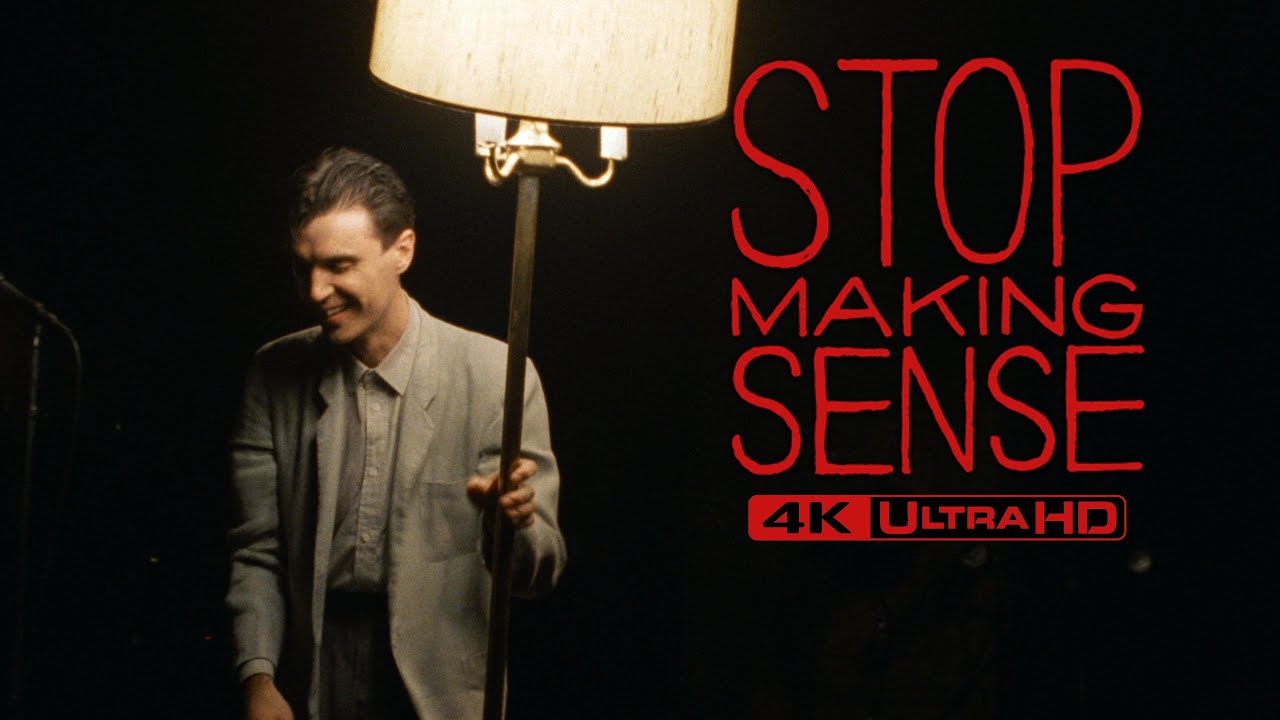
Named after a Roy Lichtenstein lithograph, This Must Be the Place (Naive Melody) was released as a single in November 1983. Being dropped out some five months after becoming a key standout on its much-bought parent album, it’s not hugely surprising that the single did little business. It reached a paltry 62 on the US Billboard Top 100 and a slightly-better 51 on the UK Chart. Over the years, however, it’s gone on to be one of the band’s most cherished songs.
Astutely tapping into a universal anxious apprehension many feel when beginning to believe that a relationship could actually go the distance, This Must Be the Place (Naive Melody) is a nuanced exploration of a facet of love’s journey that had never been analysed in a song before.
It’s a beautiful, sincere insight into the psychology of happiness, delivered by a man who, ironically, had become adept at documenting his experiences with a detached perspective.
“I try to write about small things: paper, animals, a house. Love is kinda big,” Byrne summed up in his Self Interview.

This Must Be the Place found Byrne on the precipice of contentedness. And, for a man so defined by his unease, it felt like a kind of resolution. Or at least, the anticipation of taking a breath.
But Byrne, as an artist at least, continued to be a restless wanderer. Talking Heads would plough on, producing three more studio albums (and a film) before finally calling it quits in 1991. Byrne's solo career would flourish over the ensuing decades. Here in 2026, David Byrne continues to regularly play this song whilst touring his latest studio album Who Is the Sky?
“It’s a very comforting song,” said Talking Heads’ drummer Chris Frantz in his interview with Songfacts. “I think people listen to it and it kind of warms their heart because it’s a song with a happy and secure message. I love that song myself. It’s really sweet - quite an accomplishment for a band such as ours.”
