


Enola Gay is not only one of Orchestral Manoeuvres in the Dark's most memorable tracks, it is one of the most poignant, bittersweet and perhaps contradictory pop songs ever written.
It’s an incredibly hooky, catchy and pitch perfect chart hit, yes, but it's also about the plane that dropped the atom bomb on Hiroshima on August 6, 1945, at precisely 08:15am, which ultimately killed 140,000 people.
Catchy? Yes. Bleak? Just a bit.
Enola Gay is an anti-war song, of that there is no doubt, and the fact that it hit number one in peace-loving Spain perhaps backs up these credentials. Yet its writer, Andy McCluskey, has often been as conflicted about the song as his poignant lyrics are with the joyful music.
“The song is not in any way, shape or form a celebration,” McCluskey told The Telegraph in 2020. “It’s really a discussion. It’s about the moral dilemma. It’s about what happened - and how it happened. There is no more greater moral dilemma than whether you should drop an atomic bomb that kills 140,000 people in the hope that it might save five million. There are so many questions that hang over the dropping of the bomb, but one thing you cannot deny is that it was an absolute atrocious thing to do."
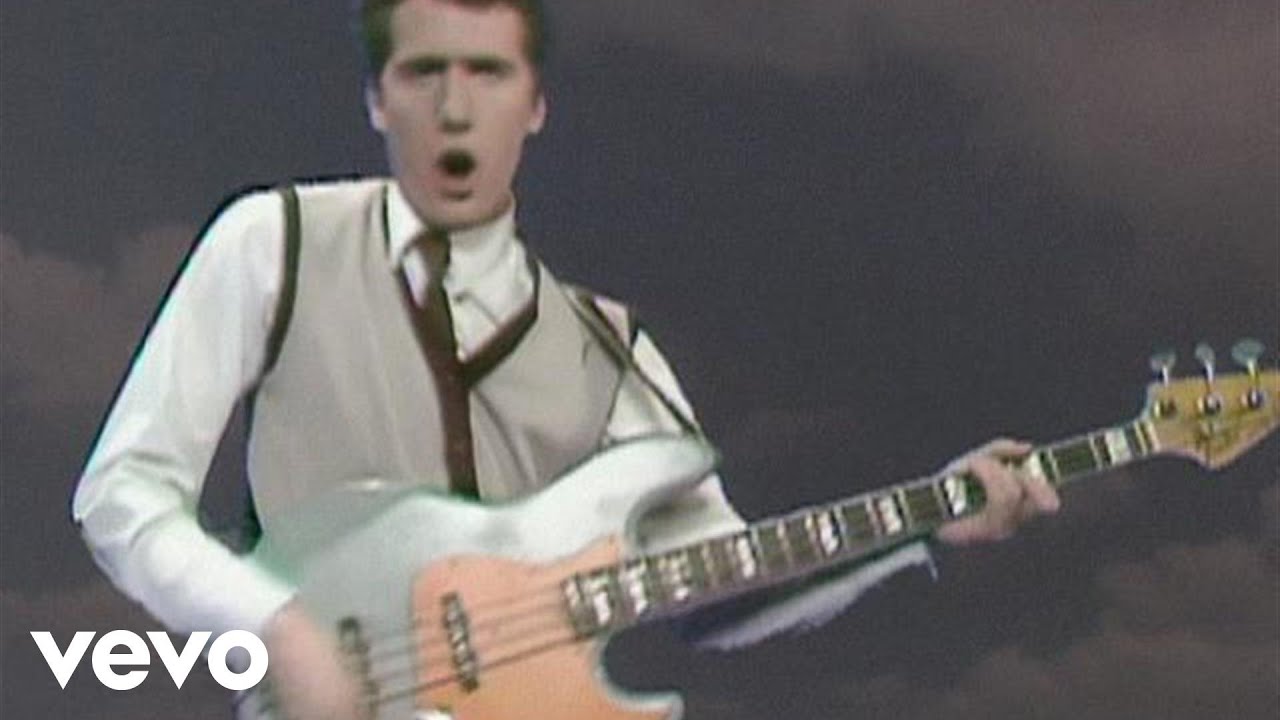
But why, you may ask, were a couple of young lads from the Wirral in North-West England interested in penning a song about 1945 in 1980, and in the process, making one of the best synth-pop songs ever written?
For the answer, you have to place yourself in Britain at that time. It was a place that was generally grey, depressed and living under the shadow of the Cold War, where armed conflict never seemed too far away and where nuclear war was a clear and present danger.
At the time we were bombarded with stories about how Russia could unleash armageddon upon us at any moment, and the only government reassurance was to distribute a leaflet that described how your only defence against such an attack was to hide under your table.
Or, the leaflets said, you could use your last remaining four minutes to paint the windows white (to reflect the radiation, naturally), or take a door off its hinges and hide under that.
And the soundtrack to all of this? An air raid siren filled with enough dread and terror to freeze you to the spot, whatever you were doing.
The icing on the cake was paranoid mix the the nuclear war TV movie Threads, a film that was so despairingly hopeless and dark that one watch would send you to RAF Greenham Common to join the anti-war protests at the US fighters based there. This was peak-bleak Britain.
Basically we'd have gladly raced our Raleigh Chopper bikes into a nuclear blast just to end it all.
What we all needed was joyous synth-pop as an antidote, and we certainly got it… albeit synth-pop that was highly aware of this tense context.
Andy McCluskey and fellow OMD founder Paul Humphreys were busy building their (little did they anticipate) five-decade career in 1980. They had successfully released the track Electricity, itself a kind of perfect, synth-punk take on Radioactivity by Kraftwerk, and were looking to build on this and the success of their self-titled debut album.

The only problem was that any royalties were still a long way in coming so Humphreys was bouncing between jobs and dole cheques while writing at his mum's house with McCluskey.
It just so happened that he had to work on the day that Andy came up with the idea for Enola Gay, so missed out co-writing one of the band's biggest hits.
"It was just me at the back of his mum’s house," McCluskey recalls. "That’s when I wrote the music. I thought - 'oh maybe I could sing about that Enola Gay plane.’”
And while that sounds like a totally random idea, you not only have to insert yourself in 1980 Britain, if you dare, but also consider that McCluskey and Humphreys were and are massive geeks, and proud of it.
Paul would apply his own obsessive actions to the synths and electronic sound, and in this case, McCluskey would channel his own Second World War obsession into his songwriting.
"I had a fascination for warfare," Andy told Songwriting Magazine in 2020. "Not in a celebratory way but in a sense that I was drawn by the horror of it and the moral dilemma that people were allowed to do things in war that were illegal at times of peace. If you’re interested in Second World War aeroplanes then ultimately you have to come to the one that effectively ended the war."

In Paul's mum's back room (a phrase that could also be an OMD song title, if you think about it) Andy put the chords and melody together on an organ in a way that would become an OMD standard: "It’s a typical linear OMD song; it is the same four chords all the way through and it never varies. The verse, the melody, the middle eight, it’s all the same."
The band played the track out before it had been properly recorded, but a drum machine purchase helped get it over the finish line.
"We purchased a Roland CR-78 CompuRhythm, which was one of the first programmable drum machines," McCluskey revealed. "As well as having the presets like Bossa Nova and Tango, you could actually program your own drum sounds. So we programmed up the drum pattern that became the bed for the whole track, and is one of the most distinctive parts of the song."

The lyrics came via Andy's obsession with historical detail. No Google or Wikipedia in 1980 meant frequent trips to the library (remember those?) to make sure he had his facts correct, right down to the name of the bomb, Little Boy, which he cleverly weaved into a double meaning where the pilot's mother, Enola Gay, who the plane was named after, proudly waved her ‘little boy’ off to do his deed.
It's 8:15
And that's the time that it's always been
We got your message on the radio
Conditions normal and you're coming home
Enola Gay
Is mother proud of little boy today?
Once the song was written, McCluskey was rightly proud of his own little boy, but those close to him had reservations, as he told the Telegraph: "For Paul it was a little strange - like trying to adopt a stepchild. It wasn’t his baby. Our manager at the time thought it was cheesy pop crap.”
"I was always uneasy about the fact that Enola Gay was a bright, perky pop song about a nuclear holocaust, but it was insanely catchy," Paul later admitted to The Guardian in 2013.
Thankfully Virgin, the band's label, agreed, and gave seasoned producer and former Gong bassist Mike Howlett the task of knocking the song into shape.
“We discussed the irony of the lyric in the studio," he told the Telegraph. "Such a dark subject matter, but at first listen seemingly just a 'silly' love song and with the simple pop chord structure; I definitely thought it was a hit, partly because of the catchy repeating three-note synth melody, as well as the classic chord cycle. There must be dozens of classic '50s hits with this same cycle - Stand By Me comes to mind. And, of course, the way the song title starts every verse.”
The track and OMD's second album, Organisation, were recorded in no less than four studios, including Liverpool's Gramophone Suite, Ridge Farm, The Manor and London's Advision.
And as the best recordings do, it all went without so much as a hitch, the only issue being a re-recording of Andy's vocals using a vintage Neumann M49 which suited his voice better.

"The emotional way I sang the song helped give it strength," he told The Guardian. "I’m also proud of the fact that, although Paul and I were obsessed by technology and electronic sounds, we never wanted to do the silly ‘we-are-robots’ thing that was fashionable in the early 80s."
"Our great inspiration was Kraftwerk," Paul added, "though we didn’t have the technology to emulate them. Today, making our new album, I’ve got about a billion synths and the possibilities are endless; but back then, proper synths cost thousands. Ours were really quite cheesy. Most of the melodic parts of Enola Gay were recorded on a Korg Micro-Preset bought from a mail order catalogue - the cheapest one you could buy.
"The single might sound big and grand, but when you listen to the solo parts on the master, everything is so small; 60 per cent of that sound must have come from the reverb effects we used in the studio."
With fairly mixed feeling in the OMD camp, the song was released in October 1980 but contrary to any negative expectations, it became huge.
Even including 'gay' in the title - a word transitioning from one meaning to another at the time, couldn't deflect its success in Thatcher's Britain after some incorrectly took the song to be a gay anthem.
"People couldn’t comprehend how this strange song about a plane that drops a bomb could be a hit," McCluskey says, "but it became an absolute monster, selling five million copies across Europe. It seems ridiculous in this age of the X Factor and manufactured pop stars that anybody could, almost by accident, get a song to the top of the charts that they considered to be art - but that’s where we were coming from."

And 45 years on the song still resonates for more than one reason. First there's the fact that it's a great piece of peace-pop: "We still close our gigs with Enola Gay, leaving the stage with the drum machine playing," says Andy, who of course later went on to create British 2000s girl group Atomic Kitten. "I never understand bands who tire of playing their biggest hit, the song that’s been the key to their entire life."
But of course there's another reason it still matters. Enola Gay is not just a sparkling slice of 1980s pop perfection, it is a reminder of one of humanity's darkest hours.
Listening to it today and its theme is still just as resonant. After all, we still live in a world where the globe’s superpowers are again using their nuclear arsenals to posture and assert dominance on others. That same Cold War paranoia and existential fear is back in the air.
Perhaps then, the time is ripe for some new producers to rise up with a new anti-war anthem. Actually, there's no 'perhaps' about it. The time is now: to sing, produce and shout and rebel, otherwise war really is never going to fade away.
Over to you, kids.
