


One morning in early 1971, John Lennon sat down at a Steinway upright piano in the bedroom of his Grade-II listed Georgian house at Tittenhurst Park, a 72-acre estate near Ascot in Berkshire, and wrote a song regarded by many as the ultimate peace anthem, an ode to idealism and a meditation on collective hope.
The song was Imagine and, for many, it is viewed as the defining composition of Lennon’s post-Beatles career and one of the greatest songs of the 20th century.
Critics have debated its merits. While some view it as a deeply poignant song others have found it overly sentimental. But for Lennon that was the whole point.
Imagine is “anti-religious, anti-nationalistic, anti-conventional, anti-capitalistic,” he once said, “but because it is sugarcoated, it is accepted.”
It’s 55 years since Lennon wrote and released the song. But its simple plea for a world without war, borders or divisions resonates just as powerfully now as it ever has done.
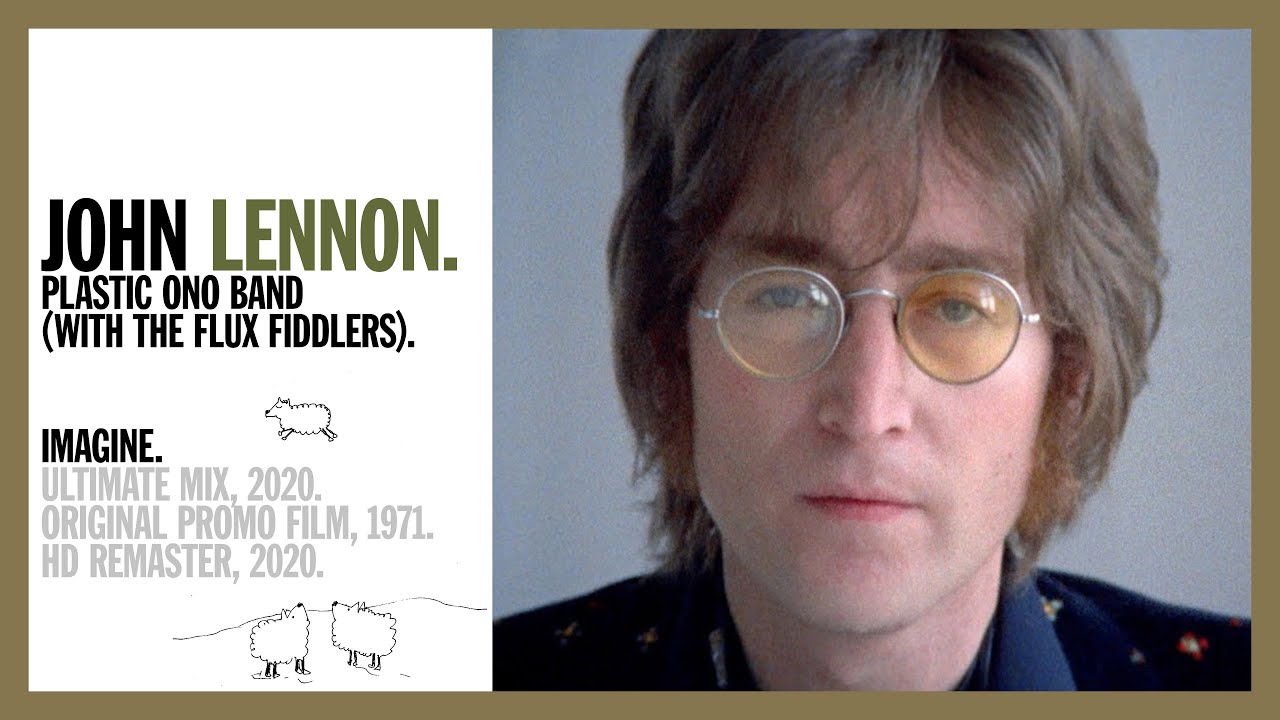
By 1971, Lennon was moving away from the more left-field, visceral material of the Plastic Ono Band and returning to calmer, more conventional music as he began working on the album that would become Imagine.
The inspiration for its title track came from a number of poems in Yoko Ono’s 1964 book Grapefruit, one of which was called Cloud Piece. This included the line: “Imagine the clouds dripping, dig a hole in your garden to put them in.”
In an interview with Andy Peebles of BBC Radio 1, recorded in New York on 6 December 1980, Lennon explained that Imagine “should be credited as a Lennon/Ono song”.
“A lot of it – the lyric and the concept – came from Yoko,” he said. “But in those days I was a bit more selfish, a bit more macho, and I sort of omitted her contribution, but it was right out of Grapefruit, her book. There's a whole pile of pieces about ‘Imagine this’ and ‘Imagine that’.”
In 2018, Lennon’s comments resulted in Ono being formally recognised by the National Music Publishers Association in New York as the co-writer of Imagine.
In another interview in December 1980, with writer David Sheff, Lennon said that the song was also inspired by a book about “the concept of positive prayer” that he and Ono had been given by American comedian, actor, writer and political activist Dick Gregory.
Lennon was allegedly later contacted by a religious organisation with a request to use the song.
He recalled: “The World Church called me once and asked, ‘Can we use the lyrics to Imagine and just change it to “Imagine one religion?”’ That showed [me] they didn't understand it at all. It would defeat the whole purpose of the song, the whole idea.”
On 27 May 1971, Lennon began recording the song at Ascot Sound Studios, a facility that he and Ono had created in the basement of the original house on the estate. Sound engineer Eddie Veale helped build the studio and called it “the first professional home studio in the UK”.
Phil Spector and Yoko Ono produced Imagine and the album that bears its name.
Lennon assembled a crack band for the recording. On drums was future Yes drummer Alan White, while revered session player Nicky Hopkins played additional piano.
On bass was Klaus Voormann, a long-time friend of The Beatles from their Hamburg days and a linchpin in their backstory, who also designed the Revolver album cover.
“Tittenhurst Park was a sort of paradise, beautiful gardens,” recalled Voormann in the 1988 documentary Imagine: John Lennon. “The house itself wasn’t that big but a very, very nice house. I loved it. The studio was really small and the atmosphere was very loose.”
The sessions for Imagine took place on 27 May lasted until early evening. According to writer David Fricke in his 2012 book The Making Of Imagine, they recorded three takes and chose the second one for release.
The Imagine: John Lennon documentary offers a compelling glimpse into the recording of the song.
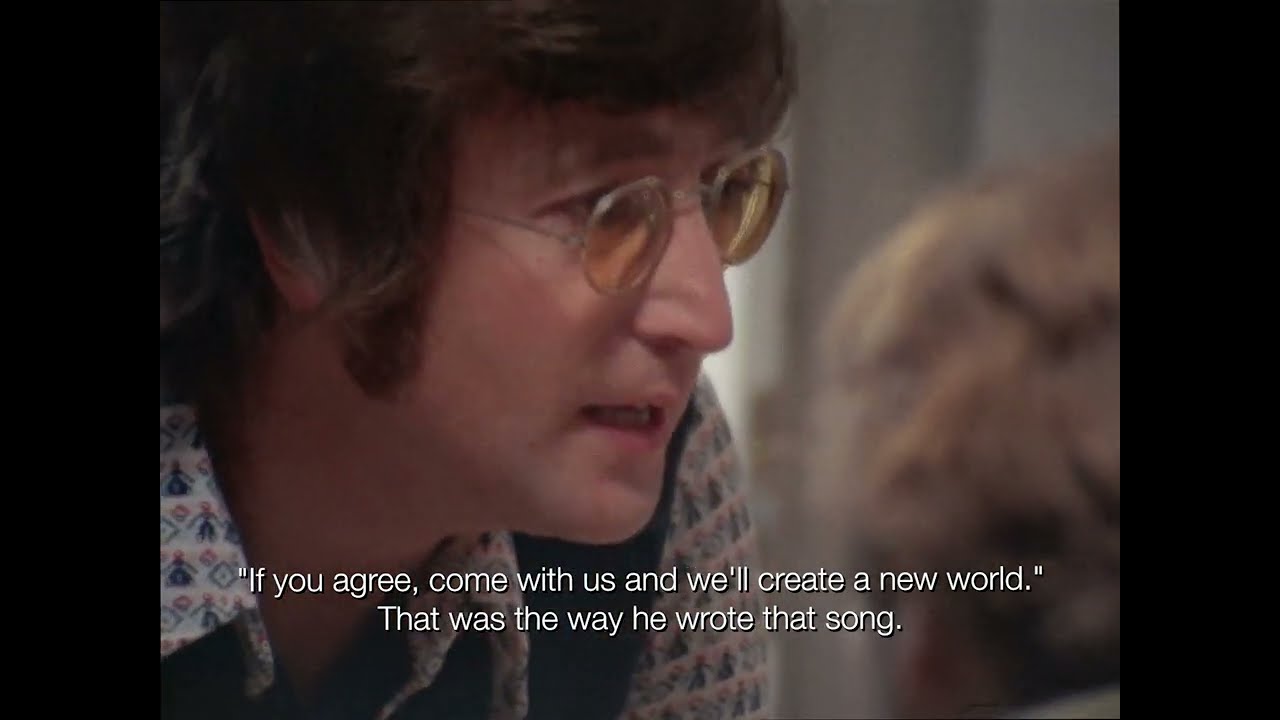
“What’s this one, a ballad?” Nicky Hopkins asks Lennon as they sit behind the mixing desk in the cramped basement studio.
“Yeah, come on I’ll teach you,” says Lennon.
He then proceeds to play the song on the piano, as Hopkins, Ono, Voormann and White look on.
Towards the end of the song, Lennon veers into pastiche, taking his vocal way down low, but the song’s emotional power is still evident.
“It’s a nice song, for sure” says Hopkins.
“Yeah, that’s the one I like best,” replies Lennon.
Yoko Ono then suggests adding another piano track an octave higher. “It’s such a delicate song,” she says.
Voorman suggests using the white grand piano.
The next footage is of Lennon, at the white piano in the large white living room at Tittenhurst Park, with headphones on and fully mic’d up, while Yoko sits behind him on the carpet, smoking a cigarette and listening intently. This is the footage for the iconic promotional film for the song.
During the mixing process, Lennon can be seen standing at the desk telling Phil Spector that “it should be just a piano song” as he and Spector determine where exactly the piano should sit in the mix. “The bass sounds too trebly,” says Lennon at one point.
Watching Lennon’s performance in this documentary, one thing becomes abundantly clear. The key to Imagine’s greatness is its simplicity.
Much of the song’s emotional power also stems from Lennon’s exquisitely calm and understated performances, vocally and instrumentally.
It’s a beautifully crafted song. There is such an impeccable feel to his playing on the Steinway upright, beginning with the iconic C-Cmaj7-F chord progression, and an innate humility and directness to his vocal performance.
One of the song’s major hooks of course is the emotive descending melody on the bridge: “Imagine all the people/Living for today”, followed by a blissful “a-ha” falsetto from Lennon, all underpinned by a F-Am/E-Dm7-F/C-G-C/G-G7 chord progression.
One of Lennon’s great talents was conveying a feeling and idea simply and directly, and that is precisely what he does with Imagine.
Cynics may argue that the song is naive, utopian and idealistic, but it also shows insight and empathy. In simple humanitarian terms it is difficult to argue against Lennon’s belief that global unity is the key to the world’s problems, while division through wars, nationalism, capitalism and religion can bring only poverty and pain.
“Imagine no possessions/I wonder if you can/No need for greed or hunger/A brotherhood of man.”
As Yoko Ono said of the song, the lyrics to Imagine are “just what John believed: that we are all one country, one world, one people”.
It’s a view reflected in a review by Rolling Stone magazine, which described the lyrics to Imagine as “22 lines of graceful, plain-spoken faith in the power of a world, united in purpose, to repair and change itself.”
The arrangement and mix of Imagine were kept lean and direct. Nicky Hopkins contributed a higher piano part but his electric piano part was not deemed necessary in the final mix.
On 4 July 1971, a subtle layer of string overdubs were added, at The Record Plant in New York, and the song was finished.
Imagine was released as a single on 11 October 1971 and became the bestselling single of Lennon’s solo career.
“Imagine is the best song I’ve ever written,” Lennon told writer David Sheff in 1980. “It’s almost like a prayer.”
The song reached No 3 in the Billboard Hot 100 and No 1 in Canada, Australia, New Zealand and South Africa, but was not released as a single in the UK.
Following Lennon’s violent murder in 1980, the song went to No 1 in the UK, Ireland and Luxembourg.
The song’s lyrics upset some religious groups, particularly the line, “Imagine there’s no heaven”.
In an interview with Rolling Stone founder Jann Wenner in 1970, Lennon said he considered the song to be as strong a composition as any he had written within The Beatles.
In the five and a half decades since its release, the song’s beauty and its power as a beacon of hope has given it a colossal and enduring lifespan.
In 2006, former US president Jimmy Carter told Debbie Elliott of NPR: “In many countries around the world – my wife and I have visited about 125 countries – you hear John Lennon’s song Imagine used almost equally with national anthems.”
More than 200 artists have covered the song, including Madonna, Stevie Wonder, Joan Baez, David Bowie, Elton John and Diana Ross.
![David Bowie - Imagine (Live) [Official Video] [HD] - YouTube](https://img.youtube.com/vi/yo5W9ByBbrQ/maxresdefault.jpg)
In Ray Coleman’s 1992 book Lennon: The Definitive Biography, George Martin singled out the song from Lennon’s solo work. “My favourite song of all was Imagine,” he said.
Across the decades, the song has been appropriated in moments of great triumph and tragedy.
The morning after the November 2015 Paris attacks, German pianist Davide Martello brought a piano out into the street in front of the Bataclan, where 89 people had been shot dead the night before, and performed an instrumental version of Imagine to honour the victims of the attack.
Not surprisingly, the song has charted highly on numerous polls over the years. In 2004, Rolling Stone ranked the song number three on its list of the 500 Greatest Songs Of All Time.
The magazine described Imagine as “an enduring hymn of solace and promise that has carried us through extreme grief, from the shock of Lennon’s own death in 1980 to the unspeakable horror of September 11.
“It is now impossible to imagine a world without Imagine, and we need it more than he ever dreamed.”
