
It’s the sound of spring condensed into four minutes. Paul McCartney’s Coming Up has a zesty, eager bounce in its step, entirely fitting for an iconic artist stepping into a new decade.
Nearly half a century on it’s one of the most enduring singles of his post-Beatles career. Played to the right crowd on the right occasion, it can still fill floors in 2026.
But though in retrospect it – and the McCartney II album – has been viewed as a fresh start for Macca, that’s not exactly how it was intended at the time. Coming Up was recorded in mid 1979, just after the release of Wings’ Back To The Egg album. The group were still very much a going concern at the time – they had tour dates pencilled in for the autumn.
Indeed, as late as October 1980, McCartney was still insisting, in an interview with Club Sandwich, that the band had a future: “It doesn’t mean Wings are going to split up,” he said of the McCartney II album. “It just means that for the time being, we’re doing solo things rather than a group project.”
Back in the summer of 1979, McCartney had a gap in his schedule and he used it in the way he knew best: working on new music. Working from home in Sussex, he used a hired Studer 16-track, plugging one microphone directly into the back of the machine. Later on, he moved up to his Scottish farmhouse – where he’d written the bulk of the first McCartney album a decade previously – and finished what were initially just exploratory recordings.

It was in Scotland where inspiration hit for Coming Up. “I went into the studio each day and just started with a drum track,” McCartney told Club Sandwich. “It is very much like sitting down with a few lumps of clay and putting down one after another until it makes itself into a face or something. In this case, it just made itself into the song.”
“Then I built it up bit by bit without any idea of how the song was going to turn out. After laying down the drum track, I added guitars and bass, building up the backing track. I did a little version with just me as the nutty professor, doing everything and getting into my own world like a laboratory. The absent-minded professor is what I go like when I’m doing those; you get so into yourself it’s weird, crazy. But I liked it.”

“Then I thought, ‘Well, OK, what am I going to do for the voice?’ I was working with a vari-speed machine with which you can speed up your voice, or take it down a little bit. That’s how the voice sound came about.
"It’s been speeded up slightly and put through an echo machine I was playing around with. I got into all sorts of tricks, and I can’t remember how I did half of them, because I was just throwing them all in and anything that sounded good, I kept. And anything I didn’t like, I just wiped.”
Coming Up, he summarised, was “very much like sitting down with a few lumps of clay and putting down one after another until it makes itself into a face or something. In this case, it just made itself into the song.”
Though other tracks on the album, like Temporary Secretary, were clearly experiments, Coming Up had clear commercial appeal. So it was not surprising that when Wings started touring that autumn, it became part of their set - “we wanted to do something the audience hadn’t heard before.” McCartney reasoned.
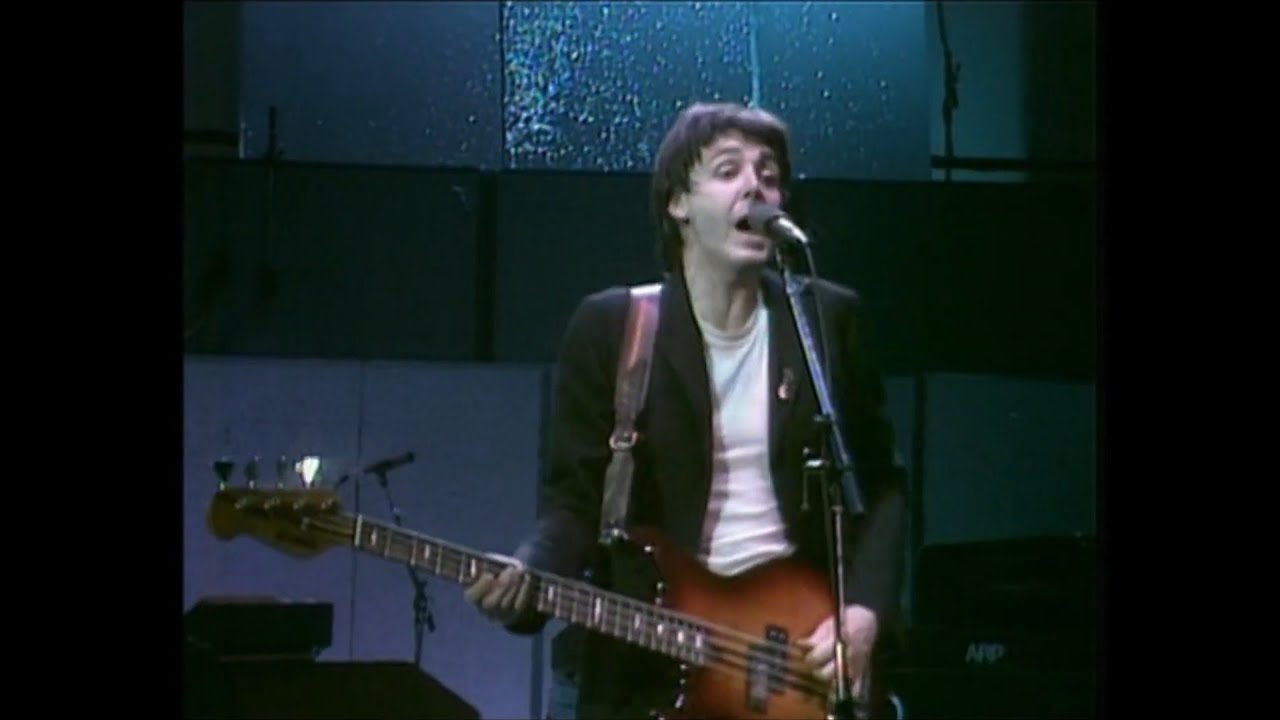
Wings would have probably played it on the Japanese tour scheduled for January 1980, but those gigs never happened.
McCartney was caught attempting to smuggle 250 grams of marijuana in through Narita Airport and spent nine days in jail for his trouble. Whether the ex-Beatle was trying to subconsciously trying to sabotage the tour, or he arrogantly thought his stardom would insulate him remains unclear to this day. But the tour was cancelled, Wings never played live again and on his return to the UK McCartney appears to have had a rethink about the material he’d recorded the previous summer.
He decided to go ahead and release it, initially as a double album, before it was (quite rightly) whittled down to a single. Coming Up was an obvious choice as the lead single. A live version of the same track, recorded with Wings at the Glasgow Apollo in the December was placed on the B side.
Curiously, for the US market, the sides were flipped. Columbia Records reasoned that American record buyers would rather hear Paul’s “real” voice.
Whatever, the single was a success on both sides of the Atlantic. In the UK it raced up to Number Two, but got stuck behind Dexy’s Midnight Runners’ Geno. In the US it reached Number One, his seventh chart topper since the Beatles’ demise.
It was helped along its way greatly by its video, which by the standards of 1980 was cutting-edge. You may recall it featured an impossibly boyish-looking Macca (he was 37 at the time) fronting a ten-piece big band. But on closer inspection all the musicians are… Paul McCartney disguised as other pop stars.
“The drummer character in the video I based loosely on John Bonham, who’s a friend of mine” McCartney confirmed in a 2024 Youtube interview. “One of the guitar players I based on Hank Marvin. One of the guys in a group called the Sparks (Ron Mael) was the pianist. I based characters on some people I knew, some people I’d seen. And I made up the rest up.”
Elsewhere, there’s a Frank Zappa, an Andy Mackay of Roxy Music and a Beatlemania version of himself (complete with Hofner bass) who shakes his head cutely during the ‘wooo’ bits at the end of each chorus. Linda is in there too, both as herself and in drag (king) mode.
And to cap it all, according to ‘Bonham’s’ drum head, the band are called The Plastic Macs – not just making the obvious point that – literally - all the instruments are played by the song’s author, but surely a little nod to his old partner’s one-off supergroup. For twelve years previously, at the Rolling Stones’ Rock N’ Roll Circus, John Lennon fronted a group called The Dirty Mac that contained Eric Clapton, Keith Richards (on bass!) and Mitch Mitchell.
But then Lennon was never far from his thoughts. Though the two men had not spent time together since 1976, they were in contact and still on cordial terms. Prior to the Japanese tour, McCartney had rung the Dakota and offered his friend “some dynamite weed” (presumably the stash that Japanese customs seized) and when he had been held in jail, Lennon had sent him a supportive message.
Billboard Number Ones were all well and good, but they were not as valuable to McCartney as a word of praise from the one man in the world he (musically) looked up to. So one can imagine how he felt when word got back that his erstwhile partner had not only heard Coming Up but liked it.
The apocryphal story is that Lennon exclaimed ‘F**k a Pig! It’s Paul!” when he chanced across the vari-speeded version of Coming Up on the radio some time that summer. Whether those were his exact words matters not. He was certainly impressed, apparently saying that he couldn’t get the track out of his head: “It’s driving me crackers!”
“I thought that Coming Up was great,” he elaborated later in 1980 in a video interview. “And I like the freak version that he made in his barn better than that live Glasgow one. If I’d have been with him, I’d have said, ‘That’s the one to do.’”
The two men had a long shared history of friendly competition. During the second half of their Beatles career they had effectively acted as each other’s editors, improving and inspiring each other to new heights of creativity.

Even as solo artists, this dialogue through music had continued. During the early 1970s, there had been sniping – McCartney’s Too Many People provoked Lennon’s scathing How Do You Sleep? which begat his ex-partner’s hurt response, Dear Friend. Come 1973/74 there seemed to be a rapprochement and Let Me Roll It from Band On The Run can be seen as a song inspired by Lennon’s recent work or even written to elicit approval from his friend.
With Coming Up, he finally had that approval once more. What’s more, Coming Up might have played a part in Lennon’s own return to music later that year. In that video interview, Lennon said: “If I’m impressed by a record on the (radio), I immediately want to write (a song). Warren Beatty said it about movies. ‘A great movie is one that makes you want to make a movie.'”
And word got back to McCartney that Coming Up was the song that had inspired him. “I heard a story from a guy who recorded with John in New York, and he said that John would sometimes get lazy,” McCartney later said. “But then he’d hear a song of mine where he thought, ‘Oh, s**t, Paul’s putting it in, Paul’s working!’ Apparently Coming Up was the one song that got John recording again. I think John just thought, ‘Uh oh, I had better get working, too.’”
The result, as we know, was Double Fantasy. And whilst Coming Up will always be redolent of fresh starts, optimism and positivity in general, there’s a poignancy there too – for it’s one of the last lines in the Lennon – McCartney conversation, the musical friendship that changed the world.
