


There are key moments in most gifted artists’ careers when they instinctively recognise the need to make radical stylistic shifts in order to move forward creatively.
Throughout the ’80s, for example, certain artists stood out for defying convention and carving out their own unique creative paths – artists such as Peter Gabriel, Pixies, Kate Bush, Kraftwerk, Laurie Anderson, Run-DMC, Rakim, Cocteau Twins, The Cure, Brian Eno, Swans, Grace Jones, The Smiths, Sonic Youth and Talking Heads, to name just a few.
One pivotal addition to that list is Prince, a one-stop creative powerhouse whose phenomenal talent spanned songwriting, composing, production, filmmaking and the ability to play pretty much any instrument under the sun.
He also had a ferocious work ethic and a fearless artistic vision, as was demonstrated in February 1987, when he released Sign O’ The Times, the title track from his sprawlingly ambitious double album of the same name.
This song was a sparse, heavily stripped-back amalgam of electro-funk, soul, psych-pop, blues and rock, with lyrics that were aimed squarely at socio-political issues of the day – AIDS, gang violence, poverty, the crack epidemic and the Space Shuttle Challenger disaster.
Sign O’ The Times was the sound of ’80s optimism unravelling. It was also a song that, in the context of 1987 chart land, sounded quite unlike anything else around.
By the time Prince began work on the song and the album from which it came, he had fired his backing band, The Revolution, with whom he recorded the landmark albums Purple Rain (1984), Around The World In A Day (1985) and Parade (1986).
It has been suggested that Prince fired the band due to the potential awkwardness following the ending of his engagement to fiancée Susannah Melvoin, sister of The Revolution’s guitarist, vocalist and creative collaborator Wendy.
Prince was certainly wounded by the end of the relationship with Susannah and, from that point on, he worked largely in isolation, playing every instrument himself and heavily utilising a Fairlight CMI synthesiser/sampler and a Linn LM-1 drum machine.
The Sign O’ The Times album emerged out of the wreckage of three abandoned projects – Dream Factory, Camille and the triple album Crystal Ball. A compromise was subsequently reached with Prince’s label, Warner Bros Records, that he would record a double album.
Prince withdrew into his studio and his ferocious work ethic fuelled his creative output. His major musical collaborator by this point was his engineer Susan Rogers, who recorded him at various studios in Minneapolis, Los Angeles and Paris.
Rogers was Prince’s in-house sound engineer from 1983 to 1988 and was one of only a handful of people allowed to sit in on sessions.
“He had to have his privacy,” Rogers told Red Bull Music Academy in 2016. “He had to be completely alone. We did not have visitors in the studio. He needed his people around him, the people that he knew well and that he could feel comfortable with – during that time I was one of them.
“I knew how he liked to work, I could be quiet, I was his facilitator of recording, and I made that happen. He [required] everything there and set up ahead of time because he wanted to be able to move from instrument to instrument.”
Sign O’ The Times was a song written and recorded over a feverishly productive weekend in 1986.
The track’s sombre tone reflects a period of deep introspection, with Prince reflecting on world events such as the AIDS epidemic, gang warfare and endemic poverty within the US.
The socio-political slant of the lyrics on Sign O’ The Times directly reflected the lyrical content of rap music. Prince was acutely aware of the emergence of hip-hop and anticipated its eventual crossover into the mainstream marketplace.
The gritty, half-spoken lyrics in the song and the minimalist Run-DMC-style production are all evidence that Prince had his ear to the street. Sign O’ The Times finds Prince as an apocalyptic commentator, taking these hip-hop elements and repurposing them in a whole new lyrical and instrumental context.
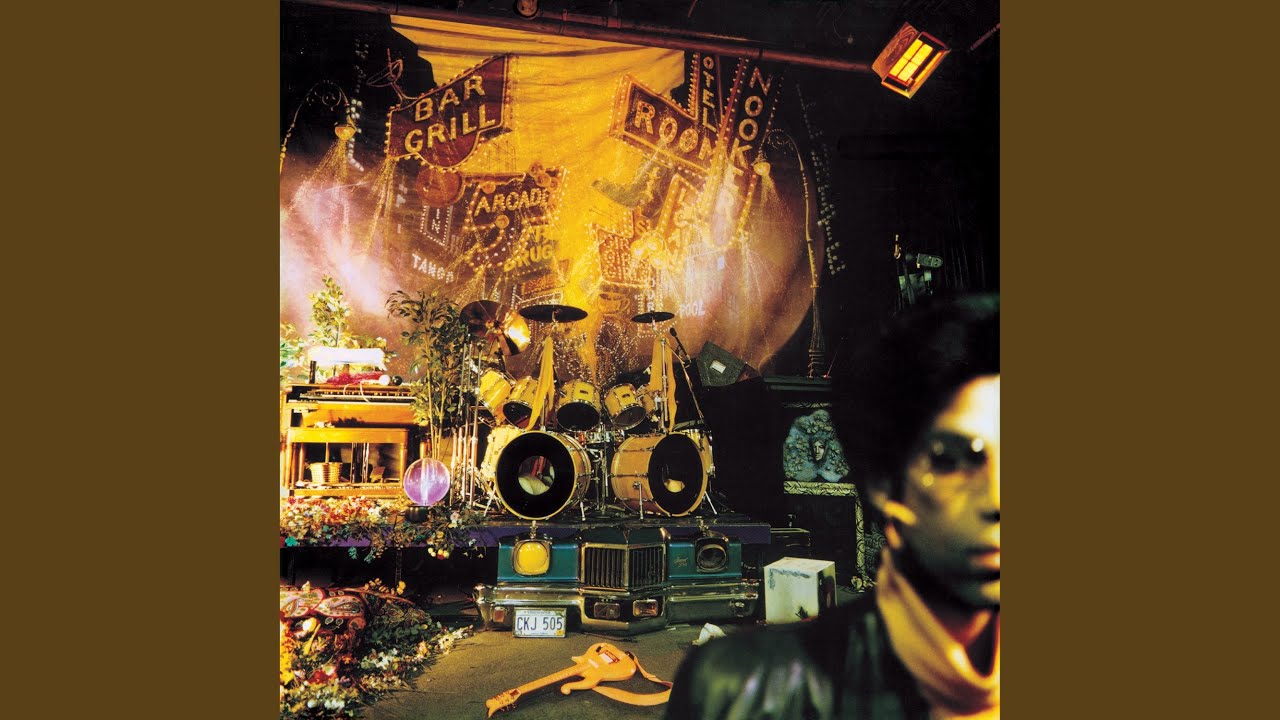
“He was definitely growing and trying new things lyrically,” Rogers told the Red Bull Music Academy. “He had some new textures and new sounds there as well, but definitely the single Sign O’ The Times was a serious attempt at social commentary. It was timely, so he was expressing, ‘Here’s where I’m going, everybody’. That song came about halfway through the making of the album and was a pivotal moment in shaping the record.”
The Sign O’ The Times song was recorded at the legendary Sunset Sound Studios in Hollywood on 15 July 1986. Rogers was the only other person in the studio with Prince, although he reportedly insisted that he was the only person present when he recorded his vocals on the track. He allegedly wrote the lyrics while sitting in his Rolls Royce convertible.
This car would play a major role in the recording of the Sign O’ The Times album. Susan Rogers made cassette dubs or remixes of the songs as Prince reportedly liked to test his mixes while blasting them out on the car’s stereo as he drove around Hollywood.
Susan Rogers once recalled that she and Prince were listening to a fresh cassette mix when Prince stopped at a 7-Eleven store where, to his amusement, he was told by a man in the queue that he looked very much like Prince – “only shorter”.
The Fairlight CMI synth/sampler was fundamental to the creation of the Sign O’ The Times song. The Fairlight provides the primary keyboard riff, the sampled electronic bass and several percussion elements heard on the track. All of the Fairlight sounds used are reportedly factory presets, including the “orchestra hit” towards the end of the song.
The LinnDrum LM-1 was reportedly used more sparingly on the title track, most likely for tambourine and cabasa sounds.
40 years on from Prince writing and recording this song, Sign O’ The Times still sounds fresh and intoxicating.
In the big, gated reverb-obsessed ’80s, Sign O’ The Times instantly stands out as different, thanks mainly to its bare bones minimalism. Space abounds in the mix and drum sounds are kept raw and open without heavy compression.
A hypnotic synth motif intros the track before a snare crack enters eight seconds in, followed by a reverb-soaked “Oh yeah” from Prince. It’s a skeletal instrumental framework, anchored by a pulsing, funk-blues synth bass.
30 seconds in, the first verse begins: “In France a skinny man died of a big disease with a little name/By chance his girlfriend came across a needle and soon she did the same.”
The lyrics go on to reference gang violence, a devastating natural disaster and a spiral into addiction.
The emotive power of the lyrics on the first verse is heightened by the vast emptiness of the mix, with only the percussive elements being present to underpin Prince’s intimate vocal delivery.
By the middle of the second verse, subtle elements enter the mix, such as a smattering of choppy funk guitar. By 1:30, the mix becomes fuller as synth bass, rhythmic guitar and percussion become more prevalent.
It’s a compelling funk groove, in C minor 7 on the verses. Then at 1:47, the whole thing lifts to an F minor 7 with an added 11th. “It's silly no? When the rocket ship explodes/And everybody still wants to fly.”
Lyrically, Prince had always flaunted sex in his lyrics but here it is melded with spirituality and a social conscience. As Nelson George put it in a retrospective review of the Sign O’ The Times album in Pitchfork in 2016: “Prince wasn’t just wrestling with fresh energy from the streets on Sign O’ The Times, but with the twin pillars of carnality and spirituality that had defined his career and that of black popular music for decades. For this Minneapolis native, it wasn’t so much a battle between sin and salvation, as it was how the warring desires could become one, synthesised through innovative arrangements, seductive yet fraught lyrics, and that remarkable voice.”
Sign O’ The Times was released as the lead single from the album on 18 February 1987 and was widely acclaimed as a gargantuan creative achievement.
The song reached No 3 in the US Billboard Hot 100, No 10 in the UK and went top 10 in nine other countries.
![Prince - Sign O' The Times [Live / Sign Of The Times] - YouTube](https://img.youtube.com/vi/YAUAXhy4oxo/maxresdefault.jpg)
It’s the creative breadth and boldness of Prince’s vision on Sign O’ The Times that is so impressive, his ability to perceive and realise such a brilliantly stark composition.
It’s certainly not the most popular of songs from within Prince’s stunning back catalogue. That accolade goes to the likes of When Doves Cry , Purple Rain, 1999 and Kiss, which frequently feature high up in polls of Prince’s greatest songs.
But 10 years after Prince’s untimely death at the age of 57, this song and the album from which it came stand as a testament to his bold ambition and sheer musical genius.
