


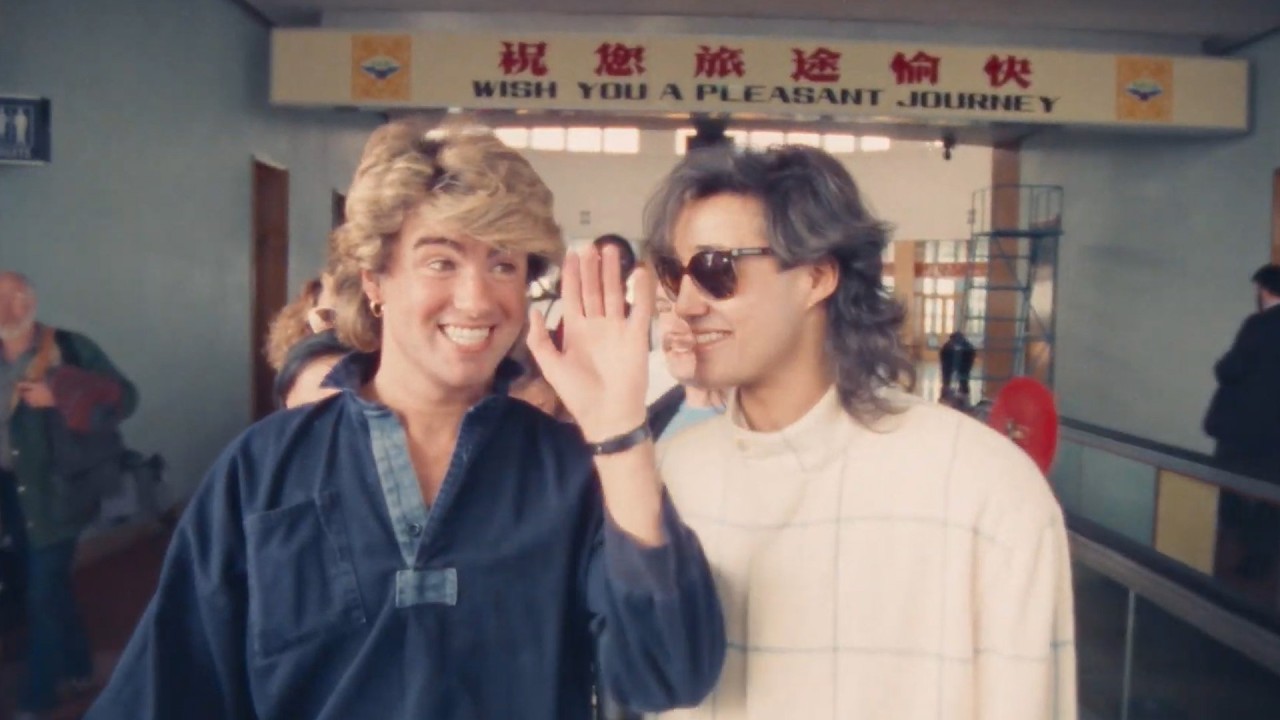
In April 1985, Wham! became the first western pop act to perform in China, winning over a people for whom the type of exuberant technicolor pop then dominating Western popular culture was entirely alien.
The ostensible objective for George Michael and Andrew Ridgeley's journey centred around two live dates at Beijing and Guangzhou (as part of their globe-trotting Big Tour). Interestingly though, the whole venture was actually a feat of promotional engineering.
Devised by the band’s Machiavellian manager Simon Napier-Bell, the China trip was envisioned as a means of generating the sort of unavoidable global headlines that would ultimately endear them to the US market - which, to some extent it did. The duo's Whamamerica! Tour followed just 4 months later.
Beyond the two shows, the near-constant parade of press conferences, banquets and formal events made for a hectic itinerary for the pair - with mutual resentment simmering between the band and a surrounding enlisted mob of journalists.
Crucially, a film crew, hired to document the trip, were also in tow, led by acclaimed director Lindsay Anderson.
Although Anderson’s film was never completed or released (a shorter, ‘pop video’ version dubbed Foreign Skies did eventually see the light of day), Anderson’s original film rushes have now been unearthed, restored and used as the foundation of a brand new film.
Wham! 10 Days in China shines the most revealing light yet on these ten seismic days, featuring brand new interviews with Andrew Ridgeley, Simon Napier-Bell and, most fascinatingly, many of the (now much older) Chinese fans themselves. The film highlights how some were so inspired by seeing Wham! back in the mid-'80s that it set their lives on a completely different course.
We spoke with director Mike Christie about the making of this film, touching on the intense time-consuming process of digging out and cleaning up Anderson’s original rushes, building the film’s narrative threads and why Wham! 10 Days in China is the definitive, 41-years-in-the-making, document of a moment when music transcended political and cultural divides.
MusicRadar: Firstly, what was it about this story that attracted you? Were you aware of the story prior to starting work on the film?
Mike Christie: “This is one of those kind of unicorn stories that's floated around in the music industry for decades. Everyone knew about the footage but no one had ever seen it. There are two patchy old films - which weren't really insightful. One of them never saw the light of day. The other one was kind of a pop video, which is what Wham! wanted it to be.
“So, it's one of those things that I've heard talked about many times. I think The George Michael Estate and George himself had been approached about this quite a bit, and they always just said no. For them, I don’t think China was a particularly pleasant experience. They weren't that interested in revisiting it.
“Then, obviously, after George passed and the Wham! anniversary project became a thing, it was very much in demand. Fans wanted to kind of reappraise it.
“Andrew has tried to live quite a private life and had sort of stepped into the shadows, but I knew him vaguely through a mutual friend. So we were talking about this as a project at the beginning of 2023. By that point I'd been to China quite a lot, so we got in touch with Andrew and floated it as an idea. What caught his imagination very quickly was the fact that I'd been there and he hadn't been back.
“I’d made a very definitive history about the art of China (called Art of China) so I’d been there a lot. I made some other films there as well. I was talking about China in a different kind of way, and the Chinese perspective was one of the critical perspectives that hadn't really ever been considered. We wrote a treatment which had that perspective in it, and then had to go through the process of getting approval from the George Michael Estate - which is complex because they understandably are very protective.”
MR: So Andrew and The George Michael Estate owned all of Lindsay Anderson’s original film reels of the China footage?
MC: “Yes but Andrew would never have done anything without their say-so. We had very good but very diligent conversations with George’s estate over the course of a year or so. After 9 or 10 months they had decided they wanted to do it. Then, there was another six months of discussing ‘how’ we were doing it.
“We always knew these cans of film existed in some classic artist archive warehouse in the middle of nowhere. Artists don’t get rid of anything - everything goes into an archive somewhere, so we knew those cans were in there.”

MR: And were you a Wham! fan, going into this project?
MC: “My sister was a massive Wham! fan. Which was quite good, because when Wham! [first appeared], she started ignoring the rest of her record collection - so I nicked it!
“There was David Bowie and Heaven 17 in there, quite cool music. So her getting distracted by Wham! expanded my music tastes, but I didn't really think about Wham! seriously. I liked some songs, I got it - but it was pop, it wasn’t really my cup of tea. But [watching the live performance footage] I was blown away. When we got the rushes, I was gobsmacked.”
MR: Before we talk in a little bit more detail about making the film, can we talk about the trip itself and the context of that time. Is it true that it was Wham!’s manager Simon Napier-Bell who engineered the trip to - somewhat cynically - increase press attention on the pair?
MC: “Yes, Andrew and George knew for a long time that Simon was going off to China negotiating. I think George was not particularly keen on doing it, but Simon talked him round, and Andrew was very cynical. It was talked about for a long time but seemed like a pipe dream. They kind of forgot about it. Suddenly it was happening.
“When I say suddenly, we looked at the timeline, and they got permission at the beginning of March and they went four weeks later.
“No one could possibly know what awaited them in China. I don't think the band necessarily understood the scale of the entourage that was going. It was well over 100 people, which is insane. They took their families, a documentary crew of 30 odd people, a tour crew, 11 band members, both managers, plus all the journalists.”

MR: An aspect of the film we particularly loved is just how tight and down to earth Andrew and George are with each other, despite all the intensity going on all around them.
MC: “They’d known each other for around ten years by then. I think at that age friendships are intense, rich and the bonds run deep. Those friendships matter more than anything else. So you can imagine the intensity in China. They were three years into this [pop] career. I just find it staggering.
“There’s a great unsaid in the film, and it didn’t belong in the film, but one of the scenes that I think is quite pivotal is like the quietest scene in the film, which is when George and Andrew are walking around Forbidden City. You can see George looking quite pensive - and there's some interviews at that that point to the fact that George knew what was coming.
“He had a sense of superstardom but he was also dealing with [his] sexuality, and rationalising his sexuality. Obviously he had come out to Andrew and Shirlie, which I think is important context, but [at this time] he could sense what could be escalatory global fame.
“Plus he’s in a foreign country with dozens and dozens of journalists. If you look back at what the newspapers were reporting back then and the way that headlines were because of AIDS and homophobia - it was a thousand times worse than it is now. I'm very aware of that from my work with Derek Jarman. We wrote a whole book touching on that subject. So, yes, I think that's a subconscious subtext for George's state of mind.”
MR: A major theme of the film is the impact and legacy of the trip on a generation of Chinese music fans, many of whom became musicians in their own right. You draw a clear line back to this moment as very much the year zero for the West and the East’s dialogue through music - how important was it to stress that point?
MC: “Documenting the impact was the whole point of the film. But we didn’t know. It was an exploration. We always knew the Chinese perspective needed telling because it had only been skimmed over.
“Early on I drew a kind of pyramid for the team - it was like Maslow’s Hierarchy of Needs. I always do bad drawings for all my films because there are always ‘organising concepts’. This film is a story about perspectives and people not understanding the perspectives. It’s also a story about pressure - there's mounting pressure throughout all of the film’s narrative layers. Except in the Chinese story. That’s where there’s a release of pressure. Culture gives them freedom.
“So, in my triangle the foundation was China - that was the base layer. The next layer was music. The next layer was the press, and the layer above that was the documentary and on top of it all was George and Andrew. So there were these five narrative layers. We were interested then in how this was going to play out [once we received the rushes]. Obviously China was going to be ever-present.
“Coming into the project, different people were saying ‘I think it’s going to be a story about the documentary’ and others were saying ‘I think it’s going to be a story about the press’ - But I think in the end it’s all of those things.
“But there’s only one real transformational story in the film - and that’s China. Wham! seeded a degree of cultural transformation in China. Yes, it boosted Wham!’s career - especially ahead of the America tour. But they were already pretty big. Did it transform them into something even bigger? Well, transform is a strong word.
“I think it catapulted them to a degree, but it didn't necessarily transform. Did it transform the press? No, none of that was transformational. But China went through a quiet transformation.
“I think there's a little bit of a butterfly effect going on in there. I think if you looked at the impact on the greater population of China, they were probably aware of this thing going on.
“Wham! arrived, they did their gigs, and they left. It’s not that it changed the country, but it seeded cultural change. It was the foundation for artistic, cultural and taste shifts that are still apparent now.
“The first friend I showed this film to was Brett Anderson from the band Suede. It was quite interesting because Suede are huge in China. When I finished the film you don't really know if people are going to like it because you're really close to it, and it's quite a weird film - so unusual. Brett was over for dinner one night and I said, ‘I’ll show you a bit of the China film’ and I put it on. And he went, ‘Can we watch it all?’ He was absorbed and watched the entire thing. He remembered the mood from playing in China in the 1990s. It was familiar to him. It echoed.
“The origin story was in there - if Wham! hadn’t gone, could anyone else have? Someone had to be first.”

MR: Going back to the making of the film itself, the first job was to process what was in the archive, and sift through the many cans of film shot for the original film?
MC: “The first month of production was the first time that these cans had come out of storage. There was a very long process of restoring this quite old footage physically, then capturing it digitally and remastering it.
“When we set out to make the film we had Foreign Skies (the 1986 film that was eventually made out of Lindsay’s footage after he was fired from the production) and we had If You Were There, which was Lindsay Anderson’s supposed original film - but that’s a rough cut really - it’s very ambient. It’s interesting but it’s not a finished documentary.
“So we didn't know what was in the cans. We thought that the worst case scenario was that we were making a film out of these two films. As it worked out Wham! 10 Days in China is made completely from the unseen rushes. There are no clips from the previous two films in it at all. So it's a brand new film. In the interviews we covered off the build-up story and the aftermath, but we didn’t actually have need for footage from the other films.
“The rushes were an absolute mess - it took seven months from start to finish to transfer, restore and sync all the rushes. One of the technical guys suggested that every minute of footage was an hour's work. So, if you think there are a lot of hours of footage… We were slightly worried.
“We went to China [to film the interviews] without having seen much, while we were there they were still arriving - drip, drip, drip. The edit started in February, In May we were kind of getting closer to the rough cut, and we were still getting rushes.
“It was so random - because the footage in these tins was chopped up. They’d literally cut bits of the film out. There was so much stuff that was great, so it was stuck back together with tape, restored and cleaned - then digitised. Then the digital footage has to be polished and restored. So yes, we didn’t use any of the first two documentaries, but the key to it was that it was a proper, in depth, editorial documentary process.
“The best story really is that ’10 days in China’ framework - it’s like an itinerary; rest day, show day…etc.
“Lindsay Anderson went to China and, as you can tell in the film, he didn’t like them. His diaries are incredibly revealing. He [talks about] not liking them, them not liking him, him not being interested in China. He calls his accident [Anderson became wheelchair-bound throughout the production due to a leg injury] his ‘happy accident’.
MR: So, what happened to him on the trip, how did he get injured?
MC: “Of course, no one really knows. It was a bit of an overstated kind of twisted ankle, maybe? I think it gave him another reason to sit detached in the background. The crew were largely undirected. Martin, the producer, did some direction, but partly out of a panic to capture scenes. They’d spent a fortune taking all these cameras. Lindsay slagged off the cameramen by the way - he said they weren't very good, but they were good!
“It’s not structured, it's not directed - they just start filming stuff. So basically, for a long time at the beginning of the project I was asking myself ‘What's my job? - Am I finishing someone else's film? What am I doing?’
“It’s quite nerve-wracking in a way but quite rapidly, I realised that actually, in reality, they weren't his rushes, and there was no film. So I was making my film, which was going to be the film.”
MR: Was there anything that you had to cut out - or couldn’t include - that you’d rather have kept in the film?
MC: “In the film we stay pretty true to the [tour itinerary] timeline, but there was a lot of stuff that we left out. There were about four or five banquets. You just need one. There was more than one press conference - and another one that's quite fiery. But with the one in the film, we let it just breathe. The discomfort - you’re kind of watching a lot of this film through your fingers.
“I think it’s important to say that Wham! had two managers - Simon Napier-Bell and Jazz Summers, who worked with him. Jazz is a musical industry legend, and is really critical to the story and Wham!'s success. Unfortunately, he died far too young, but he's in the footage.
“Sadly we couldn't find any fitting interviews with him - so you see him but his story's untold, which is a shame. So I'd say that's the only regret in terms of what we couldn't do.”

MR: Your film certainly has a mood, and it’s amazingly consistent - even when you cut between contemporary interviewees and the archive footage
MC: “I wanted the film to feel like it was a complete film made in one time. Now we can't travel back in time but when I saw the rushes and I saw how loose they were shot, I was like, "Okay, I'm going to find [interview] locations that don't jar, so they they don't look necessarily like China, but they feel like they belong in the environment.’ So, Andrew's in an old theatre. Someone's in a stadium that looks a bit like a stadium that one of the gigs was at. Someone's in a crappy backstage office. Someone's in a crappy dressing room. You know, there’s an aesthetic.
“There’s 27 interviewees - it's a lot of crappy locations to find!
“I’ve not told this to anyone else, but Andrew Ridgeley was strapped with hot water bottles because we shot his interviews in December 2024 when it was freezing cold. It was like minus-6 outside. So, there's also the way I wanted to edit it, so it looked like it was happening. It was like ‘live’.
“So you've got this world now where the interviews look like they belong in an environment that could be in the film. The camera in the interviews walks in and out - not just the camera in the footage. What that does is it swallows you into that world.”
MR: And those Chinese interviewees, how hard was it to get hold of them?
MC: “It was not easy getting in touch. We had a Chinese producer who I've worked with for a long time in China, and she had a team of three people. We had the London side of the team.
“We got Simon Napier-Bell to do interviews in China with Chinese newspapers, so that it would appear in Chinese in order to flush people out. We then had a shortlist of 12 brilliant concert attendees. Amongst them, we discovered Cui Jian. I just captioned him as ‘rock star’ but he is effectively the Chinese equivalent of Bruce Springsteen or Bob Dylan. He’s huge - and was hard to get.”
Cheng Fangyuan was always going to be in there but she recorded the covers on the Chinese version of their cassette. Then there were people like Wang Di. It’s unusual to have that many people in a film - a lot of voices.”

MR: Aside from the positive impact that the shows ultimately had on those Chinese fans, the film also gives insight into the tension and darkness surrounding the trip. Without giving too much away, a series of negative (and, in one case, outright horrible) events certainly cast an enlarging shadow across George and Andrew as the film progresses. There’s an interesting duality there. After the first Beijing show George seems crestfallen at the lack of energy from the crowd…
MC: “That footage of George getting pissed off is footage that nobody has ever seen. I do work to an act structure, so in terms of where you're at in the film by then, that is [George’s] first total understanding of the Chinese perspective. They are backstage going ‘It’s f***ing horrible’ and ‘Don’t ask what we think’, while we intercut with [positive interviews] from some of the Chinese audience, asking them what they think - the juxtaposition of perspectives is so extraordinary.
“Every time you start off with a bit of footage, and every time you go through it, you're halving it, and so you're distilling it. Then the body language emerges.
“So the story isn't obvious when you watch an hour's footage from one place, it's not obvious because you're not noticing quite so many of the micro-gestures and the discomfort and the weird looks. But as you start to cut it down, the body language begins to speak more loudly. I think that’s why you're aware of the discomfort and the pressure much more because we were able to really focus it.
“It's hard to explain how complex this process of this film was. It was working on so many different levels and narratives. Technically, emotionally - just because of George's absence.
“Tracking down George talking about China was really hard. There’s not a lot of him talking about the trip. Some of the best interview quotes came from an interview we found in the US Library of Congress. It's in the public domain and is a very wide-ranging interview, and some of the best sound bites about China came from that interview. I think we had about five or six interviews where he talked about it pretty clearly, plus stuff in China. But you worry about the fact that you don't know at the outset whether your biggest character is going to have a presence or a voice.
“Andrew Ridgeley came with us to shoot the China stuff. He actually wanted to come. But I didn't want to make one of those films where it's ‘Andrew Ridgeley goes back to the venue’ etc. It’s not that film, but he came. Andrew came [back to China] because he actually wanted to see and hear for himself.
“Often he’d come to the Chinese interviews and hide. He’d listen to the interview, and then meet the person afterwards, so his presence wouldn’t affect them. He’d literally creep in and hide behind a bit of the set!
“The whole film’s aspect ratio is the same as the original film footage. It’s this very weird box. There’s a moment at the end where we film Andrew on the Great Wall of China, and then it goes full widescreen. It’s the moment where we break out of the world of the film. It’s the moment where it moves to the ‘now’. Up until that moment, everything's been in the past.”

MR: One of our favourite scenes is where George is filmed receiving a massage, and uses that moment to speak to the film crew quite candidly about this perspective on China. Again, it’s a fantastic juxtaposition.
MC: “It's a good job George gave us permission to use the footage in the footage, because that would have been a debate otherwise! [George’s backside is partially visible during this scene, Ed]
“The making of this film was kept secret. It’s so different, it’s such a different story. It’s so honest. What was really refreshing was how authentic the George Michael Estate and Andrew allowed us [to be] in making the film. Allowing us to keep a lot of the stuff of George mucking around. [In the massage scene] we had long debates about how long we should keep George's bum on screen. And is it okay that he's playing with cough sweets and doing silly voices? But both were like, ‘That's George.’”
MR: Towards the end of the film, there’s an absolutely beautiful live performance of Careless Whisper, taken from the second show in Guangzhou. Was it important to have this song in there - and retain that lengthy sax solo introduction?
MC: “The film’s brilliant producer Alice Popplewell - who I loved working with - would sit with me in my flat brainstorming for the first three months. We would sit there and suddenly go; ‘We should try and have a number one single off the back of this film - but what would it be? What's our song?’
“We ultimately always said it's going to be Careless Whisper. It was always going to end with Careless Whisper.
“You end up with quite a committee [when making a film]. I do remember during one of those discussions about cuts, someone saying, ‘Do we need that sax solo? It’s very long’. And we were like, "Don't kill the sax solo!’
“[For the live audio] Andrew and Chris Porter remixed the 24-tracks. Chris did the original recording but again these 24-tracks took restoration. So Chris and Andrew went back into the studio and remixed it for surround. The music was less problematic than the visuals because the cameras aren't actually directed; they're just running. Not all the songs had footage because they're filming on film and they have to change the magazines, and the magazines only run for so many minutes - then sometimes the camera men are changing magazines on different cameras at the same time!
“So, some songs only had footage from one camera, others had three cameras but with exactly the same shot from slightly different angles. So you know, it was sort of weird because you’d think it’s obvious which songs you had to put in, but it wasn’t so straightforward.”

MR: It’s an uplifting finale after what seems to have been something of a cursed trip in some respects…
MC: “It’s interesting you say about the trip being cursed, I honestly wondered when I came in, will I finish this film? Is it cursed?
“Beyond the trip itself, there were competing agendas and different concerns. Is it going to be commercial enough for Sony? Is it going to be too revealing for the George Michael Estate? Are the press going to hate it because it's negative towards the press? Will the cinephiles hate it because it seems the truth about Lindsay's role is that he didn't care, which is a shame.
“To give him his dues, I’d argue that it was necessary to wait. In hindsight, I don't think you could have understood the story that was going on at the time. We had to make sense of the story, and what I like to say is, it's a film that was 41 years in the making. Lindsay didn't finish his film. Foreign Skies is kind of a pop video version of the whole thing, but it doesn't answer any questions. This is the finished film, and it took 41 years to make.”
MR: So the film is landing on cinema screens from Tuesday 28th July - did you always know this was going to be more than just a TV documentary?
MC: “When we were making it I deliberately shot a style that would work on a big screen because it's shot on film. I didn’t want it to be a TV doc - I wanted to keep it cinematic.
“Then we were saying to Sony, ‘We should put this into film festivals and stuff’. The business people were a bit skeptical. Before we know it, it’s opening worldwide. Some cinemas are playing it for a night, some for a few days and some for a couple of weeks. The worldwide TV premiere is on the BBC late summer.
“We were making our film before the 2023 Netflix documentary came out. We didn’t see it in advance, so we were really scared about how they were going to handle China. I was quite relieved when I watched it and they’d only used a few minutes, I thought ‘Oh thank God for that.’ Then we were making the film when the Last Christmas film was being made. But we were focusing on just those 10 days. That’s the point. There’s a pre-story and an aftermath but that’s just context, it was about those 10 days. What’s interesting is that there’s a trilogy of Wham! films now.
“All the way along, Andrew, Alice, and I all knew that this film was completely different. I knew it was stylistically as well but not everyone understands what a director is doing when you're making a film. You're doing style things, people won't get it. But I knew that we were making a really different film. So did Andrew.”
Wham! 10 Days in China is released on Tuesday 28th July at selected cinemas and will have its broadcast premiere on BBC Two in the UK later in the summer

