


TLC’s 1999 classic No Scrubs adopts an interesting position in the history of commercial music. Apart from being a classic in its own right, it was released in early 1999 in two forms; the radio friendly hit version, complete with its repeat-to-fade chorus, and the rap version, which includes a full rap section at the end of the song, supplied by the late, great TLC figurehead, Lisa ‘Left Eye’ Lopes.
Part of the song's enduring appeal emanates from its contentious title and lyrical thrust.
The very term ‘scrub’ was popularised by the song, drawn from the street vernacular of Atlanta, Georgia. It effectively refers to a man who lacks finances and has no purpose or prospects.
We have to remember that the song came at the tail end of the 90s, and at a time when pop music was increasingly serving as a vehicle for women to express their truths, but No Scrubs raised the temperature considerably.
Some would later dub its lyric as akin to ‘poverty-shaming’, but it wasn't the only time that it would cause debate…
A scrub is a guy that thinks he's fly
And is also known as a busta
Always talking about what he wants
And just sits on his broke ass
No Scrubs was originally composed by former Xscape members Kandi Burruss and Tameka ‘Tiny’ Cottle alongside producer Kevin ‘She’kspere’ Briggs. The rap was self-penned by Lopes.
The track was originally intended for a different project, linked with its original writers in the wake of Xscape splitting, but was offered to the three TLC girls - Tionne ’T-Boz’ Watkins, Lisa ‘Left Eye’ Lopes, and Rozonda ‘Chilli’ Thomas - albeit with some subtle changes to make it more appropriate for the trio.

The song’s contentious theme originated when Burruss and Cottle were discussing potential concepts;
“Me and Kandi were coming together to do a project for ourselves. We were sitting down, coming up with ideas, and when we wrote, we would always come up with a concept first,” Tameka told Rolling Stone. “She had a concept ’cause she had been, like, ‘I wanna talk about a screw-up, a guy that’s a screw-up that doesn’t have their own business in order’. It came from a previous relationship that she was in. And we took that and wrote about what we call a ‘scrub.'”
Tameka and Kandi recorded a version themselves, before She’kspere’ played the demo for TLC’s management. They were amazed - to their ears, it was an unmistakable hit.
“We were kind of like, ‘This is a hit for us. Like, we really feel like we can make it off this song.’ Because at this time, Xscape just broke up, and we were really trying to find our way,” Tameka told Rolling Stone. “So it was probably the best thing we probably could have ever ever did by giving TLC that No Scrubs record.”
Just as well, because it became their biggest hit by quite a margin. No Scrubs became the group’s third No.1 single with well over half-a-million in sales, and streams reaching into the tens of millions. It also secured two Grammys, for RnB performance, and best song, with the latter awarded to the writing team. Its space-age video too was ubiquitous across music television at the time.
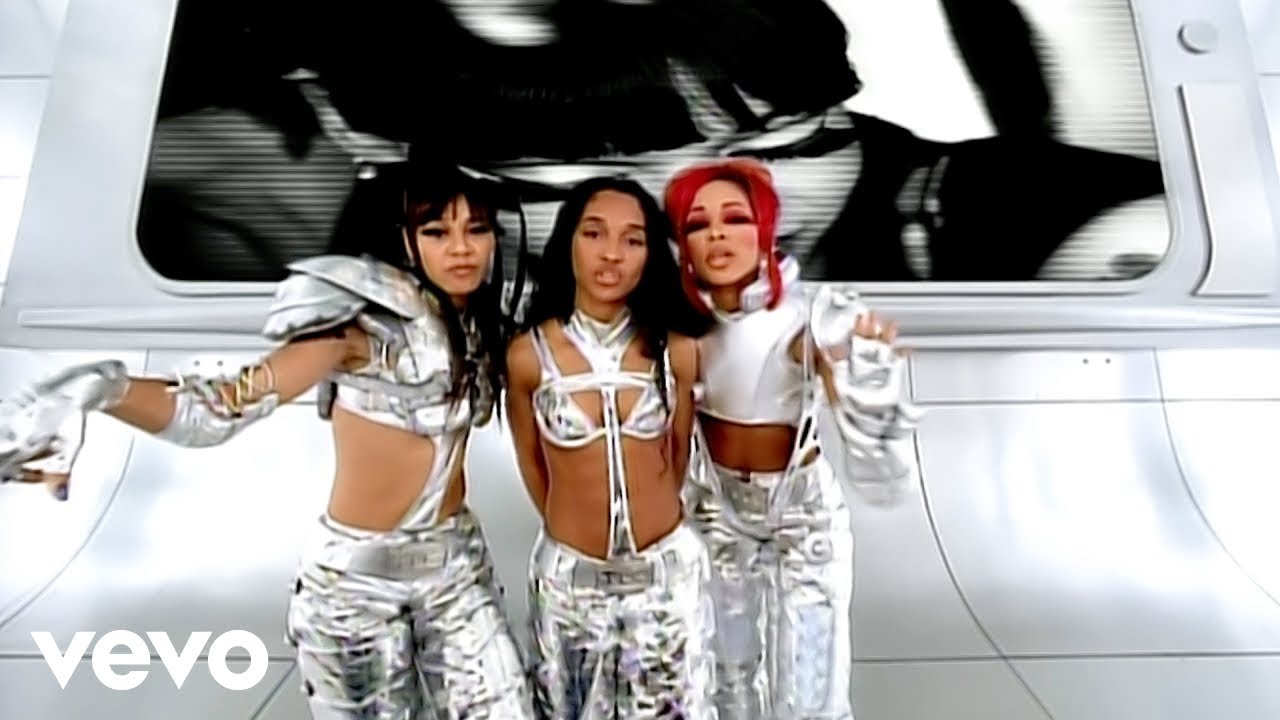
Going back to that questionable theme, and in an interview with TMF, TLC shared their meaning of the term ‘scrub’ - giving a more rounded definition beyond the superficial ‘poor’ label; “A scrub is lazy, doesn’t take care of his kids, he doesn’t have a job and doesn’t want a job. He’s comfortable being at home living with his mother,” said Rozonda, while Tionne explained that, “People of my mother’s generation - so like 1945 - used it. It comes back.”
“[It’s] a girl’s anthem” said Rozonda when asked why the single was the first one chosen for release from their album FanMail. “We thought it was the song that [the audience] would get the quickest, it’s probably the catchiest,” Said Lisa, who sadly passed away in tragic circumstances in 2002. “You listen to it one time and you know what it is.”
Given the popularity of the song and its continuing stature as an outright classic, it won't come as a surprise to learn that it has been sampled within other tracks. Artists Sleepy Hollow and Le Youth have both used direct samples from the track within their own work, but it has also attracted a turbulent association within the realms of copyright infringement.
Ed Sheeran was forced to share writing credits with the No Scrubs writing team, on his song Shape of You, due to apparent copyright infringement. It was a similar tale for Avicii's single SOS, with credits applied posthumously.
However, perhaps the reason for its winning ingredients being so easily pilfered is that the song is pretty simple in harmonic make-up, making good use of a very basic chord structure. So, it’s hardly a surprise that there might be other songs that sound similar.
No Scrubs employs the same chord structure for both verses and chorus. The elements which dictate the difference between the two sections relate to instrumental arrangement and melodic line.
The choice of key for the song might not be regarded as the most keyboard or guitar-friendly (although, surprisingly, there are no guitars on the track) We can think of the key as either Ab minor or G# minor; we are going to work on the basis of the latter, with a key signature that contains 5 sharps, as opposed to the former, which would use 7 flats.

The opening begins with chord IV - C#m7 - performed by Briggs on an acoustic guitar sound supplied by a Kurzweil keyboard, and played using arpeggiated chords. Some think that it adopts a Spanish feel, but this possibly has more to do with the chosen sound than the music itself. With each chord occupying two beats (half a bar), the second chord reverts to the home chord of G#m. We then shift to the dominant - D#7 - before returning to G#m.
The sequence is performed in a very stylised way, with the first of each pair of chords employing a sustained bass note, while the second of each pairing is played very staccato or short. The sequence also repeats, and upon the repeat, Briggs performs a flourish at the end of the sequence, implying the use of the chord G#7, with the presence of the note F#.
In essence then, the chords cycle through a IV, I, V, I sequence, which is very pleasing to the ear, incredibly common, and used in many songs in music history, hence the ease with which copyright infringement could become an issue (even though harmony is not supposed to be copyrightable element).
Being RnB from the late 90s, the song makes exclusive use of electronic instrumentation, albeit with a view of sounding vaguely acoustic. As previously mentioned, the acoustic guitar sound is quite identifiable; this was a popular timbral choice throughout the 90s for many dance tracks, with Korg synths often being the keyboard sources of choice.
Briggs employs some very tight and clipped drum sounds, which are generated over MIDI, along with a barely-audible synth sub-bass. This might explain the importance of the acoustic guitar’s bass element.
No Scrubs is rich with vocal harmonies, particularly in the chorus section, although these elements were predominantly supplied by the female writers on the team, along with session singer Debra Killings.
Another element which is laid quite a way back in the mix, is a gated/tremolo electric piano. We can hear the chords, with an applied 16th note tremolo gate, using some form of Rhodes sound, presumably also supplied by Kurzweil.

Finally, the identifiable string arrangement was also put together by Briggs, which helps to define the chord structure, particularly in the chorus section. Despite the extensive use of a two bar sequence for the vast majority of the song, the bridge section sees a considerable departure from this construct.
The bridge begins with the chords Emaj7, D#7 and F#/G# (or G#11 if preferred), all played for a whole bar. We then hear a really interesting descending sequence, with each chord playing for one beat each - G#m7, G7, F#m7, Fmaj7 - before reverting back to a chord per bar for Emaj7(9), where the guitar sound adds the 9th, before heading to D#7 for a bar.
To finish the bridge, we hear G#m7, C#7, E/F# and D#7, all played for two beats at a time. The last chord, of D#7 adopts a bass note of G (better described as F double-sharp in this harmonic context) which would lead perfectly into our key of G#m, but instead, we revert back to the previous two bar sequence, as used in the verse and chorus sections.
This concludes a pretty complicated bridge section, and one that is heavily influenced by jazz traditions, through the use of a number of chord extensions, and particularly the use of major 7ths, which always add an element of sweetness to harmony. It's the perfect juxtaposition, given the nature of the harmony in the rest of the song.
We can't leave this song without mentioning the incredible strength of the lead vocal, provided by Rozonda. This was the first time that she had taken a lead vocal in a TLC song, and by our reckoning, is a pretty strong debut.
