
By the end of the 1990s, homegrown British guitar music had fallen well out of favour with the nation’s youth. An era defined by Union Jack-emblazoned instruments, Beatles-evoking melodies and a certain laddy, booze-fuelled hedonism was fast receding in the rear-view mirror. Slightly embarrassing signifiers of an altogether different age.
For those hitting their teens in Britain between the years of 1998 and 2001, the dying gasps of Britpop withered when compared to a frenetic revitalisation of the heavier-end of the alternative music space, largely coming from the US.
But beyond that crucial teen market, those rain mac-clad twenty and thirty-somethings - still on their long Britpop-hangover - were finding solace in the communal spirit of the likes of Embrace, The Verve and Doves.
But much of it felt just a little… well, directionless
For all its downsides, the Britpop-era’s chief exponents did have an urgency to them. Be it via boiling internal tensions, a rags-to-riches narrative or a serious attempt to comment on culture and class. Some might say these were crucial elements which seemed oddly absent in the post-Britpop world.
This slightly purgatorial age has been bitingly described by some as being dominated by ‘big, festival-pleasing ballads about nothing’. A period in mainstream British rock history perhaps best exemplified by Travis’ singalong-stoking Why Does it Always Rain on Me?
The outright victors of this period were a band who nailed and revitalised the populist anthem formula better than any other, taking their tranche of mass-appeal hymns to a truly global audience, including the US. Realising an ambition that even the Gallaghers could never fully crack.
Still filling stadiums to this day, Coldplay have become one of the most successful British music exports of all time.

This transatlantic adoration began with just one song, Yellow. A song birthed out of an unusual set of happy accidents.
“It was something that was very different to what was on the radio. There was a lot of that nu-metal, like Limp Bizkit. It was heavy, very masculine music,” remembered drummer Will Champion in an interview with The I Paper. “I think Yellow represented something that was possibly under-represented.”
Formed at the tail-end of the Britpop-era in London in 1997 by UCL student Chris Martin, guitarist Jonny Buckland, bassist Guy Berryman and drummer Will Champion, Coldplay (first named ‘Starfish’) had spent the final years of the 20th century honing their craft for earnest, emotionally-wrought balladry with frequent gigging. Eventually being picked up by an A&R scout and signed to esteemed label Parlophone.
A student of Jeff Buckley, A-ha, U2 and The Bends-era Radiohead, 22 year-old frontman Chris Martin was a songwriter with an undeniable ear for melody, clearly evidenced across the band’s first two EPs, Safety and The Blue Room. But Martin’s talents fully crystallised with the band’s 2000 debut Parachutes.

Initial recording sessions in London had been hamstrung with inertia and disagreement, and it was hoped that decamping Parlophone’s latest signings to the legendary Rockfield Studios in Wales would help Coldplay manifest the winning debut expected of them.
“It was kind of a make-or-break session,” Martin told documentary Rockfield: The Studio on the Farm.
“It was our first real dip into a proper recording studio, we’d heard that the Stone Roses had spent about two and a half years there or maybe more,” said drummer Will Champion in the same documentary. “It was very much a sort of musical Hogwarts. We were sent away to figure it [Parachutes] out,” recalled Martin.
“I don’t even know that there was a clear understanding that a recording studio could capture more than what you were doing on stage. It wasn’t until the beginning of Parachutes that we started working that out,” Chris told Mojo magazine.
Recorded with producer Ken Nelson, Parachutes’ ten tracks compiled the young band’s impressive early songbook. Opening with the absorbing tension-and-release of Don’t Panic, the album pivoted to the Greenwood-ian winding riffs and Jeff Buckley-channeling angst of Shiver. Then there was the desolate heartbreak of the piano-oriented Trouble and the slow-building drama of underrated gem, Spies. The foundations of Coldplay’s musical universe were being laid.
But the album’s most memorable cut was quite different to its bedfellows.
Yellow’s devotional lyric had an almost child-like turn of phrase. Its direct, heartfelt simplicity would ultimately do much to make the song pull at the heart-strings of billions of listeners.
Eschewing any sense of edge, Martin settled on an almost hymn-evoking clearness of form, with an unambiguous expression of pure love.
I came along
I wrote a song for you
And all the things you do
And it was called, ‘Yellow’
There have been multiple versions told of the events that lit the spark of the song’s creation over the years, but what’s clear is that Yellow didn’t exist prior to the band’s trip to Rockfield.

In a Sound on Sound interview with producer Ken Nelson, he recalled the heavens themselves being the initial inspiration point.
“Yellow was written at Rockfield when we were there,” said Nelson. “The studio we were in was called the Quadrangle Studio - the studio is along one side of an open courtyard about 50 yards square, and we went out one night, and because there were so few lights, the stars were just amazing.”
Martin picked up the story in the documentary Rockfield: The Studio on the Farm. “It was so beautiful outside, all four of us were outside. Ken, our producer said ‘Look up there lads, look at the stars’. He literally said ‘Look at the stars’. We’d been in London for five years, so we hadn’t really seen anything beyond smog.”
With Ken’s suggestion to ‘Look at the stars’ echoing around his mind, Martin returned back into the studio and sat with his acoustic guitar. While attempting to track the acoustic guitar part of Shiver, Martin began to hear the word ‘stars’ as if sung by Neil Young, with his particular bendy inflection.
Martin’s acoustic guitar (a 1996-era Vincente Tatay Tomas Spanish according to our sister site, Guitar Player) was tuned to Shiver’s E A B G B D# tuning, which lent itself to distinctively warm open chords.

“I was waiting, and something was wrong with the machine, so I was waiting. I started strumming [what would be the opening chord of Yellow] and was thinking about Neil Young, and started singing [in a Neil Young-meets Kermit the Frog-esque voice] ’Staurrss’ [stars] - I was just messing around. This is really the very humble beginnings. I got the title from the Yellow Pages [a then ubiqutious British phonebook] which was at a 45 degree angle over there, I was looking for a word that was like ‘yee-aarh’ so I got ‘yellow’”
Easily moving his chord shape around the fretboard, but finding extra subtleties in Shiver's open tuning, Martin hit upon a new circular progression between the chords of B, F# and E.
Yellow’s verse then, formed with relative ease. Excited by his new discovery, Martin raced to find his fellow Coldplayers.
“Everyone else was watching football, I said ‘Guys what do you think of this?’ , played the song and they said ‘Yeah, it’s ok’. They weren’t particularly interested.”
Despite his band-mates’ faint-praise damning, Chris knew this song was perhaps the first thing in their growing set that genuinely felt like a hit.
He went to the tiled bathroom in the living room area, where he landed on the song’s spine-tingling chorus.
Your skin, oh yeah your skin and bones
Turn into something beautiful
And you know, you know I love you so
You know I love you so
“I showed them that, and they were like, ‘Yeah, we like that.’”
During this (allegedly) 10-minute stretch of time, Martin had discovered not just the basis of Coldplay’s first major hit, but a more intuitive attitude to songwriting that would also inform the band’s future successes.
As later relayed to Howard Stern, “I think with any of our songs that go on to do ok, I don’t really know how they came through. It’s the old cliche that everyone says, all songwriters say it. The good ones sort of come through you.”
When it came to assembling the full-band arrangement, guitarist Jonny Buckland constructed a driving lead part that widened the space of Martin’s introductory chords, before settling into a fragmented, clean-sounding phrasing of the song’s central sequence, which added an apt twinkle the song’s circular chordal motion. It felt both intimate and expansive simultaneously.

As concluded by our friends at Guitar Player, on Yellow, Buckland played his semihollow Fender Classic Series ’72 Telecaster Thinline through two Fender Twin Reverb combos.
As Nelson related to Sound on Sound, the producer worked with Buckland to get one of his Fender Twins’ outputting Jonny's effect-peppered signal path, which included a collection of classic effects and delays (including a classic WEM Copicat) while out of the other amp came a completely clean signal. This, Ken surmised, would increase the options when mixing.
For each take, both amps would be recorded. “I’d rather hear a guitarist who plugs straight into his amp and gets his sound,” said Ken. “But Jonny's quite good, he has a little Rat distortion pedal, but he uses it very subtly just to change his sound live and add a little bit of grit to it, so he'll have a fairly clean sound on the amp and then a little bit of grit from this box.”
Through relatively basic in terms of song-form, recording Yellow proved slightly more complex. For one thing, the track’s shifting rhythmic sands were tricky to nail down.
“It was really difficult to record, because it worked at about five or six different tempos,” recalled drummer Will Champion in an interview with MTV. “It was a tough choice of choosing which tempo to play, because sometimes it sounded too rushed, and sometimes it sounded as if it was dragging. It was quite difficult to sort of hit it on the head, but eventually we had a great take and it happened from there.”
The basic track was recorded live, with overdubbed electric guitars and backing vocals laid down later (these were actually taped in the control room!)
Producer Ken Nelson aimed to keep an intrinsic analogue warmth to the recording, “On [Parachutes] a lot of the stuff just went straight to tape, as clean as I could - the shorter the signal path, the better,” Nelson told Sound on Sound, before revealing that Yellow was particularly problematic to capture using a purely analogue set-up.
Some innovation was required, and it came in the shape of the then-new digital workstation Pro Tools, with sessions continuing up at Liverpool’s Parr Street Studio.
“We tried [Yellow] a few different ways, and a few different recordings of it, and we were never really happy,” Ken said. “We got Pro Tools in to get the feel of it just right. We enjoyed using it, and once we'd got all the takes into the computer, we then put it down to the 2‑inch, which I found was a great way to do it.”
On June 26th 2000, Yellow, which would soon be viewed as one of the 21st century’s first outright classic songs, was released unto the world.

As the second single from the upcoming Parachutes, Yellow did significantly better than its predecessor Shiver (which reached a paltry 35 in the British charts). Before long, Coldplay became a concern of the nation’s music press.
More important than that, the band tickled the fancy of that most vital segment of the music-buying audience; the people who didn’t really care too much about those bigger musical narratives, played out in the pages of NME and Q Magazine.
For those everyday radio listeners, the accessible purity of Yellow radiated strongly.
The song's appeal was evidenced by it climbing to a peak of number 4 on home soil, and similarly high chart placements across European territories. The most noted accolade was its not inconsiderable top 50 placement in the American charts (number 48), after becoming a US radio staple.
Another factor in the triumph of Yellow was the heavy rotation of its continuous-take video. The video showed Martin walking along Studland Bay, Dorset while singing the song’s lyrics to camera as the sky became lighter.
The wind-swept, rain-battered image of Chris Martin braving the elements (and the typically dismal British coast) underlined both the honesty of Yellow’s committed lyric, and a sense of Coldplay’s unaffected normal-ness.
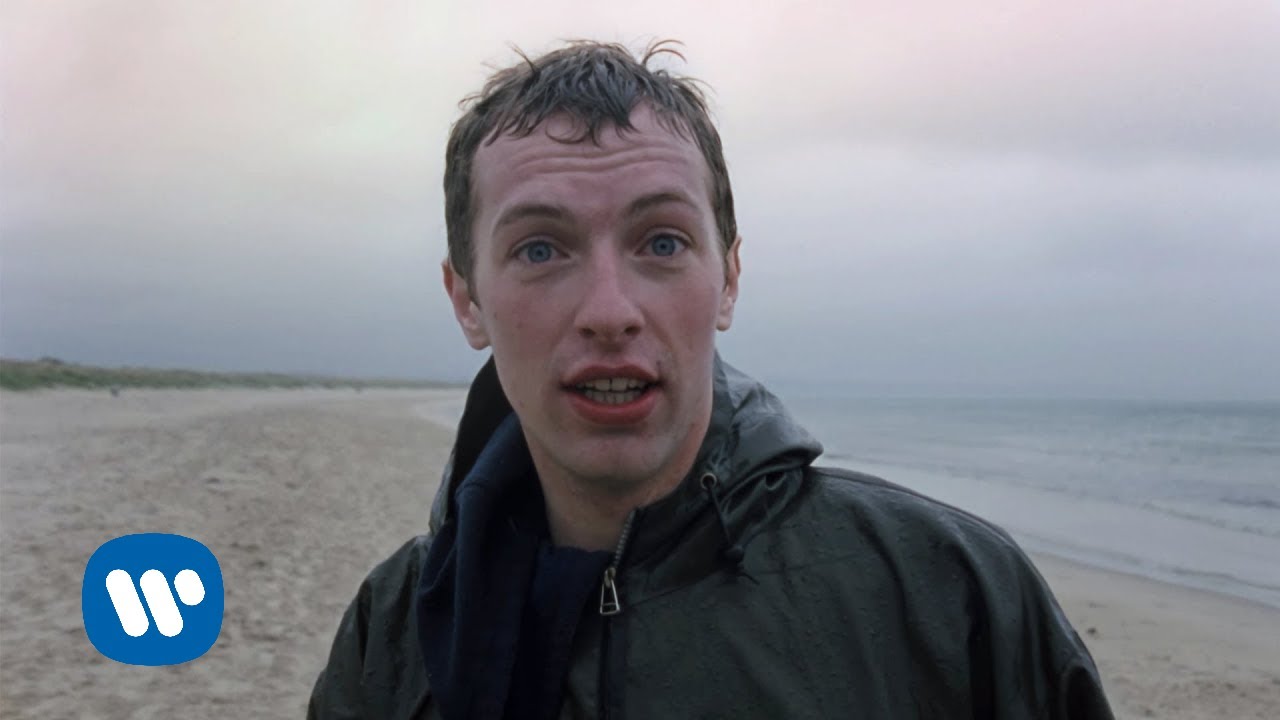
But, that wasn’t the original plan for the video…
The initial concept for the James Frost and Alex Smith-directed shoot was for the whole band to accompany Martin. Sadly, the funeral of drummer Will Champion’s mother was scheduled for the same day, meaning he wouldn’t be able to attend. Rather than having just some of the band in the video, it was settled that it would feature just Chris.
Also, plans for Martin to wander through a beach party were scuppered by the weather. In another of the many happy accidents surrounding the song, the now iconic, lonely image of Martin on the beach was a last-minute pivot from the first idea, which was for him to be striding across a more cliche sunny beach, and through the packed beach party.
Because of the conditions, the directors sent the 50+ beach party extras home, and - needing something by the end of the day - quickly landed on the one-take of Chris delivering Yellow down the camera while braving the seafront. The solitary image of Chris enduring the tumultuous beach perfectly stressed the against-all-odds oath relayed in the lyric.
“It was a fluke at the end, but quite a happy fluke,” recalled Will Champion in the MTV interview.
A month after Yellow’s release, Parachutes hit the top spot of the album chart, and fast became one of the year’s biggest selling and most hotly-acclaimed LPs.
Coldplay had arrived, and over the next decade the band would elaborate on the Yellow-formula with a slew of similarly-constructed communal anthems such as In My Place, The Scientist and Fix You, helping the band metamorphose into the stadium-packing monolith they have become.
But it's Yellow that has continued to burn brightest all these years on. As of today, its Spotify streams currently sit at well over 3 and a half billion. And the enviable, long-tail appeal of the song shows no signs of abating as the decades roll on.

But the straightforward innocence of Martin’s songwriting wasn’t for everyone, with an early press take that the band was somewhat dull eventually growing into a full-on anti-Coldplay movement, rejecting their broad-brush emotional canvas.
“A lot of the British press hates us,” Martin detected early in the band’s lifespan. “I really don’t understand why Yellow is doing so well - if I did, I’d do it again. But we don’t. We’re just sort of grateful for whatever we get.”
Music and political writer John Harris noted, in his 2004 Britpop-tome The Last Party, that for better or for worse, Coldplay had become the true winners of the Britpop-age. Snatching the populist anthem baton that Oasis had discarded, Coldplay have ran with it faster and longer than any of their contemporaries.
“[Coldplay’s] métier is expansive, anthemic music that affects an earnest sense of importance, but delivers little in the way of lyrical specifics. Thanks to their success on both sides of the Atlantic, they are the state-of-the-art rock band: proof that singing about nothing much at all means one can maximise what marketeers term one’s ‘reach’.”
A harsh assessment perhaps, but Harris’ point here is perhaps critical to understanding the ongoing resonance and appeal of Yellow deep in the context-free streaming age.
While Harris viewed Coldplay’s populist simplicity in quite a negative light, it’s an approach to songwriting that Chris Martin himself is proud.
A keen believer of the notion of songs being channeled from another place, Martin reflected in an interview with Rolling Stone that the particular circumstances that spawned Yellow all had to align.
“I had no idea about all of the spiritual writing around things like ‘look at what’s missing as an opportunity,’ or ‘the crack is where the light comes in.’ But here it was on full display without me knowing it. There was a problem, something was broken, and it created a space for something cool to arrive.”
“This whole song came from a mistake,” Martin continued. “A break, a dysfunctional piece of machinery, what happened to be lying around, and the stars themselves. It was just all a gift."
