


From playing for Presidents to rock royalty
We’ve all heard the stories of American drummers being inspired by seeing and hearing Ringo Starr with The Beatles on television as guests on The Ed Sullivan Show. For star session drummer Kenny Aronoff, that moment in 1964 was life changing.
Aronoff grew up in the small town of Stockbridge, Massachusetts with a population of 3,000. An idyllic environment for a young boy, it was near Tanglewood, the summer home of the Boston Symphony Orchestra. The orchestra’s special audition-only music programmes, during the summer, would come into play during Aronoff’s tenure as an aspiring classical musician at Indiana University.
One memorable event was playing sibelius’ Fifth Symphony with Leonard Bernstein and the best student orchestra in the country. But with all of the accolades and recognition from his performances in the classical genre, Kenny felt his true calling was to be in a rock band like Ringo with the Beatles.
After Aronoff’s graduation from college, that calling was answered by singer-songwriter John Cougar (later known as Mellencamp). Aronoff made his mark in the Mellencamp band with a string of hit songs and smash albums that contained his personal stamp through creative and original drum parts. He went on to become a prolific studio and live drummer and has been the touring drummer for both the Bodeans and Creedence Clearwater Revival’s John Fogerty for the last 20 years.
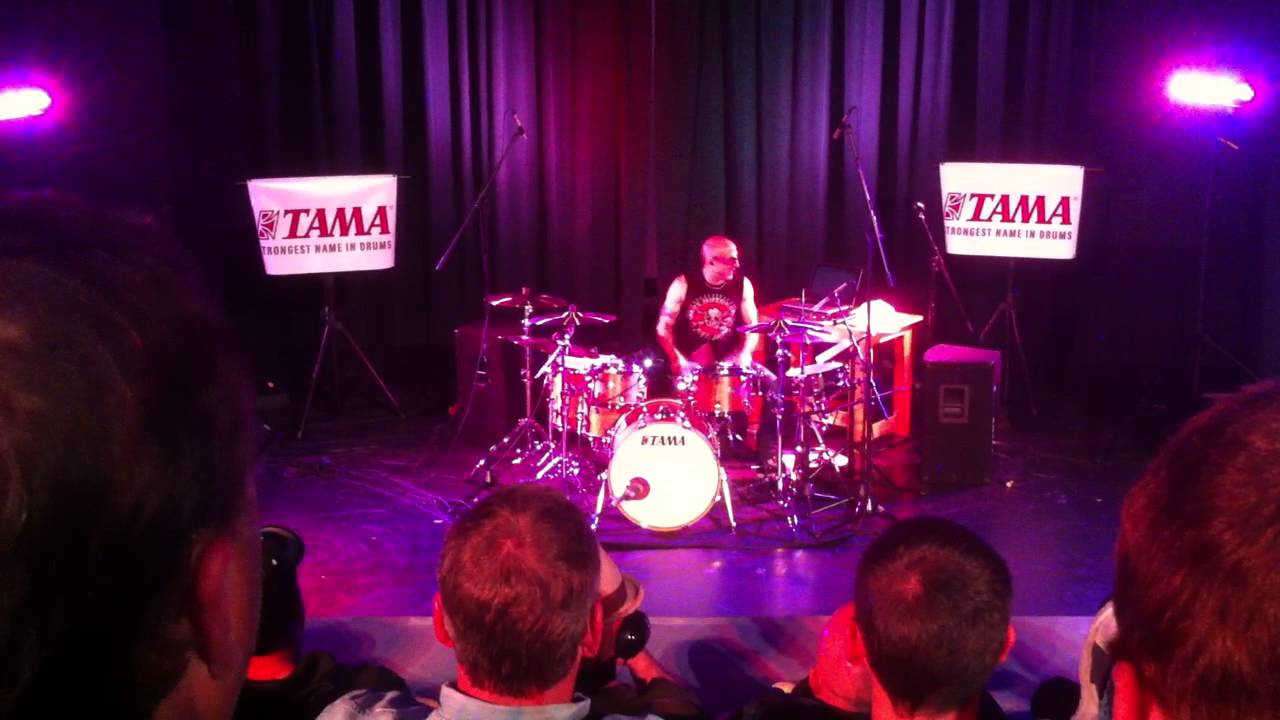
We meet with the busy drummer for an intimate chat at his private rehearsal/recording facility in North Hollywood, California, Uncommon Studios. Kenny is there rehearsing for a special gig with former Montrose and Van Halen man Sammy Hagar. An acquaintance of Aronoff’s had asked him to put together a band with Hagar to play at his private birthday bash.
Aronoff had played with Hagar while subbing for Chad Smith in Chickenfoot, and had no problem getting the singer on board for the party, which included a private jet provided for the band. As a variety of Van Halen, Hagar and Chickenfoot tunes blast out of the sound system, Aronoff plays along, rehearsing even as the photo shoot commences. These are the kind of gigs that happen in Kenny Aronoff’s world.
A new chapter
The first topic on both of our minds is the new book, which chronicles Aronoff’s musical journey from his beginnings, his experiences in university, his success with Mellencamp’s band and his subsequent rise as a session drummer.
Aronoff’s knack for simple, creative drum parts, combined with his easy, outgoing personality became the perfect recipe for recording magic. more often than not, tracks he played on became huge hits. Gradually, he started working his way up the list of studio musicians to become a first-call player. As time went on, the accomplishments and accolades kept coming. Aronoff has certainly lived a life worth telling.
We settle into the comfortable confines of the Uncommon Studios control room and Aronoff excitedly tells us the history of the book project.
“It wasn’t my idea to write a book. I was being interviewed for a Joe Satriani book because I had done a tour with Chickenfoot. In the process, the writer [Jake Brown] got really excited and said, ‘I want to write a book about you.’ He convinced me that it would be easy. I would dictate and answer questions for him, two hours every two weeks or month, and then he’d put together the book.
“I said I’ll do it if I can talk about other things besides drumming. I wanted to talk about what I’ve learned in my life. When I got it back and started looking at it a year later, it just didn’t sound like me. I thought, ‘What is this book about? How do you tell a life story?’ I had to get organised. I found calendars and day runners of every year from 1977 until now. I had kept logs of sessions and tours I had done.”

Uncommon organisation
Armed with this wealth of chronological information, Aronoff set about putting his story into a more cohesive timeline. In addition to all the logistical data, he began peppering the tome with nuggets of personal experiences per his new editor, Mike Edison’s request.
Aronoff took his involvement with the book seriously and like every other project he involves himself in, gave it his all.
After some delays and last minute changes, the project was completed. Aronoff reflects on the payoff of his meticulous record-keeping.
“When I found those, it was a goldmine. I kept files of all my sessions, from the late-’80s until now. Every record I made, I have charts. I started re-writing things so it would sound like me. I had Mellencamp, Jon Bon Jovi, Billy Corgan and Melissa Etheridge, among others, interviewed. There would be days off while on tour I would spend 14 to 16 hours on one chapter. I started to really live the book and feel what it needed. Reading it, then re-writing it so it sounded like me.”
Getting personal
In addition to the chronological details of Aronoff’s career, including detailed discography and live concert, television and video appearances, the book contains several personal stories which are entertaining without being gossipy or tabloid in nature. Aronoff offers his final thoughts about the experience.
“I’ve read the book in hardcover now and I would say 98 percent of it I really like, I wouldn’t change. Somebody told me the other day, ‘You really shared some personal stuff.’ In this book I talk about two divorces and my heavy relationships within the Mellencamp band. Breaking up with that band was like a divorce.
“I talk about getting scammed. I could have left that out. I talk about how I felt like I improved as a human being, as a person. I was wild. We were young and on the road. As I say in the intro, this book is not about a drummer who has sex with 4,000 women or snorts piles of cocaine. It’s about a guy who saw the Beatles on TV and 50 years later got to play with the two remaining Beatles honouring that show I saw when I was 11. That’s extraordinary!
In this book I talk about two divorces and my heavy relationships within the Mellencamp band. Breaking up with that band was like a divorce.
“I’d say dreams come true, but not by accident. I made it happen. I worked my ass off! The book has a lot of personal stuff in it, but as scary as it was to do it, it’s the only way I felt like the book had any meaning to me. I wanted the book to show people how difficult it is to be a rock star and that it’s not all private jets and arenas. It took a lot of work. I got bumped and I stood back up after I got knocked down.”
Personal best
Although the book lists several of Aronoff’s accomplishments in detail, we ask him to reflect on some moments in his career that really stand out in his memories.
“Oh man, there’s not just one! I won a competition by playing a violin concerto on marimba with a 60-piece orchestra when I was 22. I had only started playing marimba when I was 18. I practised that piece two or three hours a day for 365 days. That’s how I got good. To win that concerto competition, that demonstrated who Kenny Aronoff was. It took massive amounts of discipline and hard work. I went from being not great at marimba to being good enough to win a concerto competition.
“Another proud moment was playing with the Buddy Rich Big Band, because it was so different. Very intimidating. I was proud that I pulled it off. Doing Straight No Chaser, I had an out-of-body experience! It felt like somebody else was playing! I was watching my hands move, going, ‘Man, this sounds good! Whoever’s playing, don’t get in the way!’
“Getting in the John Mellencamp Band was also a very heavy, life changing moment. I got fired, I got re-hired. I learned a lot through that whole experience. I was an expert at technique, but not at getting records on the radio to be Number One.”

Good gear gets gigs
Aronoff has endorsed some of the same equipment companies for years. His loyalty and ethics pertaining to his endorsements reflect yet another aspect of his personality that has made him the go-to guy for so many prestigious gigs.
We ask him to expand on his relationship with his gear, the companies that make it, and his thoughts on its importance in his sound as an artist. “Gear is very important! Part of it is to make good gear and the other is the relationships. I hadn’t left a company until last year. It was going from Remo to Evans. There’s nothing wrong with Remo drumheads. Remo is a phenomenal company. It was a hard decision for me to move.
“It started out with me just trying out some heads for Marco Soccoli [Evans Artist Relations]. He just wanted my opinion. I tried them out in the studio and live and the engineers in both situations kept saying, ‘Your drums sound different. They sound better.’ It was this heavyweight snare head that was amazing. Even some of the Tama guys came by to a soundcheck and said, ‘Man, I’ve never heard your drums sound so good, what’s going on?’ It was the heads. After a year, I decided I have no choice, I have to make this move. It’s making me sound better.
I’ve been with Vic Firth since he was engraving his sticks by hand with a woodturner!
“I’ve been with Vic Firth since he was engraving his sticks by hand with a woodturner! They make amazing sticks. Tama makes great drums. I have great relationships with these people.
“At Zildjian, I was one of Armand’s favourite guys to hang with. We really had some wild times! There’s been drum and cymbal companies that have come after me to switch. Unless it’s a ridiculous change with sound quality, it’s just a lateral movement and I’m not moving.”
From analogue kid to digital man
Aronoff’s time as a session man has seen him navigate the shifting obstacle course of recording technology and still stay relevant. From drum machines to Pro Tools, he has adapted to and even embraced the ever-changing landscape of the industry standard.
We probe Aronoff’s mind about what kind of impact all of these changes have had on him in the studio scene.
“It used to be, they brought the drummer in for everything. Then, they had a drum machine, sequencer, or programming. To program what I do takes a long time. I can do it in three and a half minutes. You don’t have to edit one note.
“I’ll record drums, it feels great. The technology is chasing after what I can already do. Now, it’s gotten to the next level. Drummers don’t have to play perfectly in time or with great feel, because people will chop their s**t up and fix it. or, put it on a grid and lock it in.”
The scene began changing even more when once-plentiful recording budgets started shrinking as studios cut back on expenses. In turn, some larger recording studios closed-up shop, no longer able to remain profitable in the new paradigm. This led to a host of musicians investing in their own recording equipment and creating their own home recording studios.
I’ve done six-hour soundchecks with Fogerty. Fogerty was the first session in my life where I was told to show up with just my sticks!
Aided by the technology of the internet, players were able to share tracks back and forth digitally. This led to several studio drummers offering their services via the online medium. Once again, Aronoff’s ambition to remain relevant in the studio scene led to the creation of his own place to provide this exact type of service.
“When I got my own studio, I didn’t want to do it. But, I realised I had to adjust to the scene. People couldn’t afford to rent a room for $3,000 a day, put drums in it and record. The budgets weren’t there. I saw the writing on the wall.
“I loved session work, so I got my own control room and drum room. Most of the heavy pre-amps and eq I bought was BAE. I have eight 1073s, four 1084s, and 11 312s. This models the Neve and API, the classic sound. It’s real punchy, warm, and expansive. I use Pro Tools 11 with an Apogee interface. I also use some SPL stuff.”
Current events
Outside of all of Aronoff’s studio and live gigs, his main focus for the last 20 years has been anchoring the drum chair for John Fogerty’s band. Having played drums for such song-orientated craftsmen as Fogerty and Mellencamp, we ask Aronoff about the challenges that each leader presented.
“Both of them are extremely driven. I’ve done six-hour soundchecks with Fogerty. Fogerty was the first session in my life where I was told to show up with just my sticks! He would tune the drums to a certain pitch and put moleskin on them in certain areas. He knew just where to put them to get that sound. On the bass drum he would put a Remo Fyberskyn 3 head on the beater side, no front head, and take a packing blanket, fold it three times, exactly right, he would do all of that.”
Mellencamp pushed Aronoff to his limits to come up with something fresh and creative for each song.
“I was in the hot seat all the time. John would play a song on acoustic guitar and he expected me to come up with a drum part that was simple and unique in feel, that would make the song a hit single. That’s not easy to do! John admitted, ‘All my songs sound the same, so you have to make it different.’ that was a lot of pressure!”
Besides being in demand as a drummer for live gigs and studio sessions, Aronoff has recently ventured into the motivational speaking arena, joining other drummers like Rich Redmond and Mark Schulman. They use their experiences in the music world as examples that can be applied to other aspects of life.
Aronoff speaks of the insight he gained while writing his book, and which he applies to his motivational work.
“I came up with seven ways that I believe help me become and stay successful. There are key things like self-discipline, hard work, and communication skills. How to execute a plan that you create to reach your goal. How to stay healthy mentally, physically, and emotionally. How to stay relevant. I have a show I’ve been doing it for about three years and have turned it into a professional business. It’s so gratifying. People come. They don’t even have to be a musician.”