





MusicRadar Verdict
Just when you think you’ve seen enough fancy reverbs and ambience pedals, along comes another. However, EarthQuaker Devices has proven past history within this area and it all comes together in this excellent example of the genre’s shifting atmospheric soundscapes.
Reasons to buy
- +
Lovely range of rich dimensional sounds.
- +
Stereo operation.
- +
Onboard presets.
Reasons to avoid
- -
Stretch function may have limited appeal.
MusicRadar's got your back Our team of expert musicians and producers spends hours testing products to help you choose the best music-making gear for you. Find out more about how we test.
What is it?

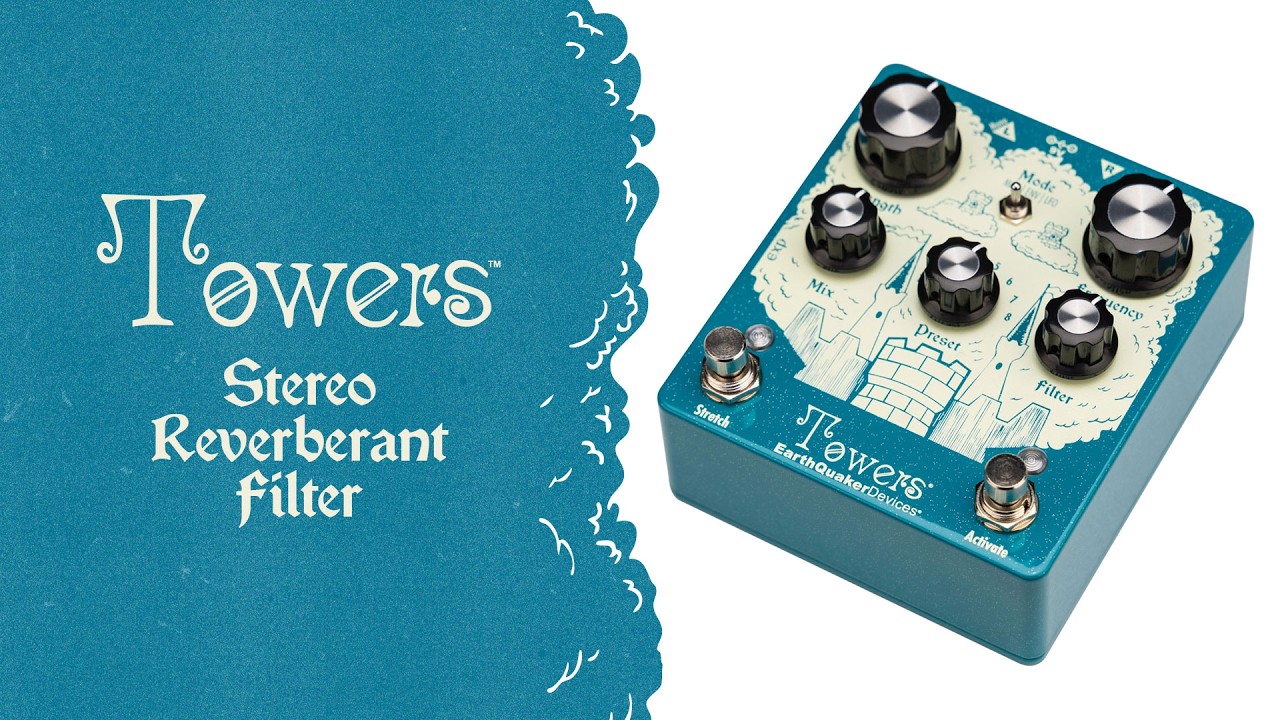
The premise of the Towers Stereo Reverberant Filter pedal is to feed your guitar signal through what EarthQuaker describes as “an array of infinitely repeating micro-echoes” into a large cathedral-style reverb.
The whole lot then interacts with a resonant low-pass filter that’s woven into the signal path for an extra layer of harmonic complexity.
Specs

- PRICE: $299 | £329 | €338
- ORIGIN: USA
- TYPE: Stereo Reverberant
Filter pedal - FEATURES: Tails or Full bypass, 8x assignable presets
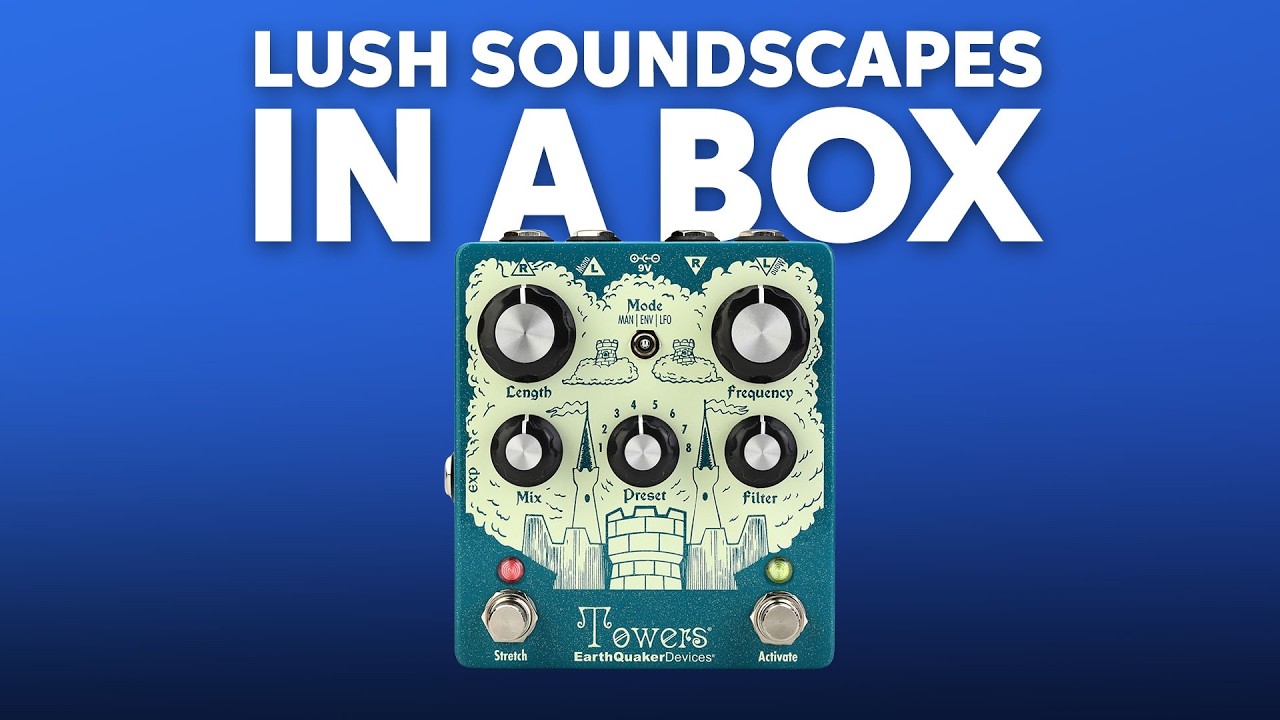
- CONTROLS: Length, Frequency, Mix, Filter, Preset selector, Mode switch (Man/Env/LFO), Stretch footswitch, Activate footswitch
- CONNECTIONS: Standard inputs (L/Mono, R), standard outputs
(L/Mono, R), EXP - POWER: 9V DC adaptor (not supplied) 85mA
- DIMENSIONS: 108 (w) x 121 (d) x 64mm (h)
- CONTACT: EarthQuaker Devices
Usability and sounds

While you get a standard Mix knob to add effected sound to the dry signal, and a Length knob that determines how long your reverb tail is, the filtering is the key to the Towers’ unique sonic aspects, adding a ringing richness and movement.
A Filter knob controls how much the filter is mixed into the reverb pathways, determining the depth of harmonic resonance, with the filter Frequency dialling in variations of the effect via three toggle-switched modes that determine how it is applied.

Manual mode is used for setting the Frequency knob where you want it for tonal shading. In Envelope mode you can control the filter frequency with picking dynamics, the Frequency knob adjusting the sensitivity of the envelope and determining how you can emphasise that ‘opening filter’ movement in the sound. In LFO mode the filter frequency is controlled by a slow moving LFO, with the Frequency knob adjusting the sweep rate.
It’s here that you’ll find the most dramatic stereo effects as the signal pans across the field.
With left and right channels working independently, the pedal is at its optimum in stereo, but its richly textured reverb still works perfectly well in mono.

Verdict
Verdict: ★★★★½
For performance, a second footswitch initiates the Stretch function, which slows the processor speed, doubling the length of reverb effect
There’s plenty to explore, with subtle sonic changes engendered by small knob adjustments, so it’s great that there are eight preset slots for you to save and recall any favourite sounds you might discover.
For performance, a second footswitch initiates the Stretch function, which slows the processor speed, doubling the length of reverb effect and generating a lo-fi effect that pulls apart the delay lines while smearing the filter and lowering the frequency responses – it’s not unlike a tape slowing-down/speeding-up effect.
There’s also provision to plug in an expression pedal for control of any one of the parameter knobs.
MusicRadar verdict: Just when you think you’ve seen enough fancy reverbs and ambience pedals, along comes another. However, EarthQuaker Devices has proven past history within this area and it all comes together in this excellent example of the genre’s shifting atmospheric soundscapes.
Hands-on videos
EarthQuaker Devices
Sweetwater
Cesar Soto of Ministry x EQD

- “A feral supernova awaits if you dime those dials”: EarthQuaker Devices Barrows Fuzz Attacker review
- This article first appeared in Guitarist. Subscribe and save
