


At 4:03pm on Saturday 13 July 1995, Bryan Ferry strode out onto the Live Aid stage at Wembley Stadium to perform a set in front of a 72,000-strong crowd and an estimated global TV audience of between 1.5 to 1.9 billion.
Accompanying Ferry was a crack 10-piece band, which included such luminaries as David Gilmour and top-tier session musicians such as drummer Andy Newmark.
The third song in their set was Slave To Love, which earlier that year had been a big UK hit. As the band launched into the opening bars, a roar of recognition went up from the Wembley audience. This was the first time Ferry had played this achingly beautiful ballad live, but while anyone watching would not have known it, things were not going at all well up on stage.
“When I performed the song for the first time, at Live Aid, the drummer broke his snare drum skin, the bass was in a different tuning, Gilmour’s guitar wasn’t working properly, and someone had to tape another mic to mine because it wasn’t audible,” Ferry told The Guardian in 2024. “But despite all that, the song took off pretty quickly… It’s fabulous when people identify with your feelings about something.”

Slave To Love was released as the lead single from Ferry’s sixth solo album Boys And Girls. The song’s honeyed tones and heart-rending premise propelled it to No 10 in the UK Singles Chart and it is regarded by many as the greatest song from Ferry’s solo catalogue. While it was released in the ’80s it is not constrained by the sonic confines of that decade. It stands instead as a timeless and enduring classic.
Bryan Ferry began planning the album Boys And Girls in July 1983 at his Sussex home, two months after Roxy Music’s split following the Avalon tour. He invited co-producer and engineer Rhett Davies to lay down basic sketches of songs onto eight-track, using keyboards and drum machine patterns. Davies had worked on Roxy’s last three studio albums – Manifesto, Flesh And Blood and Avalon.
The Boys And Girls album took over a year to complete and Ferry used seven studios, including Compass Point in the Bahamas, Sarm West in London and Power Station in New York, although much of the actual recording was done at the White House Studio in London, a demo facility owned by Ferry’s label, E.G. Records.
As the project developed, a core of musicians evolved including big hitters such as David Gilmour, Nile Rogers and Mark Knopfler. The line-up that featured on the recording of Slave To Love was Gilmour, Neil Hubbard and Keith Scott on guitars, Guy Fletcher of Dire Straits on keyboards and Omar Hakim on drums.
Tony Levin has been cited as the bassist on the song although in an interview with The Guardian, Ferry referred to Neil Jason as the bassist. ”Neil Jason had a swing to his bass playing that suited the track down to the ground,” said Ferry.
Rhett Davies recalled that the project felt like a natural progression from the Avalon album.

“Bryan’s Boys and Girls album felt like a continuation, just without Roxy,” Davies told The Guardian. “We started working on it at his house in Sussex with simply his voice and his CP-80 electric piano. We went to a studio in London called the White House, then went to Bette Midler’s house in New York. She’d had trouble sleeping and had built a soundproof room, so we set a studio up in there.”
In his interview with The Guardian, Ferry said that the inspiration for Slave To Love came from the song Prisoner Of Love, a 1946 single by the Ink Spots. Ferry recalled that his aunt’s husband was in the armed forces in Europe and brought home the 78rpm single.
Ferry went on to explain how the lyrics for Slave To Love came into being.
“I wrote the lyrics in a hotel room in New York, while pacing the floor at night. I’d done more esoteric things in the past, but I wanted something simple and memorable, a song for everyone. A hit! The first line – “Tell her I’ll be waiting/ In the usual place/With the tired and weary/And there’s no escape” – set the scene.”
Ferry said that the early framework of the song was built around guitarist Neil Hubbard, whose tasteful playing can be heard on Roxy Music’s Flesh And Blood and Avalon albums, among others.
“Neil Hubbard had the most wonderfully soulful tone and we recorded him early on to build the song around him,” Ferry told The Guardian.
Released in the midst of the synth-dominated ’80s, Slave To Love was like a sonic balm to the digital bombast of the age. The song exuded an ageless sophistication and carried forward Avalon’s sleek and seductive atmosphere.
Admittedly, the song and the album from which it comes are almost too smooth for their own good. The lush spaciousness and impeccable production could so easily have sounded banal.
But there is an alluring melancholy running through the song and hints of darkness amid the smooth production. Ferry’s intimate jazz-tinged croon meanwhile is mournful and heart-rending as he recounts the powerless feeling that comes from romantic obsession.
“You’re running with me/And don’t touch the ground/We’re the restless hearted/Not the chained and bound/The sky is burning/A sea of flame/Though your world is changing/I will be the same.”
Ferry is amply supported by the beautifully layered backing vocals of Chic singer Alfa Anderson and the Bahamian three-sister vocals of Colleen, Lisa and Simone Fitz-Charles.

Slave To Love’s power lies in its restraint and every element is made to count. A distinct Latin feel pervades the song, which is set against a languid, swaying samba beat. As ever, there is a cool, controlled elegance to Ferry’s vocal performance.
The song is anchored by a hypnotic percussive pattern, which features one prominent, if unexpected, element. “Bryan loves having something straightforwardly passionate throughout a song,” Rhett Davies told The Guardian, “and on this one it was a cowbell.”
While the song steers clear of sounds that confine it to the ’80s, there are certainly nods to that decade, most notably on the snare.
“The drummer, Omar Hakim, recorded the big snare drum sounds in New York’s Power Station studios’ stairwell, which had a famous reverb,” said Rhett Davies.
Swells of atmospheric keyboard and flourishes of tasteful lead guitar simmer in the mix before Ferry’s vocals enter 40 seconds in over a D-Bm-G-A chord progression.
The song has a warm, lustrous sound, with acres of space and with every element seamlessly placed within it. The backing vocals are rich and prominent.
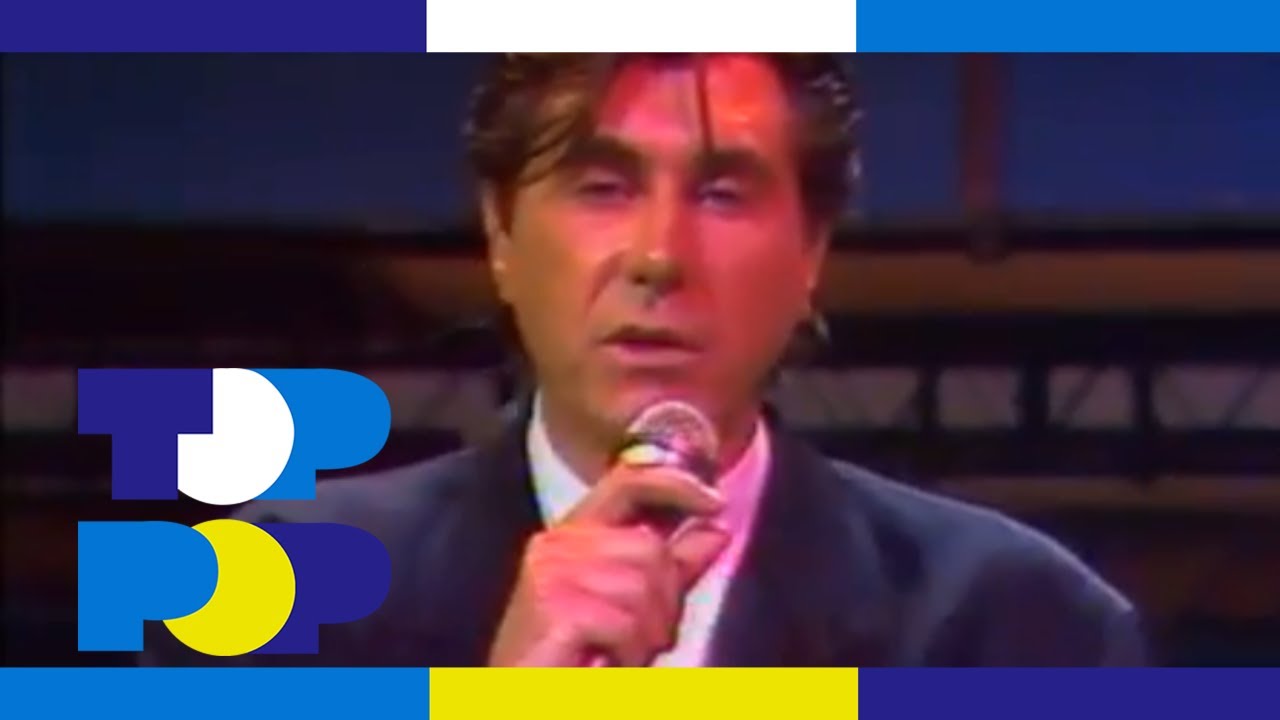
There are some sublime vocal moments from Ferry, such as at 1:33 on the line “The sky is burning” as he glides effortlessly up to falsetto on the word “sky”.
At 2:10 the whole thing drops down to F#m for the break, which features a gloriously skewed and searing lead guitar solo, melding edge-of-feedback tones with some punchy, rhythmic pushes. “The guitar solo in the middle is actually three interweaving guitarists: Gilmour, Keith Scott and Hubbard,” Ferry told The Guardian.
At 2:50, Ferry is back in for the opening lines of the final verse: “The storm is breaking/Or so it seems”. There is a real longing and vulnerability in his voice which elevates the emotional impact and at 3:15 the rich textures of the backing vocals really come to the fore on the chorus.
For all the smooth soulfulness of the song, Slave To Love was a composition beset with challenges.
“It was one of the most difficult tracks to finish and it went through a lot of lives,” Rhett Davies told The Guardian. “In the chorus, there’s a little keyboard phrase that came from another track we never got to finish, so we moved it into Slave To Love.”
The song was the last to be finished on the album, and Davies says that Ferry’s vocals were recorded towards the end as he was still working on the lyrics. The mixing engineer Bob Clearmountain mixed the song numerous times in numerous different studios.
“It was finally finished at three in the afternoon,” said Davies. “When we heard the completed song, there was just elation. When I listen to it now, I wouldn’t change a thing.”
Slave To Love was released on 3 May 1985 and reached No 10 in the UK, No 5 in Norway, No 8 in Ireland, No 9 in Italy and No 11 in both New Zealand and Belgium. It crossed over to some degree in the US but reached only No 109 in Billboard’s Bubbling Under Hot 100 chart.
The song would go on to be featured in numerous films, such as 9½ Weeks (1986), Bitter Moon (1992), Malice (1993) and Kingsman: The Secret Service (2014).
Slave To Love gave Ferry the hit that he desired. As the lead single, the song fuelled the ascent of the Boys And Girls album, which reached No 1 in the UK charts and went top ten in seven other countries.
Slave To Love relaunched Ferry’s solo career, transforming him from the frontman of Roxy Music to a solo artist in his own right and setting the template for a style and a sound that he made uniquely his own.
