


During the early ‘80s, synth-pop was gathering pace, made possible by the greater availability of synthesizer technology. Under the mentorship of Daniel Miller and Mute Records, Depeche Mode’s 1981 debut album release Speak & Spell was both popular and acclaimed. Thanks to the singles New Life and, of course, Just Can’t Get Enough, Dave Gahan, Martin Gore, Andy Fletcher and Vince Clarke were propelled to stardom very quickly… but with a number of caveats.
By their own admission, Depeche Mode seemed to accept every invitation going, be it interviews or television appearances, regardless of how bizarre or inappropriate the environment.
They were, oddly enough, no strangers to children's television, which contributed to their initial teeny-bop appeal (it wouldn’t last!). This was partly to blame for a backlash in the music press, accompanied by the inability for some to accept that a band formed of synthesists and a singer (let alone a lack of guitars), could actually represent a creative force-for-good. Regardless, the tracks they were putting out were selling. Depeche Mode were here to stay. But not all its members were…
It all became a bit too much for Vince Clarke. Just a whole calendar month after the release of Speak and Spell, Clarke announced his departure from the band, citing a difficulty with the attention brought by the band’s fame.
“I never expected the band to be this successful,”Clarke told Smash Hits. "I didn't feel happy. Or contented. Or fulfilled. And that's why I left.”
With the departure of the band’s main songwriter, Martin Gore's role increased, while the keyboard chair left vacant by Clarke’s departure was filled by another talented musician, Alan Wilder.
Having studied music, particularly the piano to a very high level during his educational years, Wilder capably contributed both in the studio and as a live player.

It should therefore be no surprise that the new lineup’s first visit to Blackwing Studios, in January 1983, would yield a successful single which was quickly released within the same month, on the 31st of January 1983.
Although later dismissed by the band, on a sonic level, Get the Balance Right! marked a perfect transition between the analogue content of Speak and Spell, and the sampler-driven and digital output that followed on DM’s subsequent albums.
Composed by Martin Gore, Get the Balance Right! stood alone as a single - it was never included as part of an album, although it has subsequently gone on to be included on many compilation albums, and has grown into a fan-favourite.
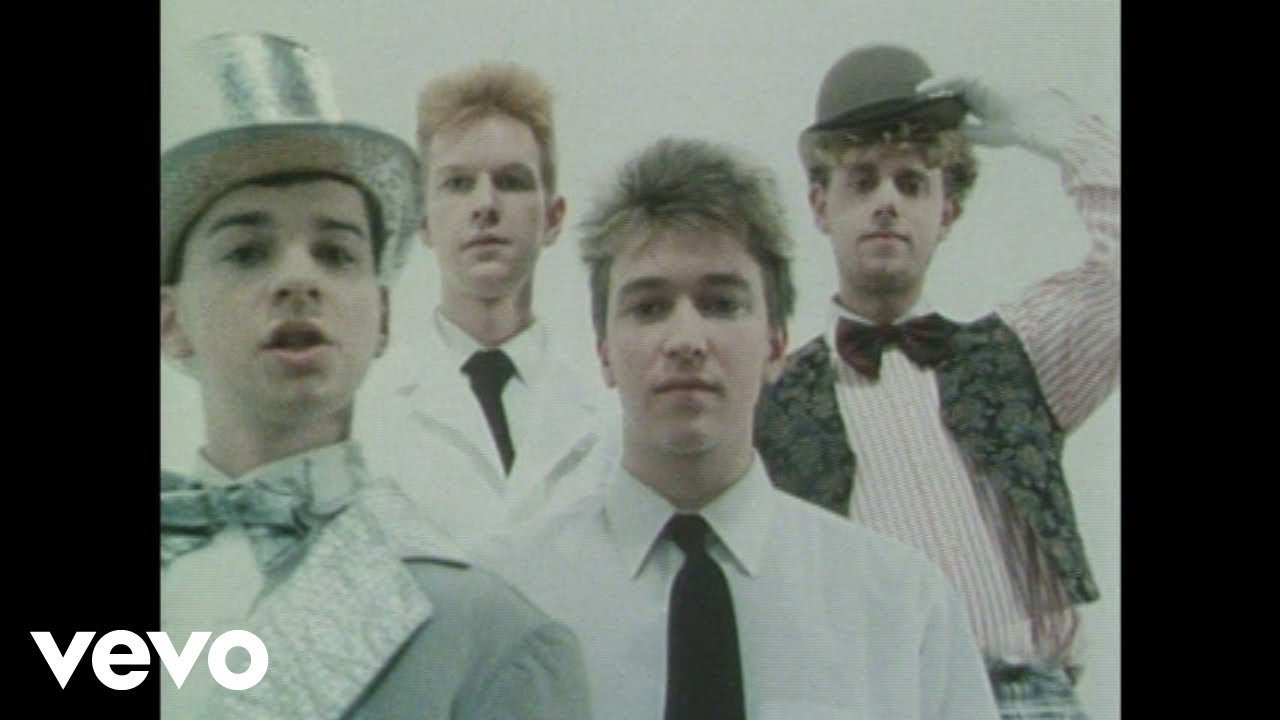
The song also follows many of early Depeche Mode's stylistic and theoretical traits; it makes extensive use of exceptionally strong hooks and phrases, with very minimal use of chordal content, which can make it very difficult to establish its harmonic landscape.
The introduction begins with minimal electronic bongos and other electronic percussion sounds, supplied by a Roland TR-808 Rhythm Composer, before a web of synth-lines appear, conjured by an ARP 2600 and a Wilder’s state of the art Synclavier.
Above the percussion we hear two notes - Eb and Bb - which occupy the tonal territory, with a degree of rhythmic insistence. The Bb falls to a G halfway through each bar, but it provides no concrete evidence of our key, until we hear the bright synth riff, which employs the notes Eb, D and C.
This riff favours C minor (an ever-popular synthesist’s key), but it is not until the bass puts in an appearance, that we can be absolutely certain of our tonal centre.
Before the entry of the vocal, we hear our second synth riff doubled by two sounds, the most notable being the bright bell-like upper tone, which moves up the scale from Eb to Ab, before heading south and resting on the note C.
It's another strong riff, compounded by the insistent bass part, which jumps in octaves, passing from notes C, to Bb and A.
This also presents a slight conundrum from a theory perspective, as there is an implied change of harmony with the shift in the bass part to the note A.
We can interpret this as a chord of F/A, which is chord IV in C minor, so it makes sense. It could also be interpreted as a diminished chord, containing the notes A, C and Eb - also notes that are included in a chord of F7.

The verse structure is pretty simple. The accompaniment remains static on the note C, although there is an implied note G in the mix too. This could simply be included as part of the programmed synth sound.
Unusually for a Depeche Mode track, a guitar makes an appearance, albeit processed through a synth and phased out of time to make it sound ‘more interesting’.
The vocal part itself falls from the note C, to a Bb and Ab, before hitting the notes G and Eb. It's reminiscent of the earlier bass part, and of the James Bond theme, which plays heavily on the use of a minor 6th interval; the note Ab, in this case.
The verse section is short, at only eight bars in length, heading straight into the chorus section, which is heralded by a pianistic riff and the harmonised lyric. This is also the moment when the bass part rises up to an Eb, before falling to a D and back to C.
One of the most surprising elements here, is that it is only after the first verse and chorus that we hear what we could regard as the strongest riff or hook of the entire song.
It adopts echoes of previous riffs, but it is the ultimate ear-worm, and the one that will stick with you for the rest of the day!
As the song proceeds, the verses are often punctuated by synth stabs, creating moments of interest as we move from section to section.
After two rounds of verse and chorus, we head to the bridge section, which is strange and curious in equal measure.
The backbeat, which is consistently provided by a Simmons snare, stops momentarily to make way for individual monosynth parts, as they weave a texture which is quite reliant upon some of the elements we have previously seen and heard, such as implied diminished chords.

It shouldn't work, but work it does, and is beautifully juxtaposed against the rest of the song, particularly with the reappearance of the main riff, which signals a return to the song’s previous construction.
After a further verse and chorus, we are then treated to a compilation of all of the riffs, as they compete for dominance in the repeat-to-fade finale of the song.
Whether it was due to the band’s urge to move on from the Speak & Spell era or not, Get the Balance Right! signalled an evolving outlook for Depeche Mode in the studio.
According to Alan Wilder, there was a real sense that their writing and production should begin to embrace 12” club mixes, which is certainly something which is represented in the overall sound of this track.
Despite the affection held for it among fans, the band themselves soon became dismissive of what they’d created…
“We were just thinking of making a stomper. But it's my least favourite track,” Dave said in a 1985 issue of Melody Maker. Martin Gore agreed… “I hate it, and I wrote it. This was the only time we HAD to turn out a single whether we wanted to or not.”
